Transformed by the Rain

Raindrops along edges of leaves of plantEarly each spring, when I begin cleaning up and weeding our garden beds, I tell myself that as soon as the sodden clay soil in the perennial bed dries out just a bit, I should dig up most of the Lady’s Mantle.

For despite its genteel name, in our garden this muscular plant is highly invasive. Its roots take hold with superglue strength, its foliage spreads like wildfire, and it readily self-sows if its flower heads aren’t cut off quickly. No matter how hard I’ve tried to keep it in check, Lady’s Mantle has had the nasty habit of crowding out other, more delicate flower species that I’d hoped would flourish.

So each spring I say to myself, “Enough!”

But then it rains – and I can’t help but notice the sheer beauty that emerges when water droplets shine like strings of pearls along the edges of the Lady Mantle’s water-repellent leaves. Apparently I’m not the only one who has appreciated this: according to Wikipedia, alchemists used these beads of water, which they considered to be totally pure, in their efforts to turn base metals into gold (thus giving rise to the plant’s Latin name, Alchemilla mollis).

It rained the other night. So once again, the Lady’s Mantle has won a reprieve.
Let’s Make this Right a Reality

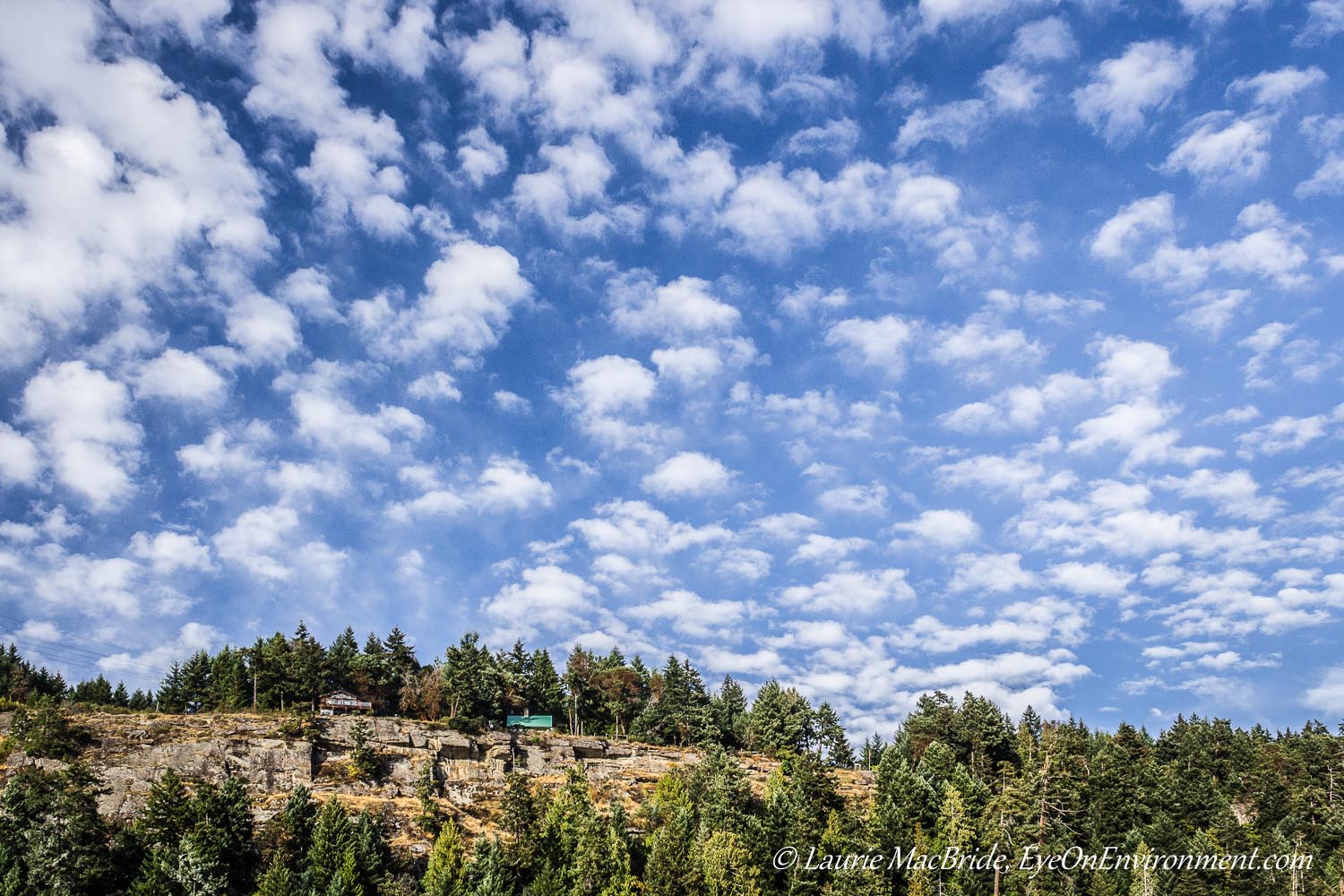
Clouds over a high ridge with houses and forestWater takes many shapes, and it’s in constant motion around our earth: evaporating from the ocean, rising up to form clouds, falling as precipitation, seeping down through the earth to feed our wells, or remaining on the surface to form snow and ice and fill our wetlands, lakes and rivers.

Whether as groundwater or surface water, it eventually it makes it back to the ocean, and the whole cycle begins again.

Today is World Water Day: a reminder to be grateful for such an elegant – and absolutely essential – transport system, provided to us free of charge by Mother Nature.

Since 1993, World Water Day has been marked annually to focus on the need for everyone to have an adequate supply of safe fresh water. Sadly, at least 10% of our world’s population currently lacks what should be such a basic human right, and even those of us with easy access to water considered “safe” are too often finding it isn’t anywhere near as clean as we had assumed.

Here at home and right around the globe, we all deserve safe, healthy water: free from pesticides, fossil fuels, heavy metals, pharmaceuticals, chemicals and radioactivity. World Water Day provides a good opportunity for each of us to think about what we can do to help turn this right into a reality.

Raindrops on Lady's mantle plants.

Making a Living on the Waterfront

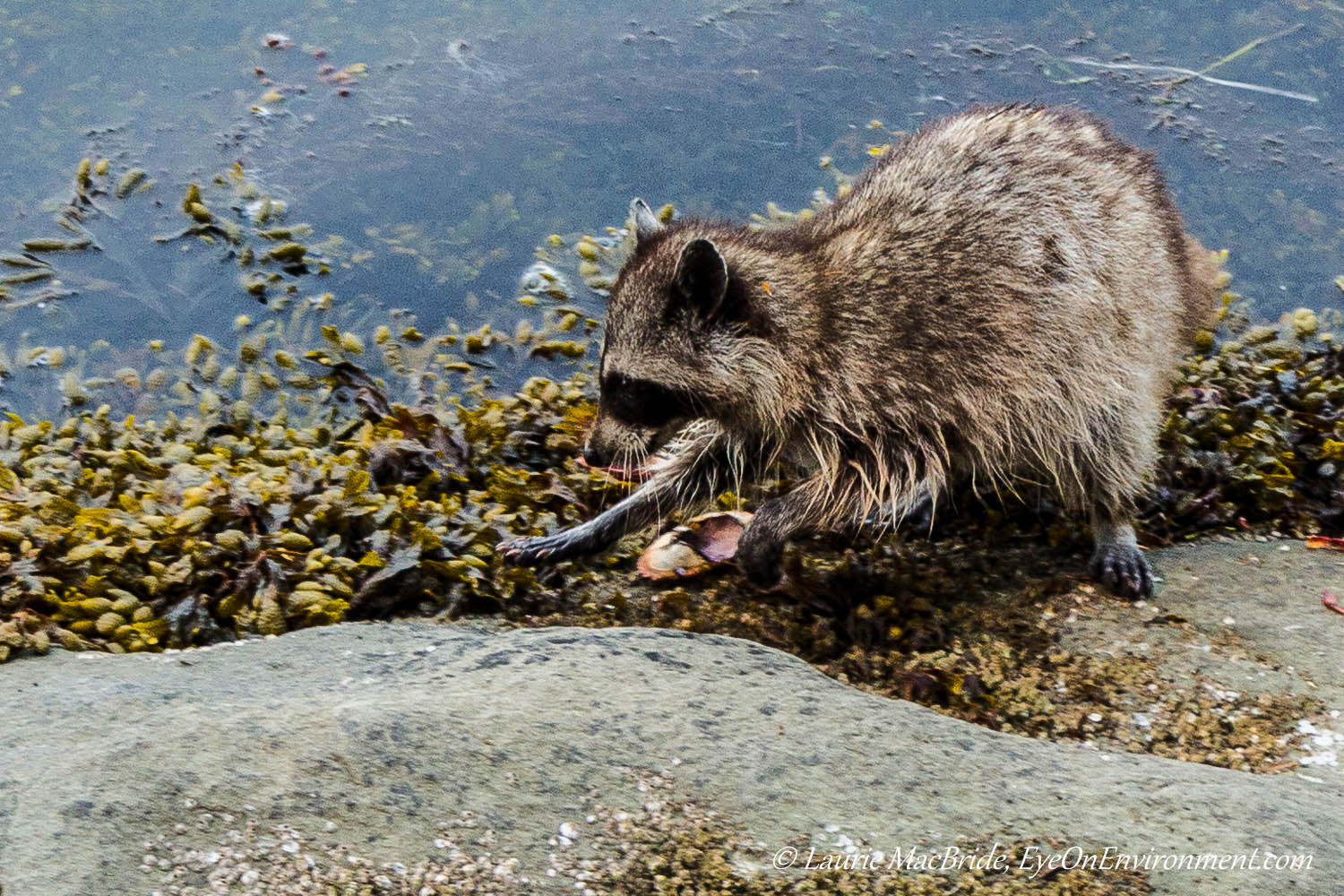
raccoon on shoreline

“What do you want, lady? Can’t you see I’m busy?” (click to enlarge)

Almost everywhere we went last summer on our boating holiday in the Gulf Islands, raccoons were hard at work.

We watched them paw through the kelp at low tide, crunching on shore crabs and other tasty treats. If you look closely, you can see a bit of shell hanging from his/her mouth in the photo above. (A reminder, you can click twice on any of these photos to enlarge them and see all the details).

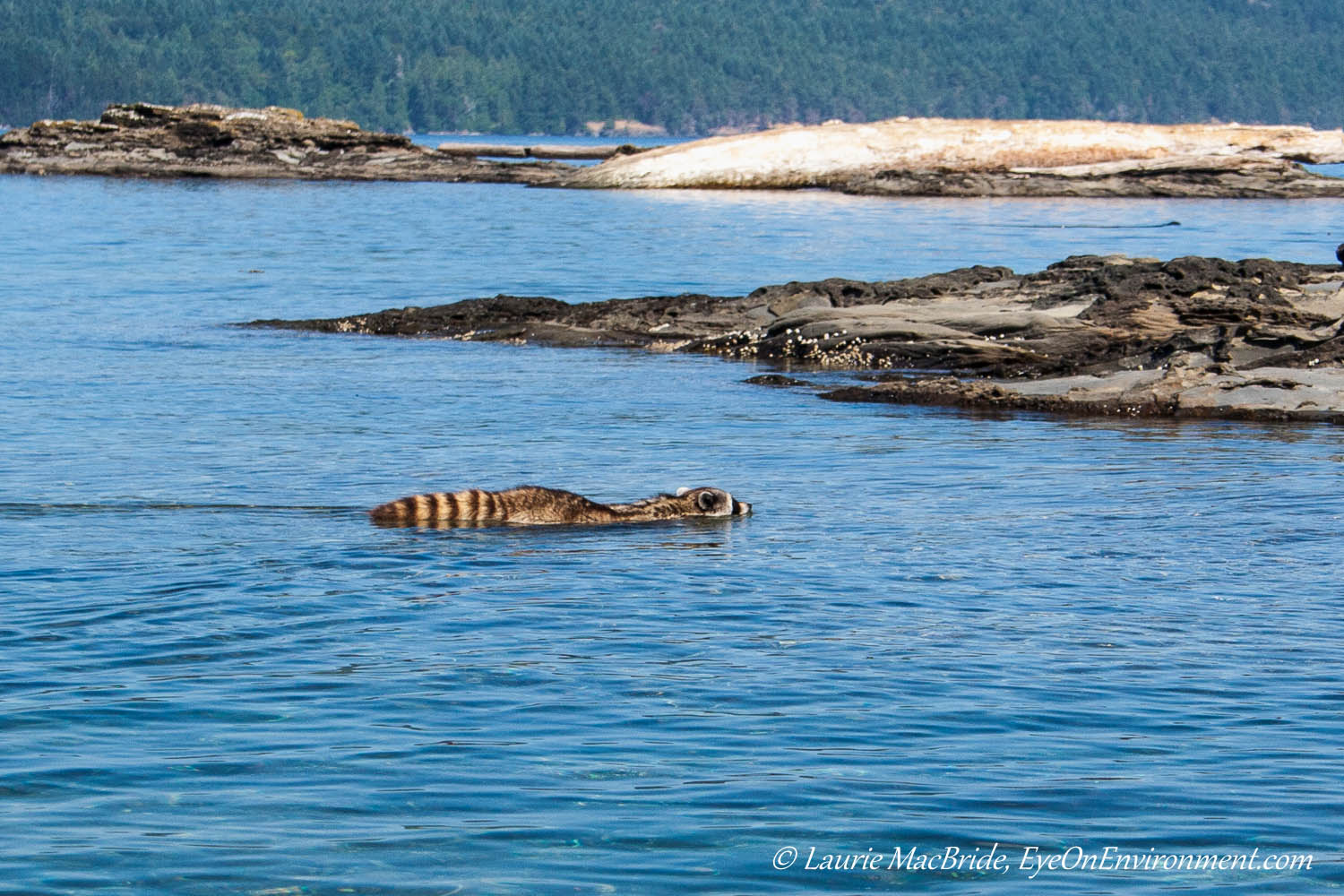
Raccoon swimming

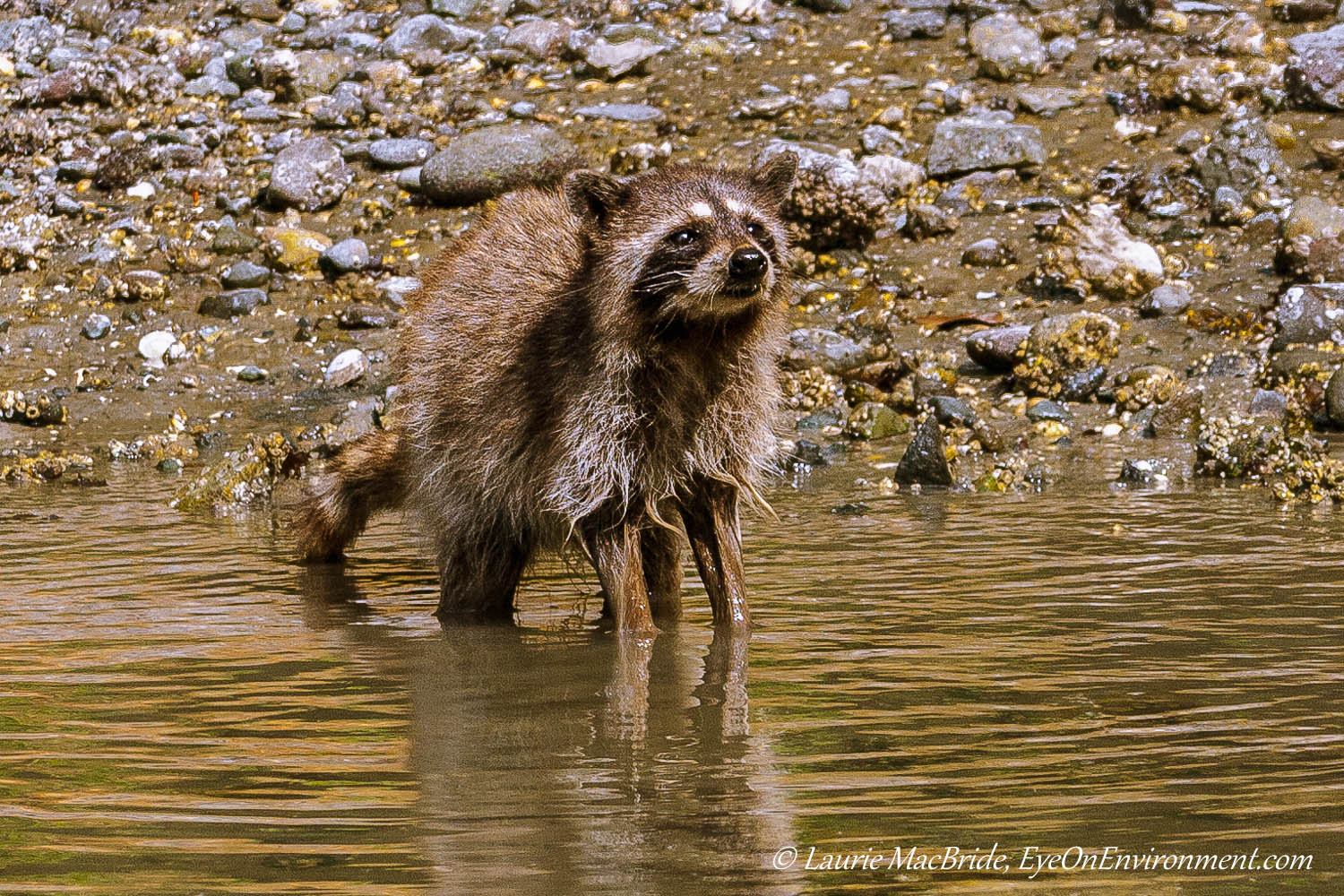
We often saw raccoons standing in the shallows, gazing upward in a deep meditation while reaching deftly about underwater to locate and snag any edibles.

Raccoon standing in shallows, gazing upward

Raccoons have an amazing sense of touch in their front paws, and this tactile ability is their most important sense in terms of survival. Even more impressive, they can stand in cold water for hours without any loss of that delicate touch – in my books, that has to rank as a superpower. (Here’s an interesting article on raccoons’ tactile sense.)

One afternoon we watched a mother teaching her two kits the moves involved in foraging along the shoreline – then abruptly ushering them into the forest when she spotted our kayaks.

Another day I watched from my dinghy as a solo raccoon took a lengthy swim from one island to another, ignoring me despite the fact I was only a couple of oars-lengths away.

_MG_4309

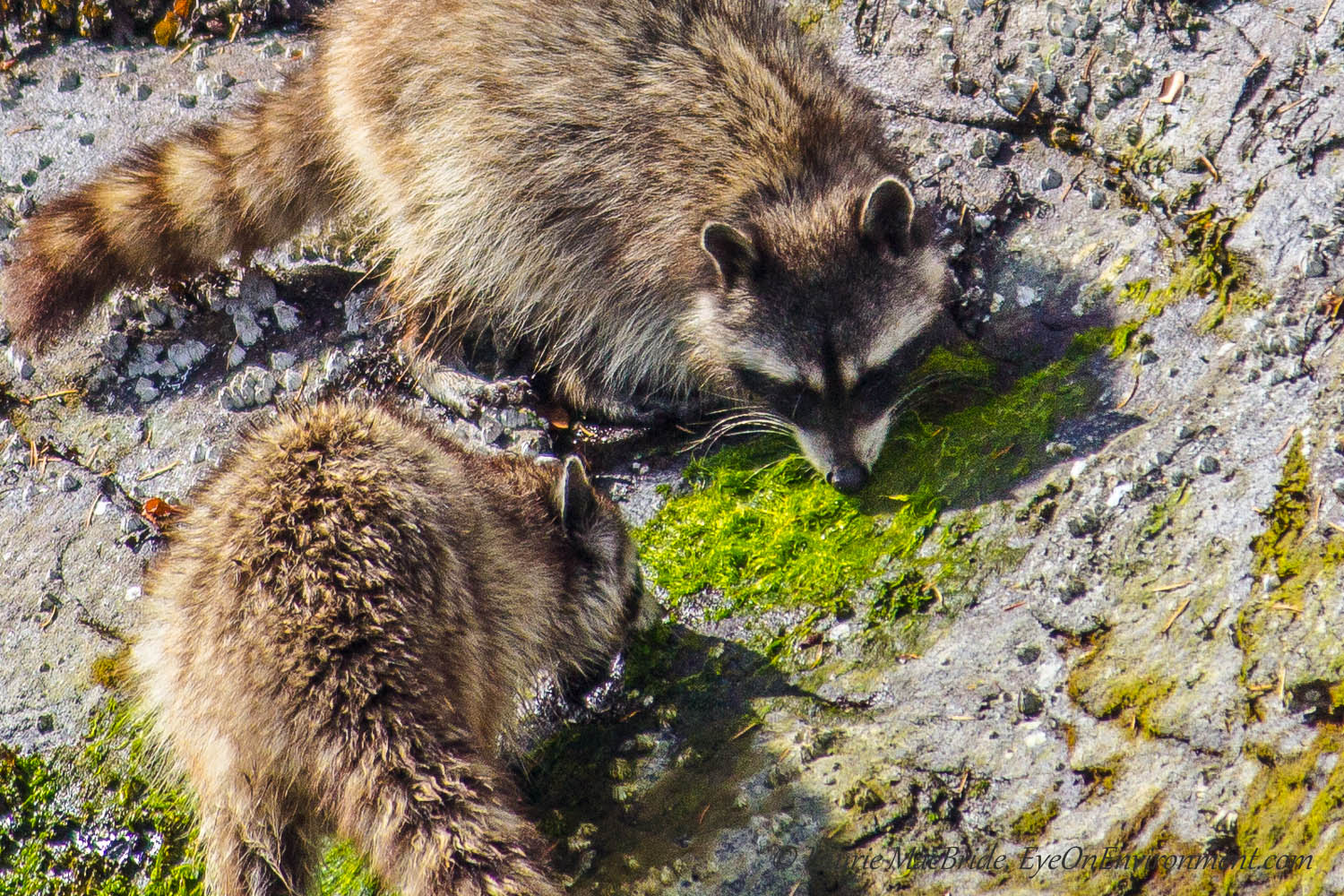
The oddest sighting among our frequent encounters took place one sunny morning at Wallace Island, close behind our anchored boat. It was low tide, and two raccoons inched along the steep shore, noses down all the while. They seemed to be licking the algae-encrusted rocks, though we weren’t sure why.

Raccoons appearing to eat seaweed

Plant foods make up a third of a raccoon’s diet, so maybe the seaweed was especially tasty that day – or perhaps they needed the minerals that this rocky salt lick offered. At any rate, they were there for a long time, diligently cleaning the shoreline with their tongues.

We were honoured and charmed to watch all of these masked bandits, so at home and at ease in their natural habitat – going skillfully about their daily business without any conflict over gardens, bird feeders, fish ponds or other mundane human concerns.

Laid-back at Low Tide

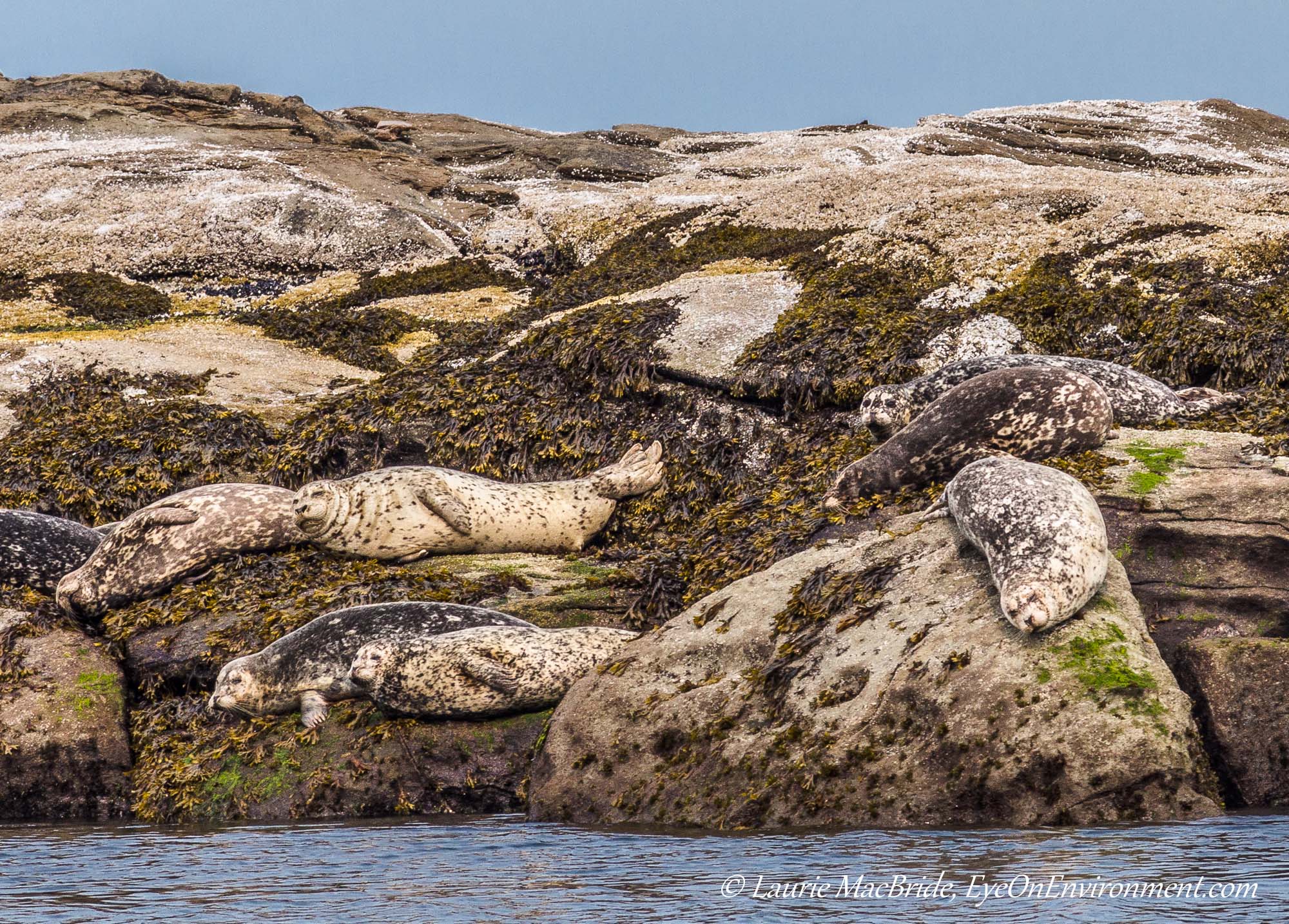
Harbour seals hauled out on a reef

Relaxing on the reef (click once to enlarge – twice if want to see their smiles )

Harbour seals can be great camouflage artists. I wonder how many times people have sailed, paddled or motored past a reef when the tide is low, not noticing the blubbery herd that’s there to enjoy a few hours of sunshine and relaxation?

The majority of  seal haul-out sites around our region are small, seaweed-encrusted reefs like the one above, off Gabriola Island. Small intertidal reefs like this – inaccessible to people, dogs and transient killer whales – provide temporary refuge for harbour seals, who are graceful swimmers and skilled hunters, but slow, clumsy and vulnerable on land.

On a rocky reef, spotted fur coats are the perfect disguise for relaxing and catching 40 winks in peace, before the rising tide forces the herd back to sea.

Of course, once you know when and where to look, it’s easy enough to spot hauled-out seals. But don’t get too close – use your binoculars (or in my case, a telephoto lens). Regulations require people to keep a respectful distance away from all marine mammals, including harbour seals and other pinnipeds (in Canada, the minimum distance is 100 metres). Which is a good thing – after all, these laid-back camouflage artists need their beauty sleep.

Saying OK to Decay

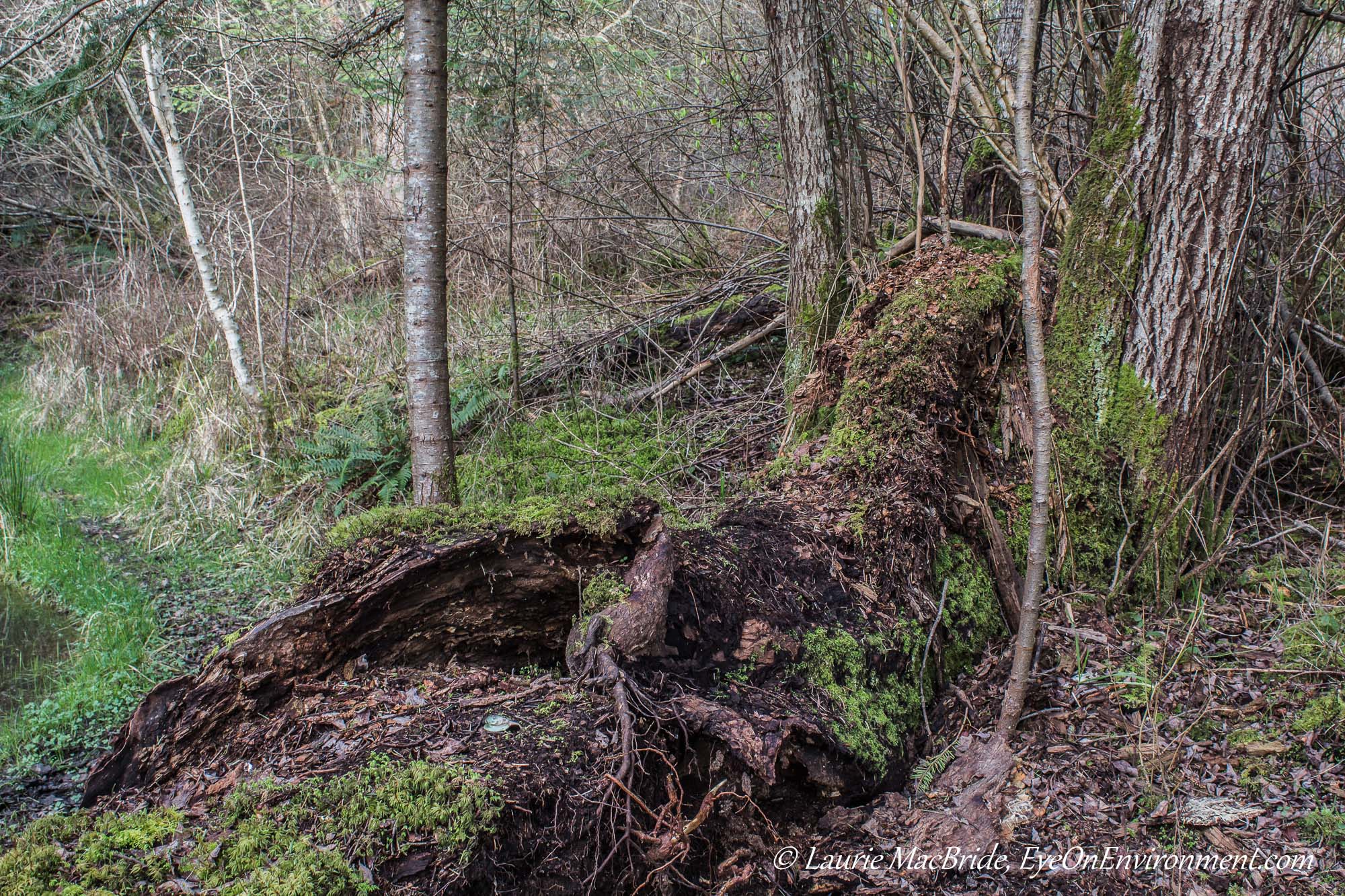
Moss covered nurse log in forest

The Nurse Log (click to enlarge, then again to see all the details)

Not unlike me, the old nurse log that rests on the edge of our southern pond seems to be getting lower to the ground and wider in the hips with each passing year.

What used to be a round, high and solid surface is now soft, spongy and low enough to step over, even with my short legs.

The nurse log supports a variety of colonizing mosses, and the roots of neighbouring firs, hawthorns and willows amble through it.

Along its top surface, you can see hundreds – perhaps thousands – of small brown scaly objects: refuse from Squirrely’s meals, eaten on a fir branch overhead. To the side of the log, the bounty of discarded seed coats have formed deep middens which will eventually become substrate for new forest mosses, plants and trees.

At its west end the decaying log nurtures a Pacific crabapple, whose branches lean awkwardly over the pond (not visible in the photo above, but you can see it here). Before very long, those branches will break off, changing the topography of the pond and starting on their own cycle of decay, renewal and growth.

Now if only I could find my own process of aging as fascinating as that of the forest…

When Light Dances on Stone

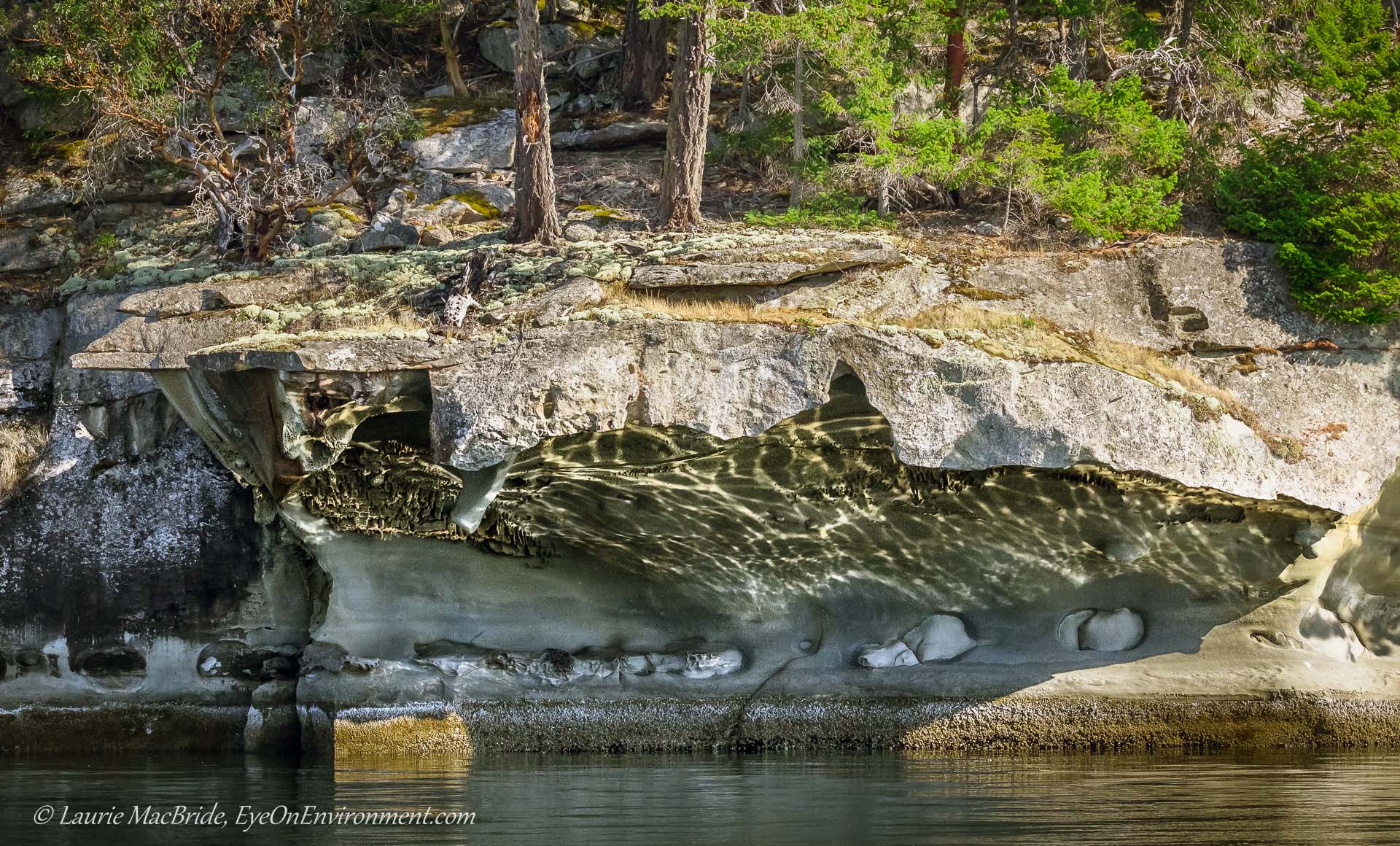
Network of light reflected onto wall of sandstone cave over the water

Light Show on Sandstone (click to enlarge)

When conditions are just right, you can see a beautiful natural light show along parts of Valdes Island‘s eroded western shoreline.

At those magical times, sunlight hits the wavelets and is reflected back up on varying angles, bouncing into the salt-eroded sandstone caverns that lie just overhead. The result is a constantly changing filigree of light, dancing along the walls and roof of each of the caves.

To see the light show you’ll need to be in a boat on a sunny day, with calm conditions and a slight breeze – enough to ripple the water but not to cause waves. A mid-range to moderately high tide usually works, but time of year, the sun’s position and myriad other complicating factors make any attempt at reliable prediction a mug’s game.

So in the end it probably comes mostly down to luck. If you happen to catch the light show, I’m sure that you’ll find this pure light to be pure delight. No 3D glasses or psychedelics required – just a lucky break from Mother Nature.

A Golden Feast

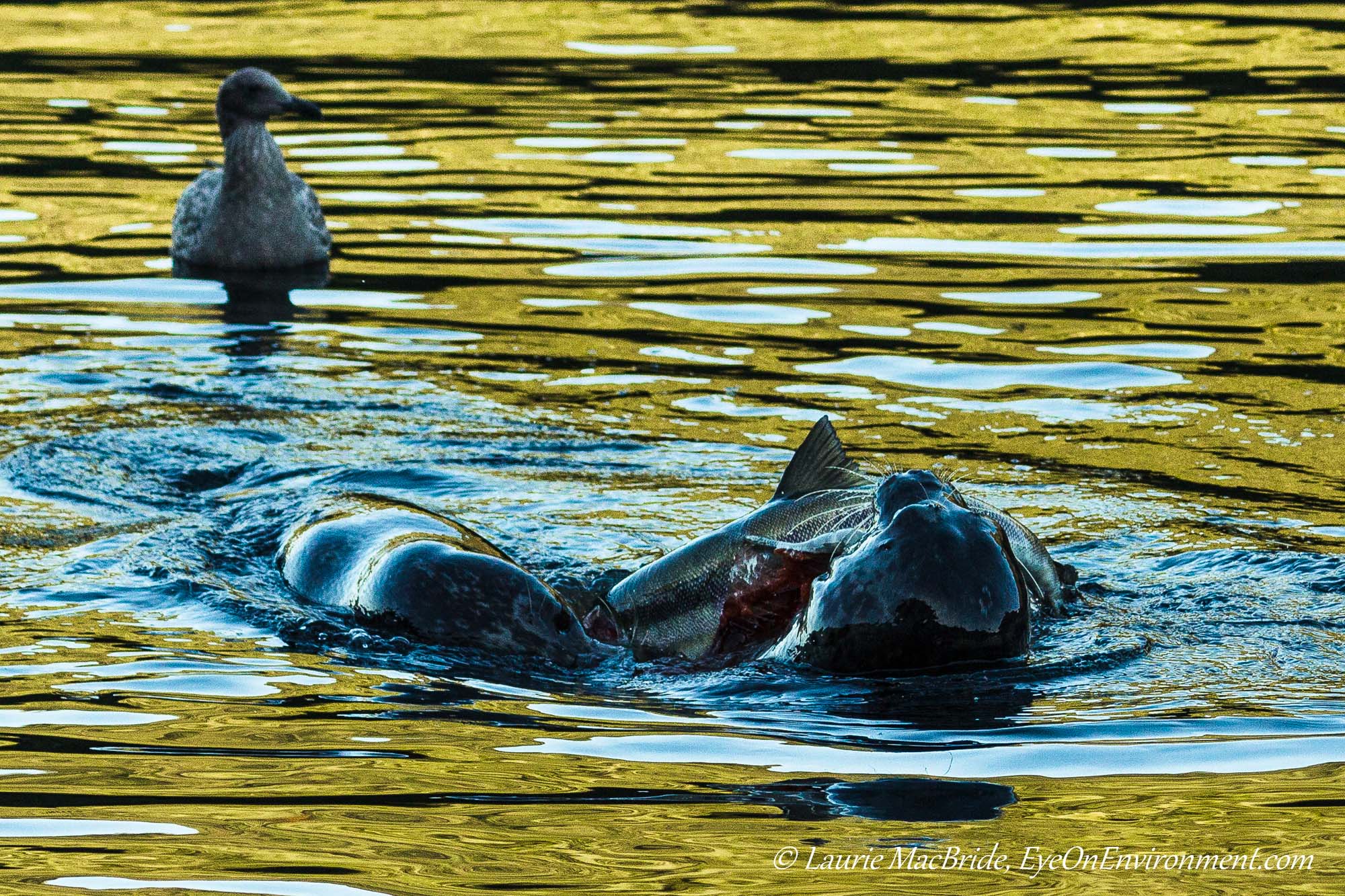
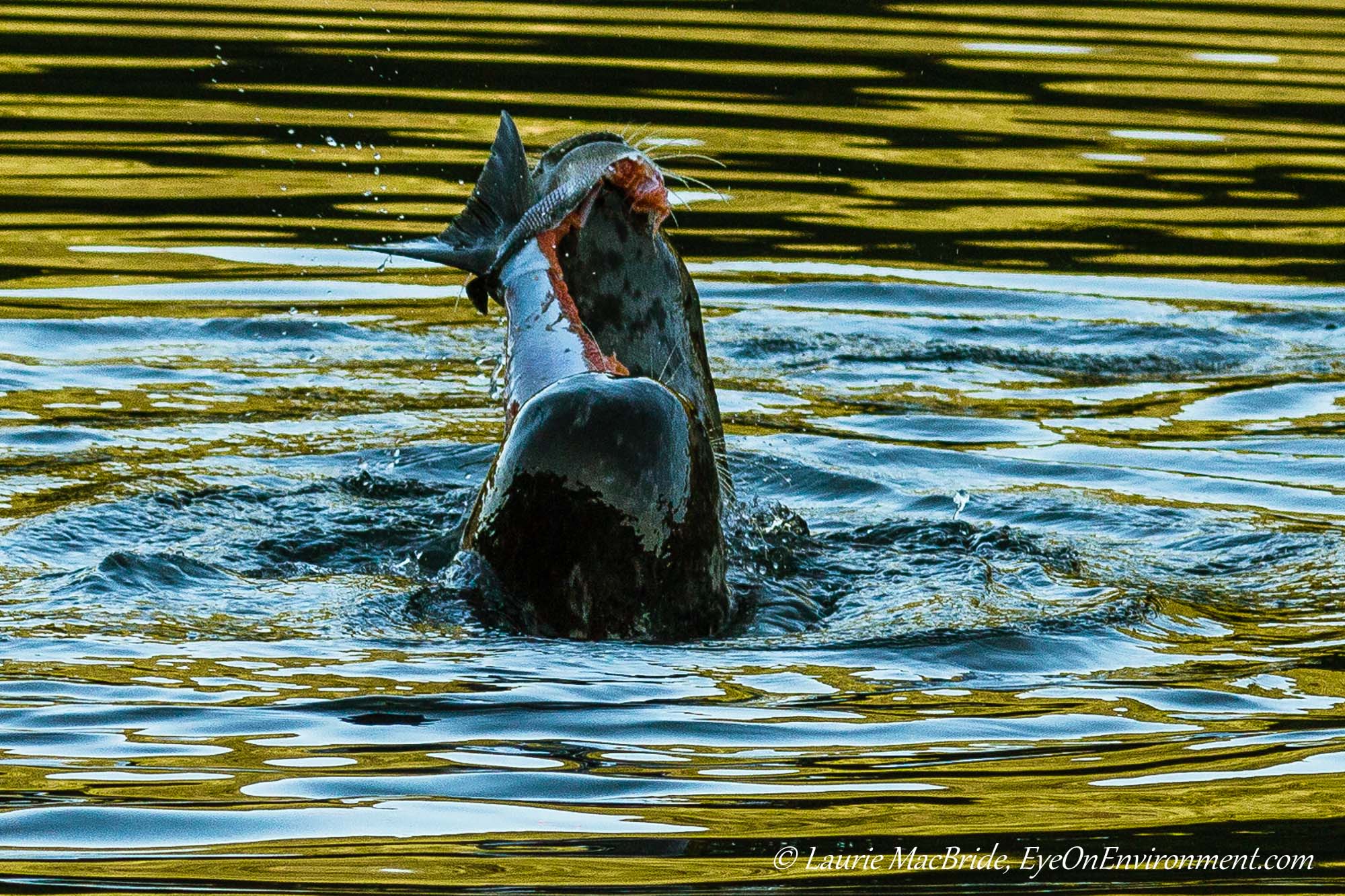
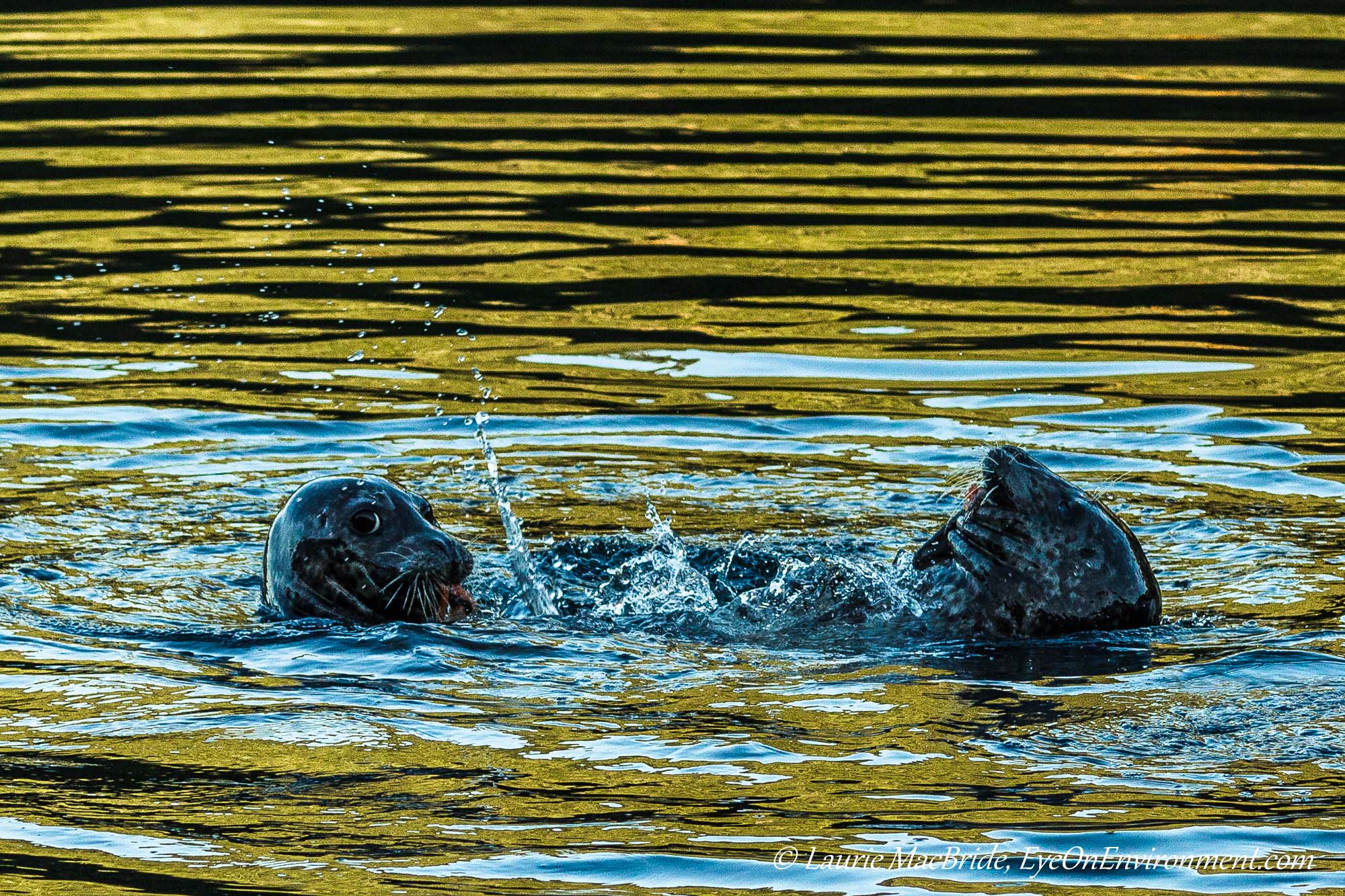
Two seals wrestling with a salmon

Salmon on the Menu (click to enlarge this or any of the other photos below)

Anchored off the mouth of the Goldstream River at the head of Saanich Inlet, we were just starting to cook dinner when I heard some sudden loud splashes very close to our boat.

In the brilliant, low-angle, golden light of a late September evening, it took my brain a few moments to decipher what my eyes were seeing.

A pair of seals had surfaced beside us, where they were wrestling a large salmon into submission.

Two seals working subdue a large salmon

The struggle went on for several minutes, with the feisty fish demonstrating some impressive acrobatics and forcing the seals to work hard.

Salmon struggling against seals

But in the end, the salmon couldn’t match the power of two very determined seals. 

Salmon subdued by two seals, with gull looking on

Eventually the fish was subdued…

Two seals eating a salmon

and the feast began.

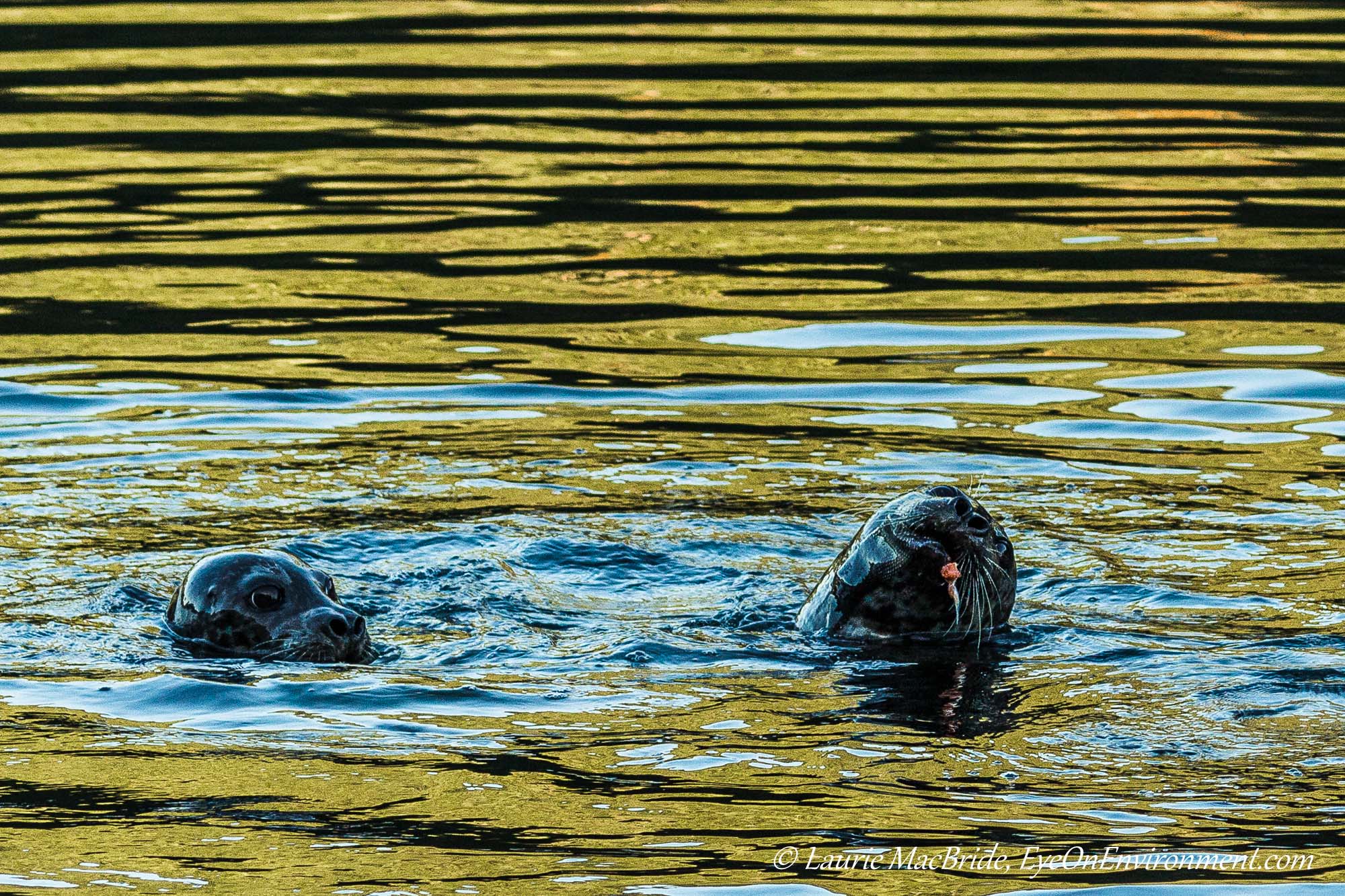
Two seals sharing a salmon

Though perhaps having such an attentive audience for the meal wasn’t truly appreciated.

It’s not often that we get treated to a real life nature show like this, right up close. Needless to say, our dinner was delayed until after the seals had finished theirs. Lucky for us, they were pretty fast eaters.

Two seals, one eating fish, the other watching

You can click twice on the images to enlarge them even more and see all the details. 

If you’re on Gabriola Island:  Three of my prints are among those on display in a new group exhibition, “Gabriola Through a Lens”, at The Hive Emporium. The show opens on December 29 and runs until January 24 . (Opening reception: December 29, 6 to 9 pm.)

The Laughs Were on Me

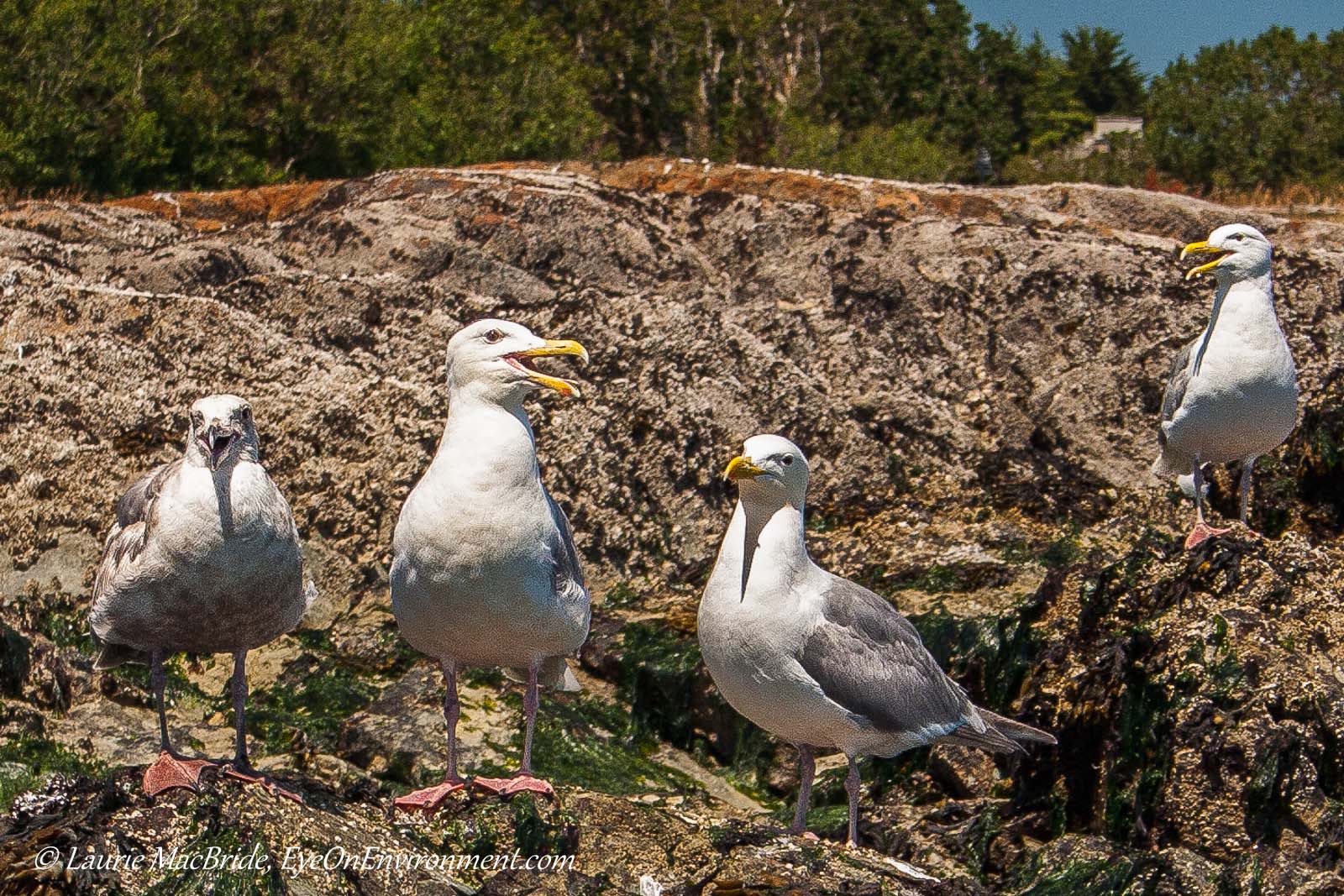
Gulls appearing to be laughing

Comedy Time – the laughs were on me (click to enlarge)

As you can tell by the elongated shadows under their bills, it was close to noon when we paddled past these seagulls, standing on a rocky point at low tide. The sun was high in the sky, and fittingly, the birds appeared to be in high humour.

Like stand-ups at a comedy festival, they seemed to single me out for special abuse. I can imagine the dialogue that ensued:

“Look at that goofy human! Would you check out her gawdy plumage? Yuck, tone it down a bit, lady!” (I regularly wear a red life jacket, bright blue spray skirt, orange windbreaker, and my kayak is a brilliant turquoise. For safety’s sake, I aim to be visible on the water. But the gulls seemed to find this logic hilarious.)

“And look at all the work she’s going to, swinging that big stick around, up and down, just to drag herself along at the speed of a limpet! Hasn’t anyone ever told her about energy efficiency?”

Yes indeed, we ponderous humans with our strange ways must provide great fodder for the comedians in the rest of the animal world.  Laugh on, friends!