Celebrating Forests

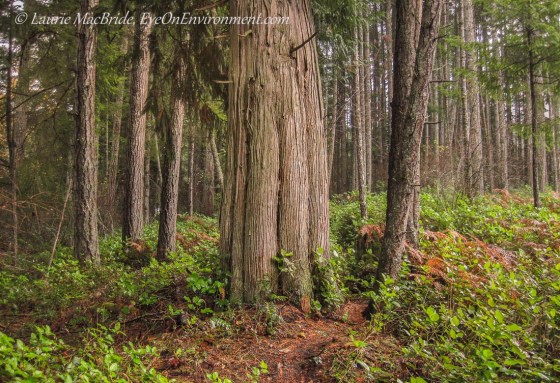
Western red cedar tree with Douglas firs in a forest

Forest Walk, Gabriola Island

It’s spring equinox in the northern hemisphere, a cause for celebration as those longer days return.

Today is also World Forestry Day – a time to think about the importance of forests, no matter what the season or where we live.

Since it was first observed in 1971, this annual event has been marked to help increase public awareness of forests and the many benefits they bring to our lives.

As living, breathing, interconnected ecosystems made up of trees, plants, insects, wildlife, fungi, microbes and more, forests give us so much that’s vital: cool and breathable air, clean water, food, edible oils, shelter, shade, building materials, medicines, fuel, recreation, solitude, serenity… the list could be much longer. And I’ve written before about the amazing power of trees to elevate our moods.

The photo above was taken during a winter walk here on Gabriola Island, when the forest was very quiet. The large tree in the centre is a Western redcedar (Thuja plicata), a conifer common to our region and one that’s well suited to our mild, often wet climate. Most of the surrounding trees are Douglas fir.

The forest floor is dominated by salal, a mainstay food for our local deer. They browse the salal year-round, and especially savour the new shoots in spring and the dark blue berries in late summer. The brownish plants on the right are dried fronds of last year’s bracken fern; a month or two from now, this scene should be almost completely green as the new bracken grows up.

World Forestry Day seems like a good time for taking a walk in the woods, doesn’t it?
If you enjoyed this post you might also like:

The Charming Giant

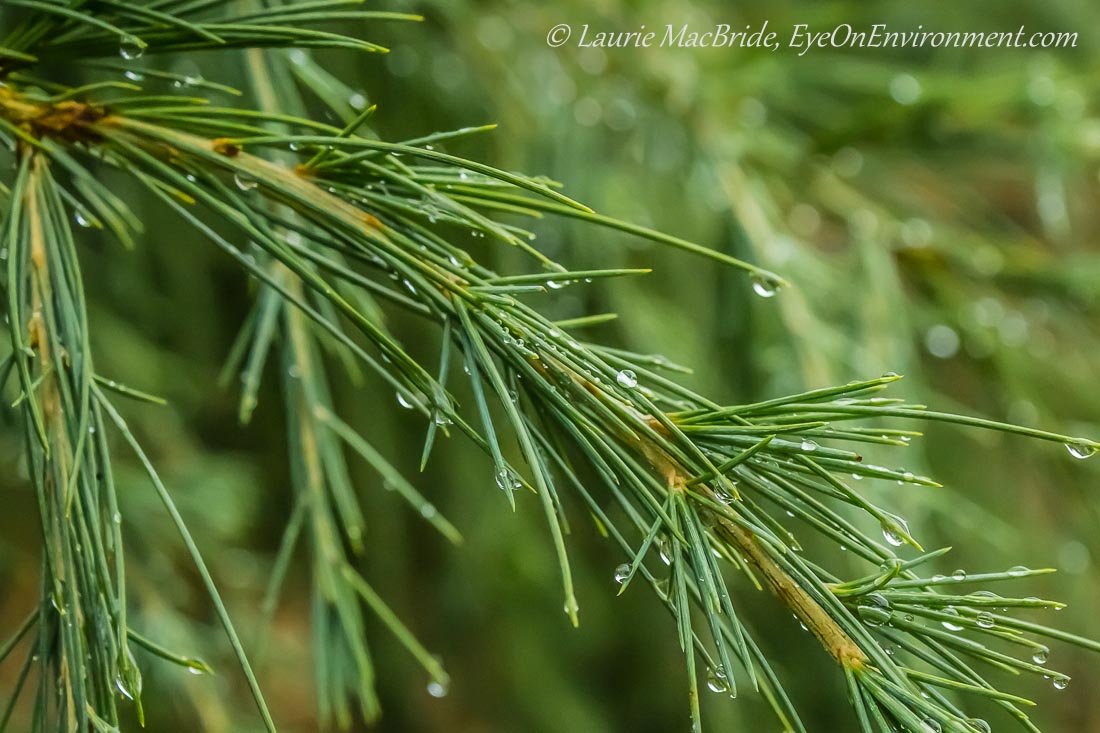
Deodar cedar branch with raindrops

Raindrop Catcher (Deodar cedar)

Fifteen years ago I bought a young Deodar cedar at a charity auction. I knew nothing about Cedrus deodara, but it looked pretty. And cedars grow well on the west coast of BC, right?

Turns out this species is a  true cedar, unlike our native Western redcedar (which is actually a cypress). Deodars come from the Himilayas and are the national tree of Pakistan. That, and the fact that they can grow to almost 200 feet with a trunk up to 10 feet in diameter, should have tipped us off that this tree was…well…not perfectly suited to our little patch of paradise here on the Gulf Islands.

It sat in its pot for a couple of years until we moved to a larger property. Then, figuring we could prune to keep it in check, and that it would add a little privacy between our house and the neighbours, we planted it – about 40 feet from our kitchen window. Oh how naive we were.

It’s grown profusely: the drooping lower branches now extend in a circumference of about 65 feet, pretty much obliterating any view to that side of our yard. We’ve kept the tree reasonably short by topping it a couple of times – with difficulty – but systematic pruning it is a challenge to say the least.

The Deodar does have its charms, though. Those spiny needles are perfect for catching raindrops, and when early morning precipitation is followed by sunshine, the view from our window is of hundreds of sparkling diamonds adorning a series of long, graceful green arcs.

Moments like that have endeared the Deodar to us, and our animal friends also seem to love it. The lower limbs reach down to the lawn, forming a drier and very private shelter for the towhees, sparrows and juncos that rush in and out of those dark recesses. And the tree provides a handy separation scheme for our resident deer family whenever someone needs a “time out”: on opposite sides of those dense, impenetrable branches, they can simply ignore each other.

Well suited to the Gulf Islands? Probably not – but this Himilayan giant seems to be working for us.

Click on these images for larger view & caption:

If you enjoyed this post you might also like:

Crocuses: Nature’s Anti-Depressant

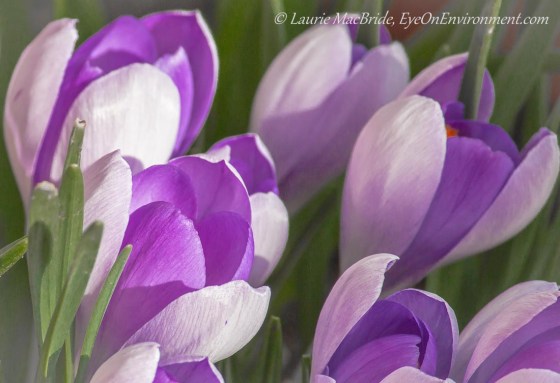
mauve crocuses

Out of Winter’s Sleep: Spring Crocuses (click for larger view)

They’re often overlooked in favour of taller, fancier flowers, but how can anyone not be charmed by spring crocuses?

As the days lengthen, these lovely little harbingers of spring emerge from winter’s cold and gloom as if from our dreams – lifting tired spirits, renewing our hopes and fueling our anticipation of the warm seasons to come.

Who could possibly ask for more, and from such a simple, undemanding plant?

If you enjoyed this post, you might also like:

A Visit from Ms. Merganser

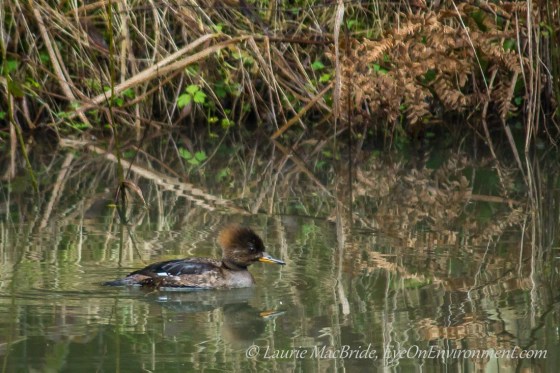
Hooded merganser in a pond

Visitor to the Pond: Hooded merganser (click for larger view)

Last week a female Hooded merganser dropped by spend some time in our garden pond.

She and her mate usually come by once a year, around this time, but they’ve never stayed more than a few hours. This time Ms. Merganser came alone, and to our delight, stayed for two full days and two nights. It was lovely to watch her from the house – although it caused some delay in our garden projects, as we didn’t want to disturb her.

She swam lively laps and made fast, repeated dives. We watched her feeding hungrily, ripping at the roots of the plants around the perimeter, but also diving in the middle of the pond, where plants were less likely the attraction. We wondered what non-vegetarian items were on her menu, and hoped she wasn’t emptying the pond of the critters we love: rough-skinned newts, Pacific tree frogs or their scarcer Red-legged cousins.

The pond’s surface is very reflective, as you can see in the photo. Underneath, the water is murky and brown. So it’s amazing to me that a bird can find food there, let alone enough to feed actively for two days. It turns out that Hooded mergansers have the right stuff for just such a challenge: they have a transparent extra eyelid, protecting their eyes like a pair of goggles, and they can actually change how their eyes bend light, giving them excellent underwater vision.

We wondered aloud whether she might nest in one of the woodpecker cavity trees in our woods. We tried to imagine those one-day old fluff balls leaving the nest: the tiny birds jump from their lofty home, which can be as much as 50 feet high, to the forest floor. How they survive is beyond the ken of ponderous, earth-bound creatures like us!

Over the two days there was no sign of her flashy, white-hooded mate. I wondered when and where they would meet up. These birds are monogamous, but how do they find each other again after their separate adventures?

Romance must have been in the air. Ms. Merganser left early in the morning on February 14. Perhaps she was off to her rendezvous, or maybe she was leaving to make way for the pair of Mallards that have used this little private pond on that date for the past couple of years.

Sure enough, just after Ms Merganser left, the pair of Mallards arrived for their annual tryst. What would Valentine’s Day be without ducks?

If you enjoyed this post you might also like:

Big Colour, Little Fuss

Close up of pink geranium blossoms in a vase

In the Pink: geranium blossoms brighten up a February day

People fuss a lot over geraniums – or more properly, “Pelargoniums” (since true geraniums are actually quite different than these popular garden flowers).

They’re not frost hardy, so they need to be brought inside for the winter. Every gardener seems to have a favorite method for dealing with them. Some people dig them up, shake the dirt off the roots and store them in paper bags or newspaper. Others take cuttings and root these in soil, then throw out the original plants; the following spring, they move the new plants to the garden. Variations on these themes abound.

As for me, I take the easy way. My geraniums never make it to the garden: instead they live, permanently, in large containers which grace the steps on the south side of our house from May through September. In October I drag the pots into the solarium, a bright, unheated room which gets good winter light, and there they live until the following spring.

I always intend to cut them back when I bring them inside, as soon as their flowering ends – but it never does! Most years they carry on blooming right through the winter, and I can`t bring myself to take out the pruning shears.

Finally, come February, I am forced to take action – otherwise the new growth will be far too leggy. I cut off the flowers and prune the plants down to a small fraction of their former height, give them a good drink of water with some fertilizer, add a layer of fresh potting soil, then trust Mother Nature to do the rest.

And for a few days we get to enjoy those lovely blooms in a vase: a welcome foretaste of summer’s luscious colours.

Landscaping by Squirrelly

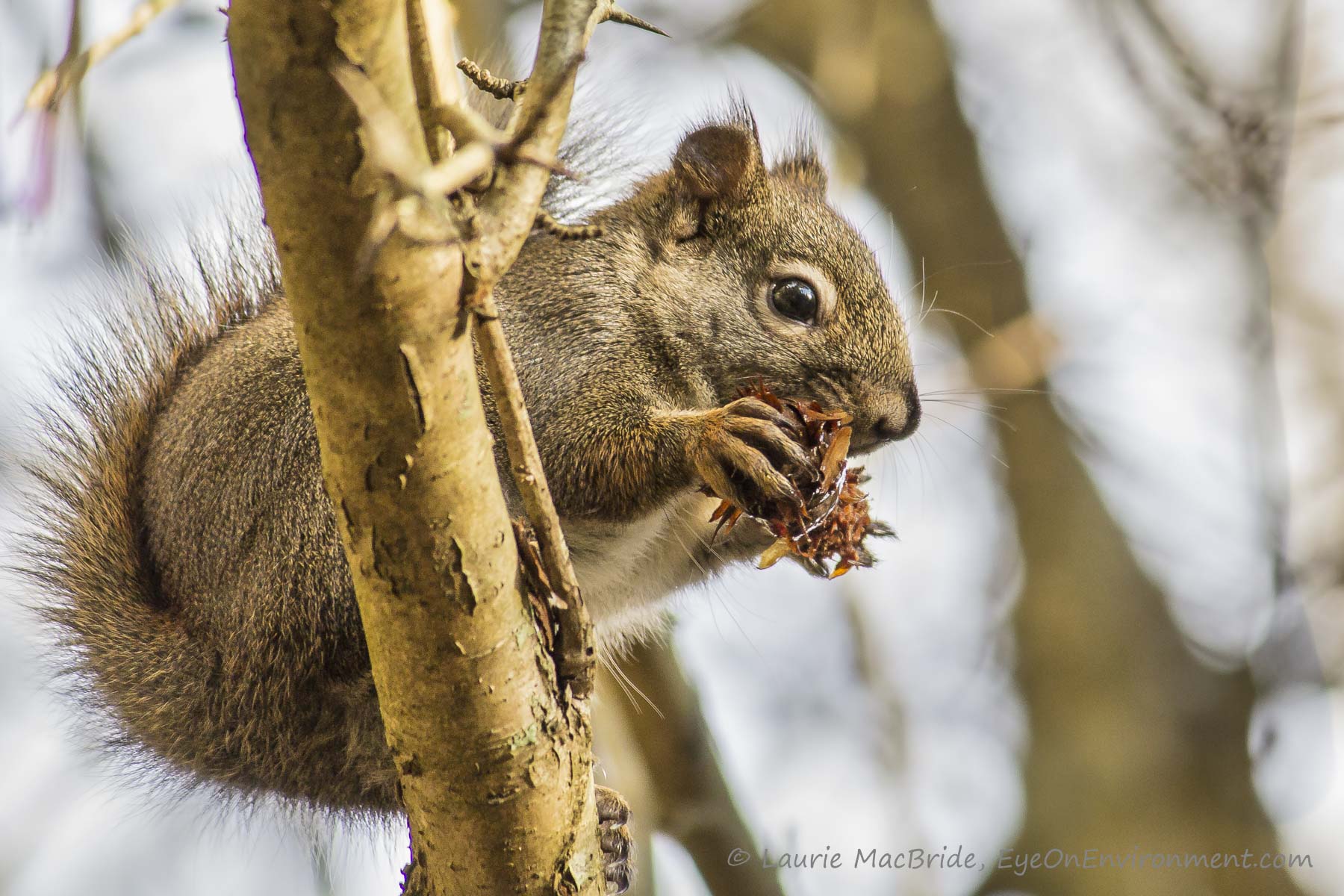
Red squirrel in tree with cone

Squirrelly, with his regular lunch of fir seed cones (click to enlarge)

Over the past year the landscape around our lower pond has been changing, thanks to Squirrelly, our resident Red squirrel.

This species (Tamiasciurus hudsonicus) doesn’t hibernate so needs to eat year-round. In the wild, a Red squirrel requires about 2 hectares of territory – making our property just about the right size for one squirrel with a healthy appetite.

The Red squirrel’s main food is conifer seeds, and fortunately for Squirrelly, Douglas firs are plentiful at our place.

It’s fun to watch Squirrelly eating a fir cone: grasping it just like we hold a cob of corn, he (or perhaps she) moves the cone from side to side, devouring the nutritious seeds.

Those seeds, however, come with inedible scales – so the whole time Squirrelly is eating, he’s dropping his refuse on the forest floor. Over time, the discarded scales form a midden.

A long-fallen tree turned nurse log, which previously supported a tiny green forest of miniature mosses, now sports a thick brown blanket of scales. The pile of scales that used to lay below one end of the nurse log seems to have morphed into several piles running the length of the log. Each time we visit the pond the midden seems larger. (Hover over an image for caption; click for larger, slideshow view).


But a midden isn’t just a refuse pile: it’s also a pantry, where a squirrel hides cones it has harvested to eat later. Red squirrels need at least one midden in their territory to survive the winter. Sometimes females will acquire extra middens and “bequeath” these to their offspring – a valuable Red squirrel inheritance.

I’ve read that Red squirrel middens can grow as large as a garage. Our little Squirrelly has a big appetite – I sure hope he’s not out to set any records.

If you enjoyed this post you might also like:

Beauty in the Winter Garden

Closeup of kale leaf with raindrops

After the Rain (Red Russian kale)

Aside from checking on the salad veggies in our greenhouse, there’s not much gardening going on at our place right now. It’ll be another five or six weeks before I get to planting garlic, the first crop I sow each year.

In the meantime, I’ve begun thinking about my rotation plan for this year’s crops, and inspecting the garden beds to see what damage the overly abundant fall rains and recent cold snap might have wrought.

My fall planting of arugula and Oriental greens didn’t survive the boggy soil (my own fault, I should have put up a cloche). And only three of my Swiss chard plants look to have survived death by frostbite.

Nonetheless, when I remember to look beyond the “failures”, I invariably find some sources of inspiration and beauty in the garden, even at this dreary time of the year.

Swiss chard plant with frost

Frosted Swiss chard – one of the survivors

If you enjoyed this post you might also like:

Harlequin: the Patchwork Performer

Male Harlequin duck

Harlequin male in winter (click for larger view)

Surely there can’t be a more dapper duck than the male Harlequin.

This natty bird seems appropriately named. In Renaissance Italy, Harlequin was a stock character in Commedia dell’arte – the popular improvisational theatre form of the time.

Originally a nimble, acrobatic clown or witty servant, Harlequin (AKA Arlecchino and Arlequin) wore a ragged shirt and trousers covered with colourful patches. Later this became a neat array of  triangles and diamond shapes as the character evolved over decades and through generations of actors in Italy, France, Spain and other European countries.

It’s not just the common name that fits this bird – it’s also the scientific name, Histrionicus histrionicus. I can’t help thinking that Carl Linnaeus had a sense of humour when he classified these birds back in 1758, considering the dictionary definitions of “histrionics”: (1) theatrical performances (2) a deliberate display of emotion for effect. If you’ve watched Harlequins diving or dabbling as they feed, or heard their piercing whistles and squeaks or the female’s nasal calls, you’ll appreciate that Latin name.

Here are a few more photos (click on an image to view them in larger, gallery format, or to comment on a specific image). All were taken at Drumbeg Park on Gabriola Island on a sunny winter day – when the Harlequins put on a much appreciated performance.

If you enjoyed this post you might also like: