Umbrellas of Summer

Nectaroscordum siculum in bloom

Bells of Summer (Nectaroscordum)

One of the oddest looking plants in our garden, which is blooming right now, is Nectaroscordum (Nectaroscordum siculum var. bulgaricum, AKA Allium bulgaricum, Sicilian Honey Lily and Mediterranean Bells).

For years I didn’t know any of its many names and simply called it “ornamental onion” – imprecise for sure, but not incorrect. Nectaroscordum is indeed a member of the Allium (onion) family, a bulb native to southern France, Italy and Sicily.

I’ve never tried it, but apparently its thick, strappy leaves are edible, tasting mildly like garlic. In Bulgaria, people grow Nectaroscordum not as an ornamental, but to eat like chives on baked potatoes or in salads.

It’s sometimes called Sicilian Honey Garlic, because of its supposedly sweet and spicy aroma – although our plants never seem to have much fragrance. No matter: it’s the unusual appearance that makes Nectaroscordum one of my favorite garden flowers. Each June I look forward to seeing the graceful pendants of bell-shaped blooms radiating down from the tops of the plants like umbrellas.

I’m not the only one who enjoys this oddball: the hummingbirds love Nectaroscordum too, and so do the bees. But fortunately for us, the slugs and deer don’t like it at all!

The Dancers Return

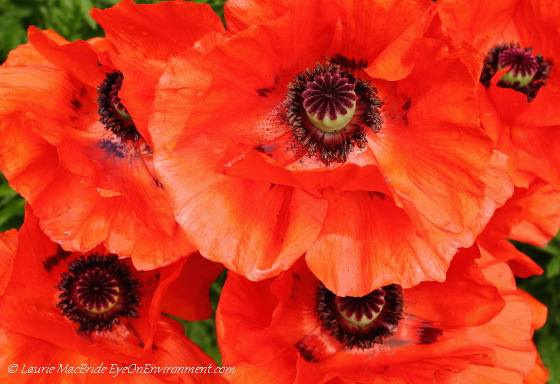
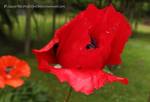
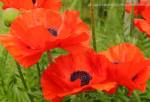
Oriental poppies

“Twirling Skirts”

Those blousy ladies are at it again – dancing in our garden. But I know it won’t last long. (More photos below.)

I blogged about them once before: how in early summer the Oriental poppies (Papaver orientale) come to life, all decked out in their colourful, voluminous skirts, kicking up their heels in an all-too-brief fling.

You have to be quick to catch them, because before you know it, their petals will drop, their stems will topple over, and their flowers will be replaced by conical seed heads.

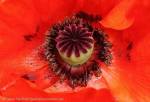
In the time we’ve lived here, our Oriental poppies have changed. They all used to be a dense, deep crimson, but over the past few years most of the flowers springing up in the patch have been orangey-red, with shorter, less dominant purplish stamens. I’m not sure why; perhaps the original plants were hybrids and they’ve reverted to their wild traits, or maybe it’s a result of the soil characteristics.

This year there seems to be just a single hold-out, with deep crimson skirts and long, midnight blue stamens. I loved the old crimson ladies, but no matter – these orangey-red newcomers are beautiful too.

But oh so brief!

More photos of the dancing ladies – click on any image to see larger view and carousel format.


Breaking the Silence

Speak out for nature and democracy

I am a daughter of this coast, born and raised on Vancouver Island, a mariner since my earliest memory: boating with my family, single-handing my own small sailboat, cruising and paddling with my partner. And for the better part of my working life I have laboured against the tide, speaking out to protect the marine environment that I love. Yet now, after many years of incremental successes, all my work, and that of countless others who value nature, is in peril.

Those who know me will be aware that I’ve been relatively quiet since I left “active duty” in the environmental movement. Burnout is all too common in that sector, so although I still do some work behind the scenes, the last half dozen years have been mostly a time of recovery for me:  finding a new voice and renewal in photography, where I seek to convey the beauty I find in nature. But now I must break my silence.

Today in Canada, two things that I cherish are truly on the line: nature and democracy.

The Harper government’s omnibus “budget” is a thinly disguised, massive and callous attack on our country’s environmental protection laws and the natural environment that sustains us. At the same time, the government is targeting charities that are exercising their legal right to advocate for environmental protection and for action to stop rising carbon emissions.

Under the changes contained in the “budget”, the hard-won, vital protection for habitat and threatened species that we have had under the Fisheries Act will be removed. Gone also will be the right of citizens, public interest groups and independent experts to have any say in Environmental Assessments or reviews of potentially harmful projects.  The National Energy Board will no longer be able to turn down a pipeline project that’s not in the public interest – Cabinet will be able to override it. Scientific research and monitoring of environmental pollutants will be slashed. Charities that work for environmental protection will be audited and potentially stripped of their charitable status.

These are just a few examples of the major and potentially devastating changes that the government is pushing, all brought forward as a fait accompli: no White Papers, no public consultation, no Parliamentary Committee discussions, no public hearings – in short, no democratic process whatsoever. This, in Canada, in the 21st century. I’m appalled, ashamed and aghast.

That’s why today, I’m joining with hundreds of organizations and thousands of individuals across the country who are saying that silence is not an option. Nature and democracy are both at stake here in Canada, and the repercussions could last for a very long time. I hope you’ll join us in defending our country’s environment and democracy.

Laurie MacBride
June 4, 2012

Here are some links to help you learn more and take action:

Look But Don’t Touch!

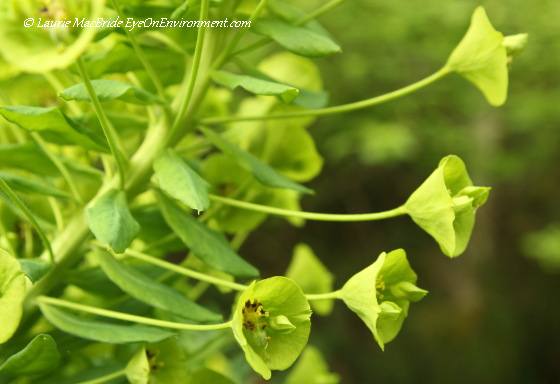
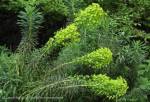
Euphorbia (spurge) in the spring

Spring Spurge

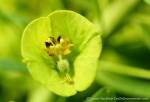
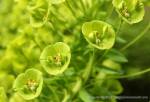
The Euphorbia in our garden is a strange-looking but oddly beautiful plant – with a very ancient pedigree. 

Euphorbia (which is actually the name of a whole genus of plants) was named way back in the year 12 B.C., by Egypt’s King Juba II (Anthony and Cleopatra’s son-in-law), after his Greek physician, Euphorbus. The good doctor recognized the plant as a “powerful laxative”, and this ability to “purge” led to the plant’s common name of “spurge”.

I wouldn’t want to try his remedy. Our plants (Euphorbia characias, subspecies Wulfinii) have a milky sap that is poisonous and caustic – causing skin irritation or even blindness if you accidentally rub your eyes. We always wear gloves when we’re working around it.

Not that our Euphorbia needs much work – it’s wonderfully undemanding. About the only care we ever give this hardy plant is to cut down the two-year old stems that have finished flowering, and tie up the tallest young stems to keep them from falling under the weight of their flowerheads.

And those flowerheads are definitely worth a close look (more photos below).

I love Euphorbia for the splash of yellow it brings in spring, and for the fact that even the slugs and deer leave it alone – for good reason!

More photos of our Euphorbia – click on any image to see larger view in carousel format:
If you enjoyed this post you might also like:

Hellebore Abundance

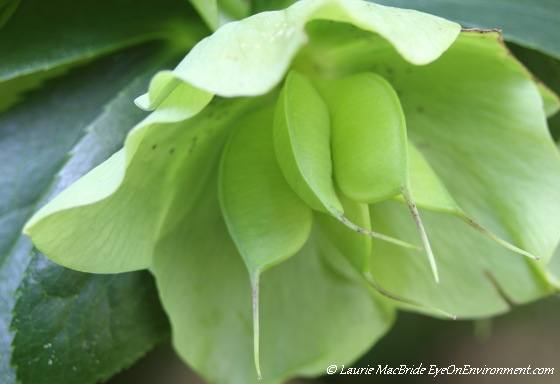
Hellebore (Christmas rose) flowers

Hellebore Abundance #1 (Christmas rose)

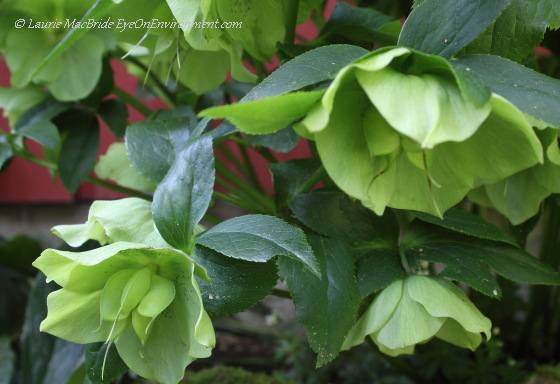
Our hellebores have outdone themselves this spring – which is surprising, since just a few months ago our resident deer family worked their snouts under the protective netting and mowed them down, along with the Sarcococca, fern and winter jasmine.  (More photos below.)

Hellebores are classed as poisonous, but the deer didn’t seem to suffer at all from their meal. I wasn’t so sure the hellebores would survive, though – let alone flower this year! But flower they did, and then some, starting very early this spring.

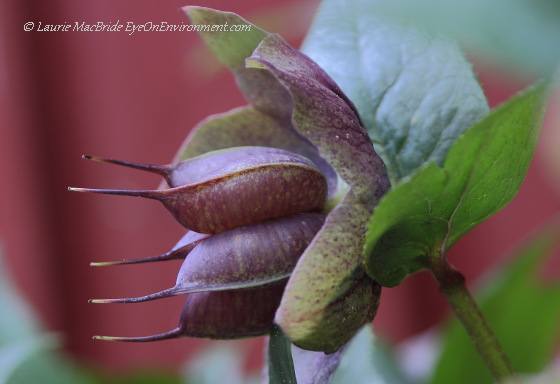
By the time I got around to taking my photos, their flowers were quite mature – you can see how large their carpels (ovaries) have become, swelling up as the seeds form inside them.

The flowers will remain through most of the summer, although their colours will fade and they’ll take on a different look as they drop their seeds. Their dark green, glossy foliage should be impressive for months as well (unless the deer go at them again, that is) .

Our abundance of hellebore flowers stems from just two plants: a “Lenten Rose” (Helleborus orientalis), with purple flowers fading to chocolatey-mauve as they mature, and a “Christmas Rose” (Helleborus niger), with almost-white flowers that take on a greenish tone as the season progresses.  Over the years the two plants’ footprints have expanded, growing more and more stems, so when they’re in flower, hellebores look to be positively bursting out of the bed.

For a shady spot on the edge of a forest, you couldn’t ask for a more perfect plant. Hellebores are hardy perennials that seem to thrive on neglect, and  slugs don’t bother them (an important virtue, as we have legions of slugs at our place).

Just don’t be fooled into believing that they’re “deer resistent”!

Click on any image in the gallery below to view in larger, carousel format.

If you enjoyed this post you might also like:

Return of the Swallows

Swallow fledgling on a gloved hand

Helping Hand (a rather ruffled Violet Green swallow fledgling)

Violet-Green swallows are back, fresh from their long journey from the tropics. They visited us four or five times in April, announcing their arrival in that lively bubbling language that is so unmistakeably “Swallow”.

They swooped low, making multiple passes over our lawn and garden and checking out the  nest boxes on the side of our house. On one of the visits, a swallow climbed inside a box and stayed for the afternoon, looking down at us each time we passed by. But so far, they haven’t actually moved in.

However, we’re keeping our fingers crossed. In the spring of 2010 we we had repeated visits by up to a half dozen Violet-Greens, causing our hopes to rise, then sink again as they disappeared. Finally, after several weeks of these short, sporadic visits, a pair moved in to one of the boxes and began raising a new family. The same thing happened in 2011. So we’re hopeful.

Could the birds checking out our nest boxes this spring be the same pair? Or perhaps some of their youngsters, now grown up? Perhaps even the little guy that we rescued? (See the photo above, and more below.) He was the last one to leave the nest in June, tumbling onto the lawn when he finally plucked up the courage to try out his wings. It’s fun to imagine he might remember us!

More photos of the fallen fledgling – mouse over image for caption, and click for larger, slide show view:

If you enjoyed this post you might also like:

Busy Times in Birdland

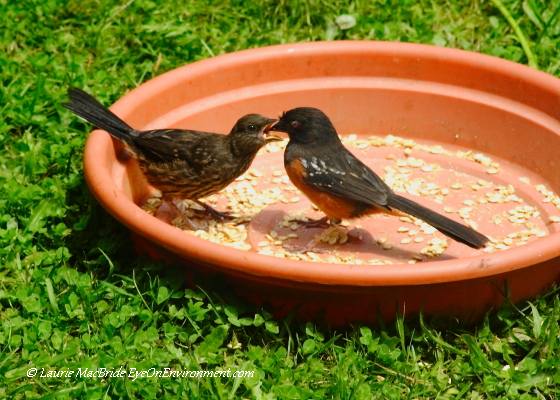
Spotted towhee feeding chick

Feeding Time for Junior

The pace of bird life around our place is picking up rapidly these days. Territories are being carved out and defended and songs are getting louder (not to mention, being broadcast at earlier hours each day). This morning we watched one of our resident song sparrows gathering up big mouthfuls of grass, carrying them off like a broad Fu Manchu moustache, to be used as construction material.

Pretty soon it’ll be the time when all those strange looking babies appear – oversized, gangly birds that don’t look quite like any species that we know. At first it’s easy to mistake them for newly arrived migrants. It’s only when they tag along behind a recognizable bird, hopping about and cheeping incessantly to gain the adult’s attention, that we can clearly see they’re the older birds’ offspring. By watching who’s following who, we can figure out which of the youngsters is a sparrow, towhee, junco, finch, robin or other avian variety.

It must be exhausting for bird parents. The Spotted Towhee in the photo above (taken in a previous summer) was, like many father birds, intensely busy – working hard all day long to feed his overly demanding chicks. He seemed not to care that the grain in the bowl was intended for a much larger animal – anything will do when Junior is screaming to be fed!

Clearly, these are busy times in Birdland.

If you enjoyed this post you might also like:

Impressions of an Overlooked Beauty

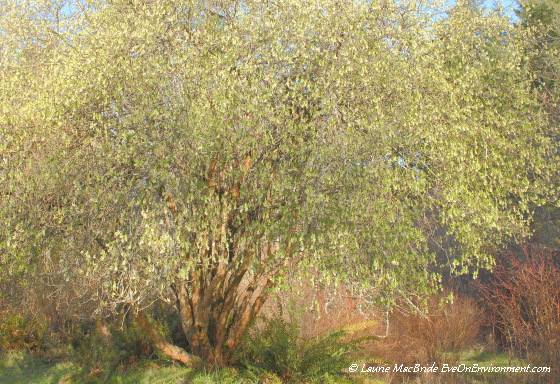
Indian plum tree in flower, Gabriola Island

Awaiting the Picnic

Where we live, winter tends to be mostly green and grey. With deciduous trees bare, our landscape is dominated by firs and red cedars and our weather is full of what we west coasters euphemistically call “liquid sunshine”. But late in the winter – usually by mid-February – our little forest starts to comes alive as the earliest-flowering deciduous species begins its annual show. (More photos below.)

We moved into our place in February 2001, on the first day of a glorious week of sunshine and warm temperatures that heralded an early spring. The garden was already offering a few edible greens and crocus blooms were ready to burst. For the first few days we were busy unpacking and organizing our new home and work spaces, and we didn’t make it much further than the garden. But when we eventually walked down the trail to the southern end of our new property, what we found took our breath away.

On the far side of the little creek that runs through our land stood a twisting, multi-trunked tree, with a wide, intricate canopy of long intertwining branches and twigs – topped by a cloud of dazzling white with a hint of yellow. It was like looking at a Renoir painting.

That was our introduction to Indian plum (Oemlaria cerasiformis) – a deciduous shrub native to the Pacific coast, which can grow to 20 feet high and 12 feet wide. It’s also known as Osoberry, Oregon plum and skunkbush (although I beg to differ; personally I rather like its scent). For some reason I can’t quite fathom, neither of us had ever noticed Indian plum before that day.

As it turns out, Indian plums are dotted all through the southern, wetter half of our property. But none are as magnificent as the one beside the creek – actually several Indian plums growing together, giving the impression of a single, large tree. From the first moment we saw it, we dubbed it “The Picnic Tree”: with its spreading canopy, gentle underlay of grass and view of our neighbour’s lovely old apple orchard, how could there be any better place for a picnic?

The beautiful blooms of Indian plum are followed by a plentiful crop of small, slightly bitter fruits – more like a cherry than a plum – which taste and smell like watermelon rind. Native Americans apparently ate them (as well as using the twigs and bark for medicinal purposes). But at our place, the birds quickly devour the fruits, so we’re seldom able to find any that are even half ripe.

Over the summer the leaves yellow and drop. By November we can see new buds on the branches, which lift our spirits in that dark time of the year. Over the winter we check the Picnic Tree frequently to see how the buds are progressing. And then by February – or rather, March, this year – at last, the lovely light has returned to our forest!

More images – click any image for larger view/slide show format:

If you enjoyed this post you might also like: