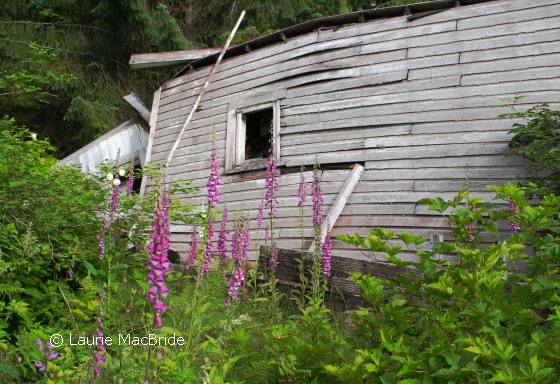
Butedale: Where Past Meets Present

In the 1920s and 30s, the cannery town of Butedale, located on Princess Royal Island in BC’s Inside Passage, supported a summertime population of more than 400 people and a thriving industry, powered by the strong waterfall flowing down from Butedale Lake, just above the town.

Even after the cannery closed in the 1950s, Butedale’s cold storage plant continued to be important to commercial fishermen for another two decades.

But its glory days are long gone now. Today, a sole caretaker lives in the old cookhouse and presides over the ruins of the town: the fallen-down remnants of its once-proud cannery, post office, store, bunkhouse and other buildings disappearing under the ever-advancing forest, salmonberry and wildflowers.

It’s amazing – and fortunate – that from the debris, he somehow manages to salvage the necessary bits and pieces to keep the generator running and the docks floating. For despite its dilapidated state, the ghost town of Butedale is vital for boaters and fishermen even today, because it offers protected moorage – something otherwise lacking in the long stretch of deep water along this part of the Inside Passage, where steep mountains fall straight into the sea, making anchoring a challenge, to say the least.

The last time I checked, Butedale was for sale. I certainly hope that whoever eventually buys it honours this ghost town by preserving what remains of its past and welcoming visitors to experience our coastal history, closeup.

More Butedale photos – click for larger carousel view:

Good Things come in Small Packages

Sandpipers on the shore

Peep Show (Blunden Harbour)

Birders refer to small shorebirds as “peeps”, because of their calls – a thin, peeping sound which can grow to quite a chorus when you run across a large flock of them.

The sandpipers in this photo are likely Western sandpipers, though it’s possible they’re Semipalmated sandpipers – the two species can look very similar in the field.

Tiny sandpipers like these, weighing only about an ounce, travel immense distances every year – wintering as far south as Peru, then breeding in Alaska and northern Canada. During migration they travel along the BC coast, stopping to rest and feed a few times. These birds were likely on their way south when I encountered them in August, enjoying the sunshine in Blunden Harbour.

Sandpipers nest right across the far north of our continent, with Western sandpipers – true to their name – all heading to the west coast of Alaska or eastern Siberia for breeding. That means that during their migrations, the entire world population of 3.6 million Western sandpipers is travelling along the BC coast!

Usually the birds have to stop down at key places along the way to rest and feed, to sustain them on their long journeys. For Western sandpipers, Roberts Bank and Boundary Bay are vital  – they’re among the very few places along their migration route where thousands of birds can feed together on tiny invertebrates in the mud flats and sand. Some sandpipers travel in smaller flocks (from dozens to hundreds, rather than thousands), so they can make use of smaller wetland areas, such as those on Sidney Island and in Blunden Harbour.

The biggest threat to sandpipers comes from human beings: our unfortunate tendency to dredge, dike, fill, pave or otherwise destroy their habitat. The global population of Western sandpipers could be devastated if the Port of Metro Vancouver is given a green light to expand its container port at Roberts Bank – an essential resting and feeding spot for these as well as many other birds. And if that happens, we humans would be the biggest losers of all.

Finding Beauty in the Mundane

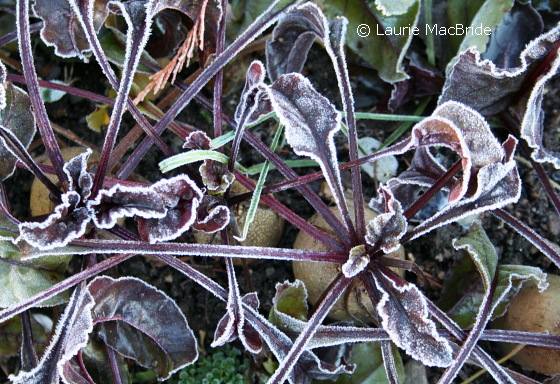
Beets in a garden with frost covering them

A Winter’s Rime

Winter can be a dreary time here on the west coast, but it’s not without its share of beauty. I was late harvesting our beets one year, and when the first heavy frost hit, a gorgeous sparkling rime covered them. I couldn’t resist composing a few photos before I pulled them from the ground. Borscht is good, but an enduring image that I love is even better!

The Chatterbox

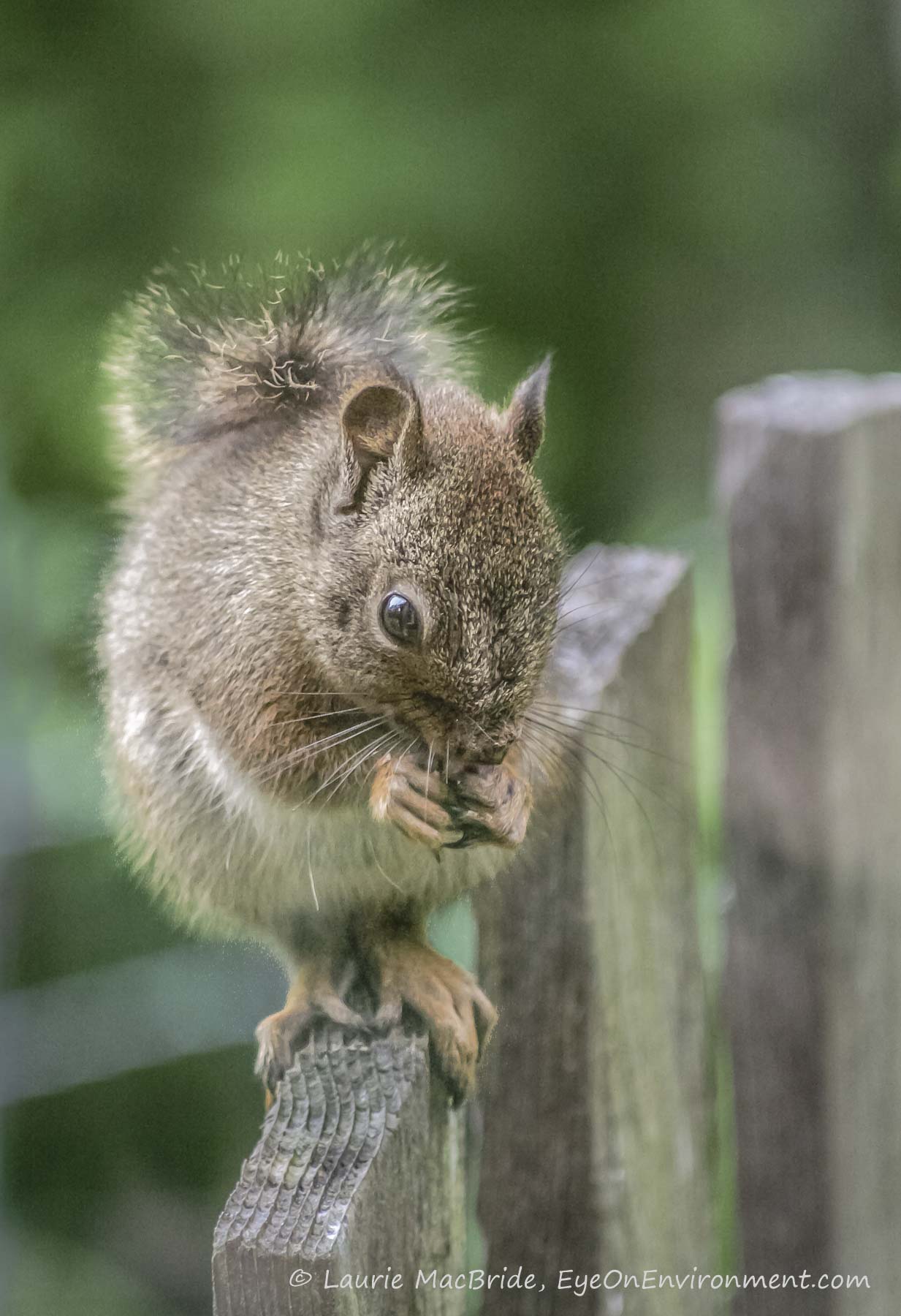
squirrel with seed, closeup

Unlike his larger grey cousin, our native Red Squirrel (Tamiasciurus hudsonicus) is seldom a nuisance: other than an occasional foray to chow down on the spillage under the bird feeder, he’s focused on collecting seeds from Douglas fir and maple trees to fill his larder.

I enjoy watching him rush along his highway in the trees and scoot up and down tall trunks, using sharp claws and hind feet that can rotate to 180°. Sometimes we see him perched out on the thin end of a long maple branch, gathering maple seeds and tossing the unwanted seedcoats down like rain over our patio. Other times we see him sunning himself on a willow branch over our lower pond. Or perhaps he’s in one of our apple trees. He’s never still for long!

The Red Squirrel is territorial, and it’s great fun to listen to his constant loud chatter as he barks, mutters and growls to defend his patch.

Amphibian Encounters #2

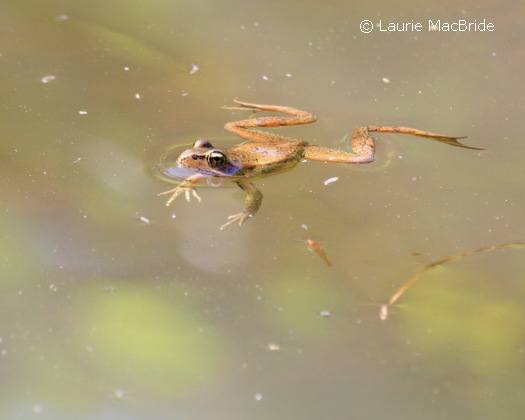
Red-legged frog floating in a pond

Prince of the Pond

I encountered this fellow one sunny afternoon in early summer, relaxing in one of our ponds. He’s a Red-legged Frog (Rana aurora), a species that’s officially at-risk. Red-legged frogs live in ponds or lakes and shady forests, so human encroachment on their habitat has taken its toll. Fortunately their population is still considered relatively healthy in the Gulf Islands, where I live.

Red-legged frogs are much larger than the more familiar Pacific tree frogs – they can grow to 13 cm (5+ inches). The underside of their back legs and their bellies are an orangey-red – the older the frog, the deeper and richer this colour will be.

Unlike their more abundant little green cousins, you seldom hear Red-legged frogs, because they make their mating calls deep underwater. About the only sound I ever hear from them is  when my foot accidentally comes too close: that’s when I hear the plop they make as they spring into the water from the bank of the pond, where they’ve been sunning themselves!

Once Red-legged frogs have mated, which can be as early as mid-February in our region, they lay a jelly-covered eggmass about the size of a canteloupe. From this, the tadpoles will emerge, and by mid to late summer they will have metamorphized into little froglets, if all goes well. In dry summers – which seem to occur more and more frequently as climate change affects our region – we worry that our pond will vanish before they have developed the legs they need to wander into the cool of the forest. It seems like a race against time, which is why I breathe a big sigh of relief whenever I spot a new generation of these lovely frogs in our pond.

Related post: Amphibian Encounters #1 (Pacific Tree frog)

Poppies: Fleeting Grace

Oriental poppies (Papaver orientale)

Summer Dance

I love the dense colour of our Oriental poppies and the way they move together so gracefully in the early summer breeze.

But the dance doesn’t last long: after what seems like just a few days, each stem in turn topples over, its flower replaced by a drying seed head.

By fall even the ferny foliage disappears, leaving no trace of the dancers – their energy hidden underground to await another summer.

Feeling the Dynamism

In the Surge

A kayak is the perfect craft for experiencing the dynamism of the outer coast, as the sea rises with each incoming wave to fill in the shoreline, then drains back out again out as the swell passes by.

It would be easy to get swept onto the rocks, but fortunately, huge bull kelp beds provide a relatively calm zone, damping down the swell a bit so that you can get in close, where it’s still dynamic but much safer. There, you can feel the rise and fall and hear the suck and surge as the water rushes along and through the rocks, and it’s almost as if you become a part of the swell yourself.

I took this photo off the Tribal Group on BC’s Central Coast, on one of the rare sunny days we experienced in the summer of 2011.

No Rest for Bees

I love the “traffic” in our garden each summer: everywhere you look there are bumblebees flitting about, landing and sampling the flowers – no matter to them whether it’s a glorious rose or a lowly teasel. And the sounds of all these hard workers on a summer afternoon are amazing: a deep, almost steady thrumming all around, punctuated by brief intense buzzes as they move on to a different plant.

It’s high time we gave bees the credit they deserve. After all, without their constant hard work all summer long, how would we have such beauty all around us, let alone all the food crops that grace our tables? And not to mention the honey, of course.

True, other insects – and even some birds – contribute a share of the pollination, but bees have to be the hardest working, most productive pollinators around, bar none. We really do depend on them: it’s estimated that a third of all the food we eat requires pollination by bees. So it’s worrisome, to say the least, that bee popoulations are in steep decline all over the world. The latest reports in the US show a 96% drop in four species of bumble bees over the past few decades, and the figures from Europe are similarly bleak. One of the causes has likely been the increased global use of pesticides since the 1970s – part of the dark side of the “Green Revolution”.

Organic gardens like ours provide a much-needed safe haven for bees, birds and other wildlife. And of course, a wonderful place for photographers to hang out!

Related photos – click on image for larger view:
Bee on echinacea flower