Eye of the Heron

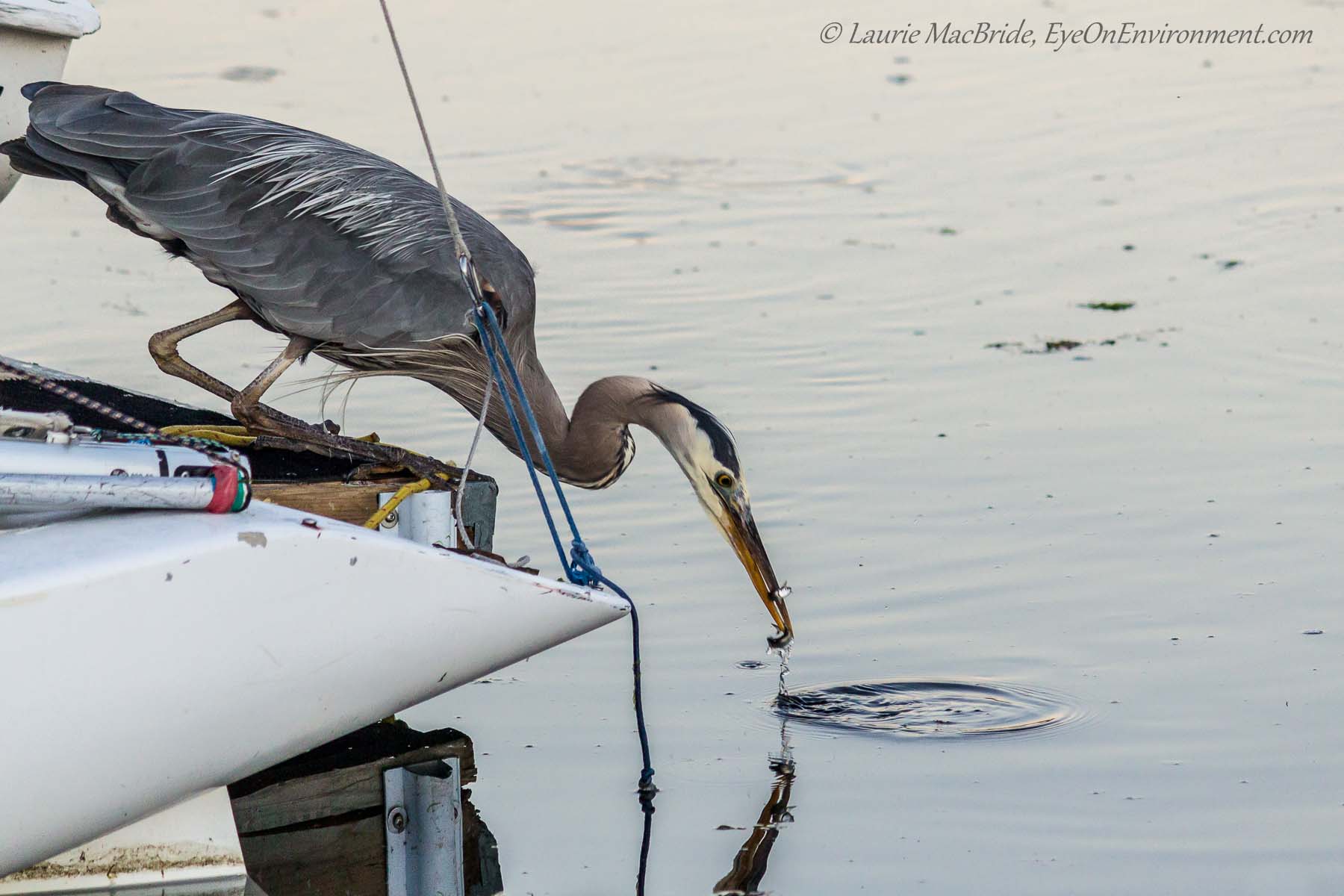
Heron fishing off a dock

Through the looking glass: Great Blue heron at work (click to enlarge)

The Great Blue heron relies on stealth and lightning quick reactions to catch its dinner – along with amazing eyesight.

Its eyesight is about three times more detailed than ours, and its binocular vision gives it very good depth perception. It also has a built in “zoom lens” – allowing the bird to switch instantaneously between telescopic and macro vision (probably as good or better than our fanciest modern camera lenses).

If we lowly humans were in the same situation as the bird in these photos, most of us would starve, at least without the aid of polarizing sunglasses and decent fishing gear. Staring into the water, we’d be thrown off by the glare, the surface motion and the dominance of our own reflection. Even if we were able to spot a fish, we’d have a hard time judging its exact location because the refracted light would distort our angle of view.
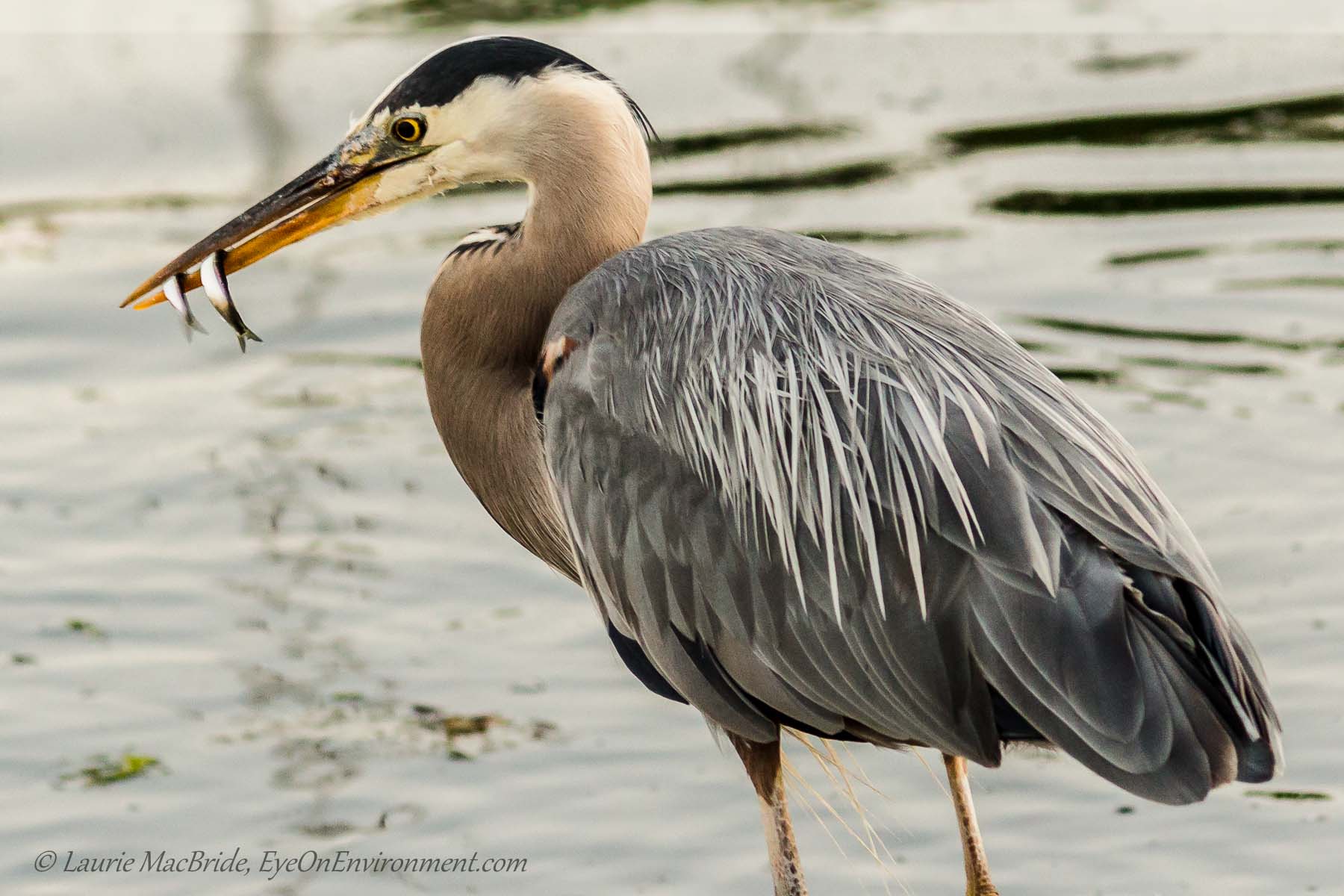
Heron lifting its head with two fish in its beack

Double success! (Click to enlarge)

The bird in these photos may have been managing to reduce the glare and distortion by extending its long neck and tilting its head to bring its bill almost straight down. If so, the trick worked, as we watched it catch two, three and sometimes even more fish with each rapid thrust of its elegant beak.

In an earlier post I wrote about BC’s coastal Great Blue herons and why they’re a species at risk here in the Strait of Georgia. Luckily, many have managed to adapt to our increasingly urban environment. For example, you can often find a Great Blue heron like the one in these photos, using a dock in a quiet corner of a marina as a handy viewing and fishing platform – affording humans a bird’s-eye view of this awesome fisherman in action.
Heron with two fish in beak

Stone-Faced

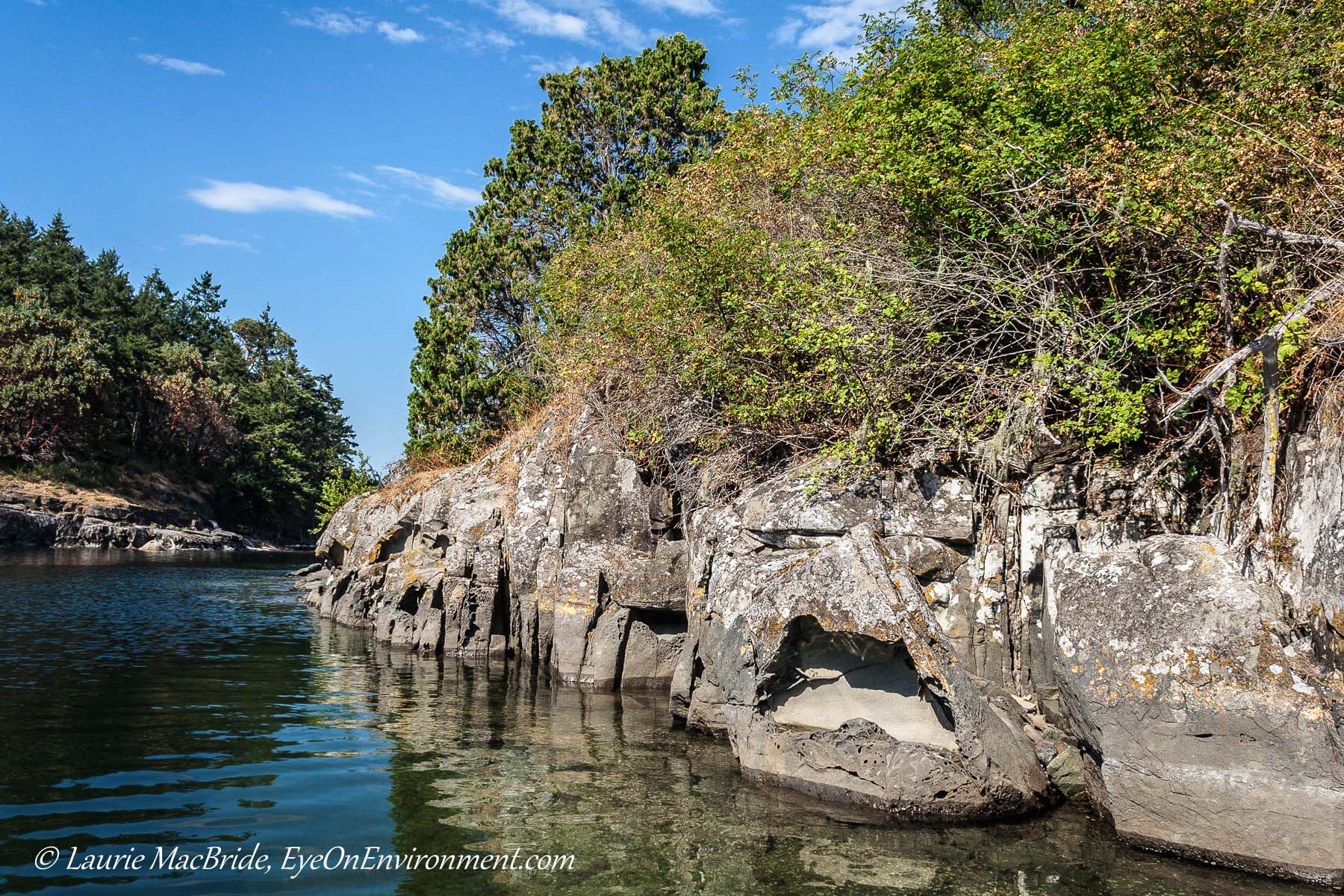
Open-mouthed face shape on shoreline

If sandstone could speak, what would it say? (Click to enlarge)

Over time, the sandstone shores of our region have been eroded by the elements, producing all manner of fascinating textures, patterns and visual oddities. I’ve written before about the natural art gallery you can find here and its strange shape-shifting tendency.

When the tide is right, you can find some pretty interesting “faces” along many stretches of shoreline in the Gulf Islands. This one, off Portland Island, jumped out at me when I was rowing our dinghy there this summer – though I’m not sure whether its open mouth was welcoming me or warning me off.

Thirty Shades of Yellow

It's bright under the kiwi vines (click to enlarge).

It’s bright under the kiwi vines (click to enlarge).

November tends to be damp, gray and dreary here on the west coast, so it’s a month I never anticipate with pleasure. Right now, with the darkness closing in earlier each day and that dreaded month fast approaching, I’m starting to crave a bit of extra light and colour.

Thankfully, our Hardy kiwis and Bigleaf maples are managing to brighten up their respective corners of our yard – along with my spirits.

We don’t get the glorious spectrum of autumn colours here that you’ll find back east, but our west coast deciduous trees and garden vines know a thing or two about yellow. It’s a colour with a surprisingly wide range of hues – my online dictionary lists over 30 shades of yellow. And at this time of year, that cheerful palette is exactly what I need.


If you are on Gabriola Island this weekend, be sure to catch the Gabriola Photography Club’s annual Fall Show & Sale: Sunday, November 1, at the Rollo Centre, 12 noon to 4 pm. See you there! 

May the Fronds be With You

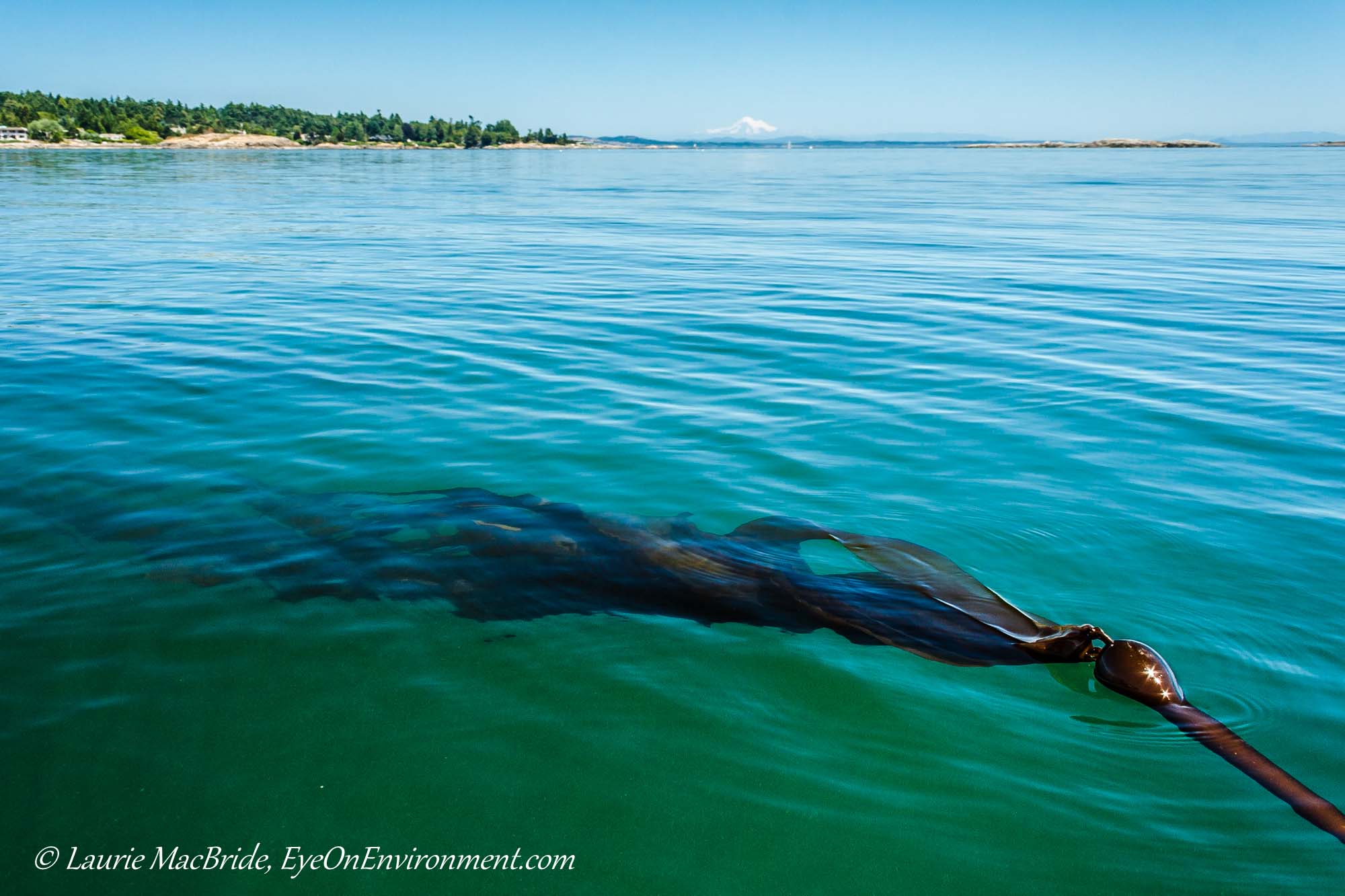
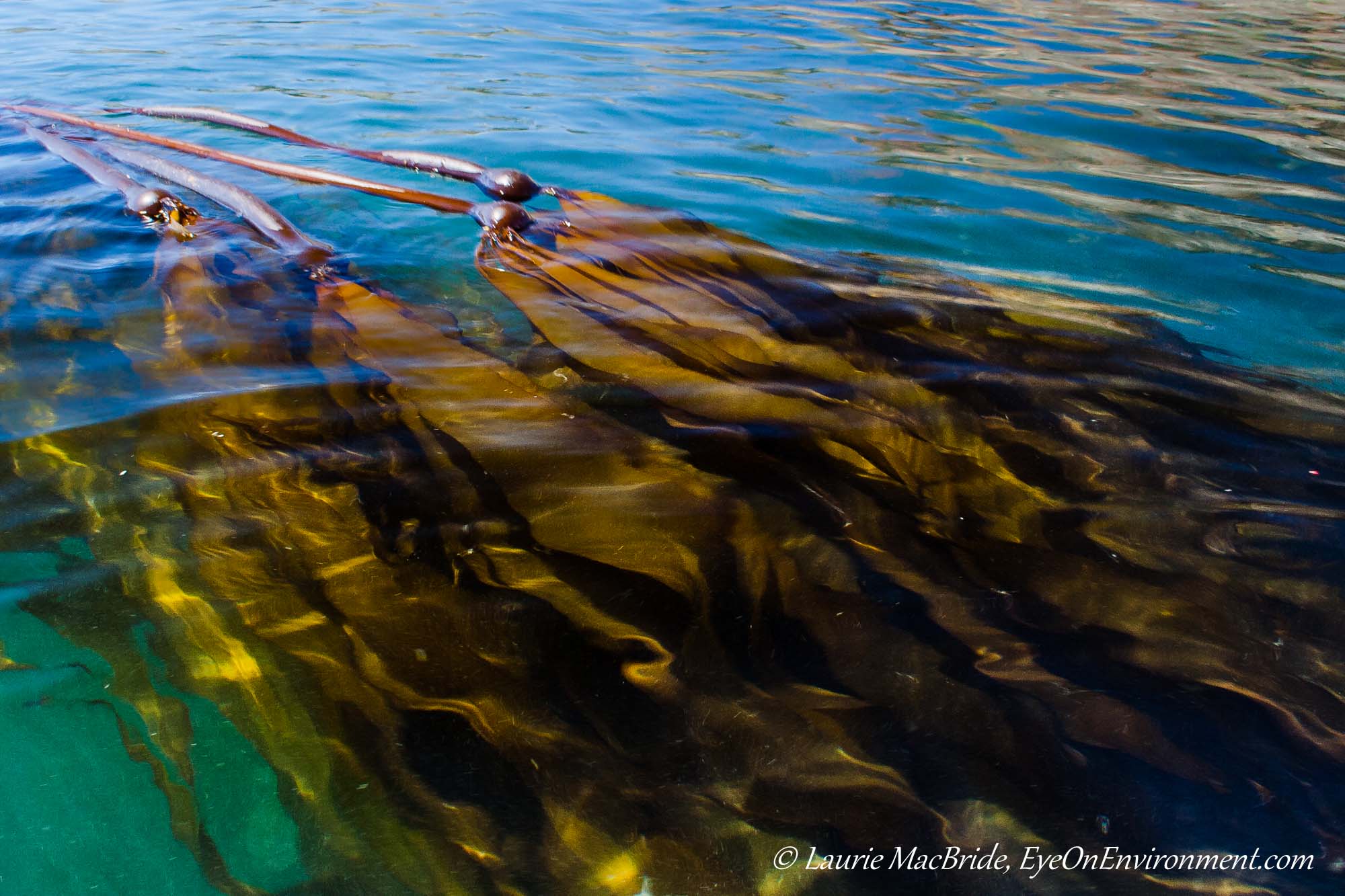
Kelp fronds streaming out

In the Current – and going in the right direction (click to enlarge)

“Current affairs” factor into our decisions when we’re kayaking.

If there’s next to no surface current, we’ll often just dawdle along, soaking up the scenery. When the current is stronger and it’s going in our direction, the paddling is easy so we’re able to make good speed towards a destination.

By contrast, going against the current can make for hard slogging, so we usually try to time our passages to match its direction – especially if we’re heading home after an already lengthy paddle. At worst, if we’re fighting a current, we hope it’s a minor one.

But currents can be localized and dynamic, changing several times over the course of the day. So how do we judge their relative speed and direction?

If it’s summer, we look to the kelp beds along the shorelines and rocky reefs we love to explore.

Long blades of kelp flowing in the currentBull kelp is attached to the sea floor by a holdfast, with its stem growing up (sometimes as much as 80 feet) to reach the sunlight. A bulbous bladder keeps the plant’s long, thick fronds floating near the surface where they can photosynthesize.

As we paddle along we take note of which way the kelp is streaming. The fronds flow in the same direction as the current, cascading out like long locks of hair. How extended these tresses are tells us the relative speed: the more they stream out in one direction, the faster the current.

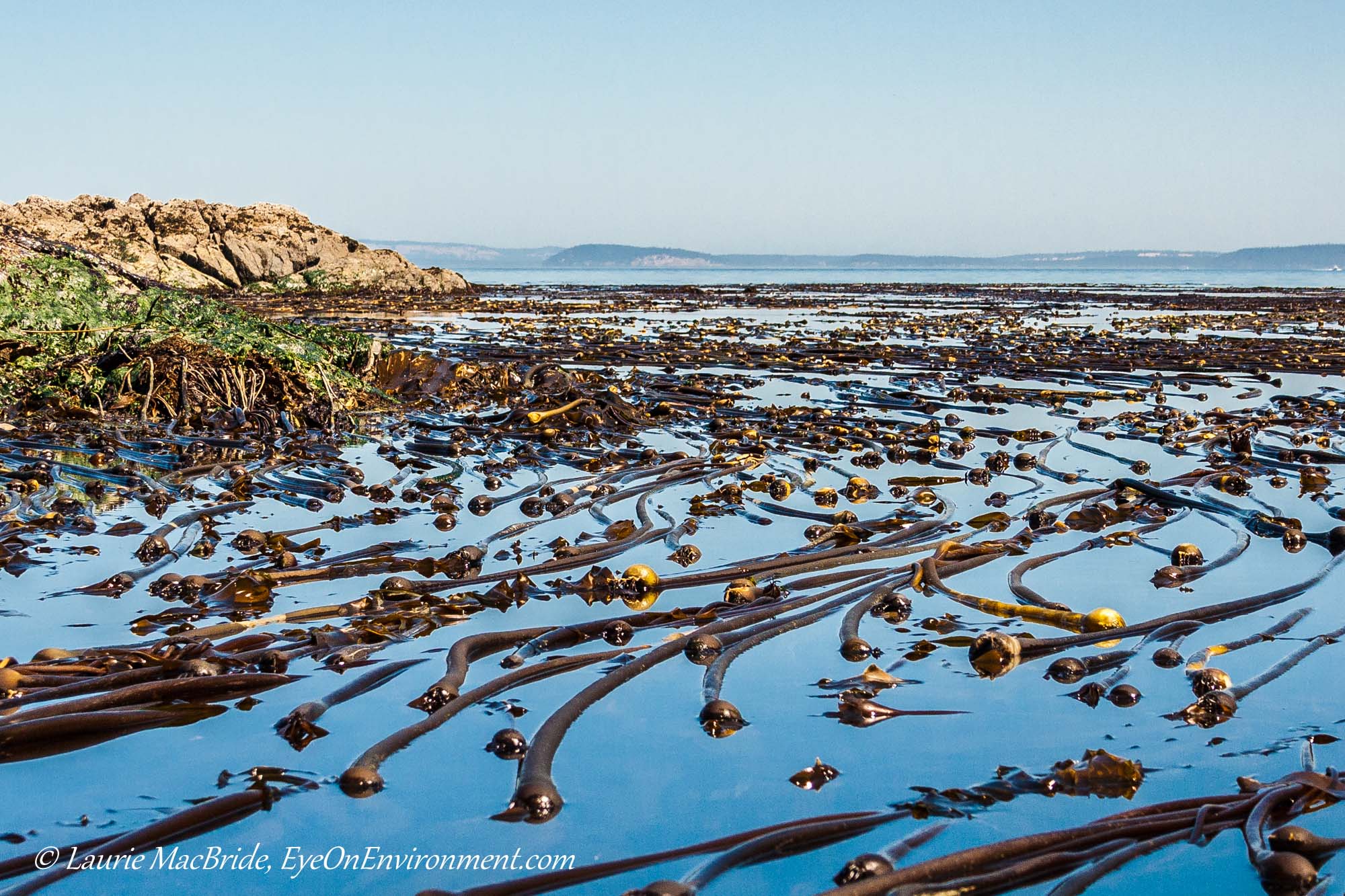
When they’re hanging straight down or floating lazily in all directions (as in the photo below), the current has slowed or stopped – usually an indicator that it’s starting to reverse direction.

As in life, we sometimes have to paddle against the current, which gets tiring. So whether the fronds are with or against us can make a big difference to how we feel at the end of the day.

Thick kelp bed

Here be Dragons Delish!

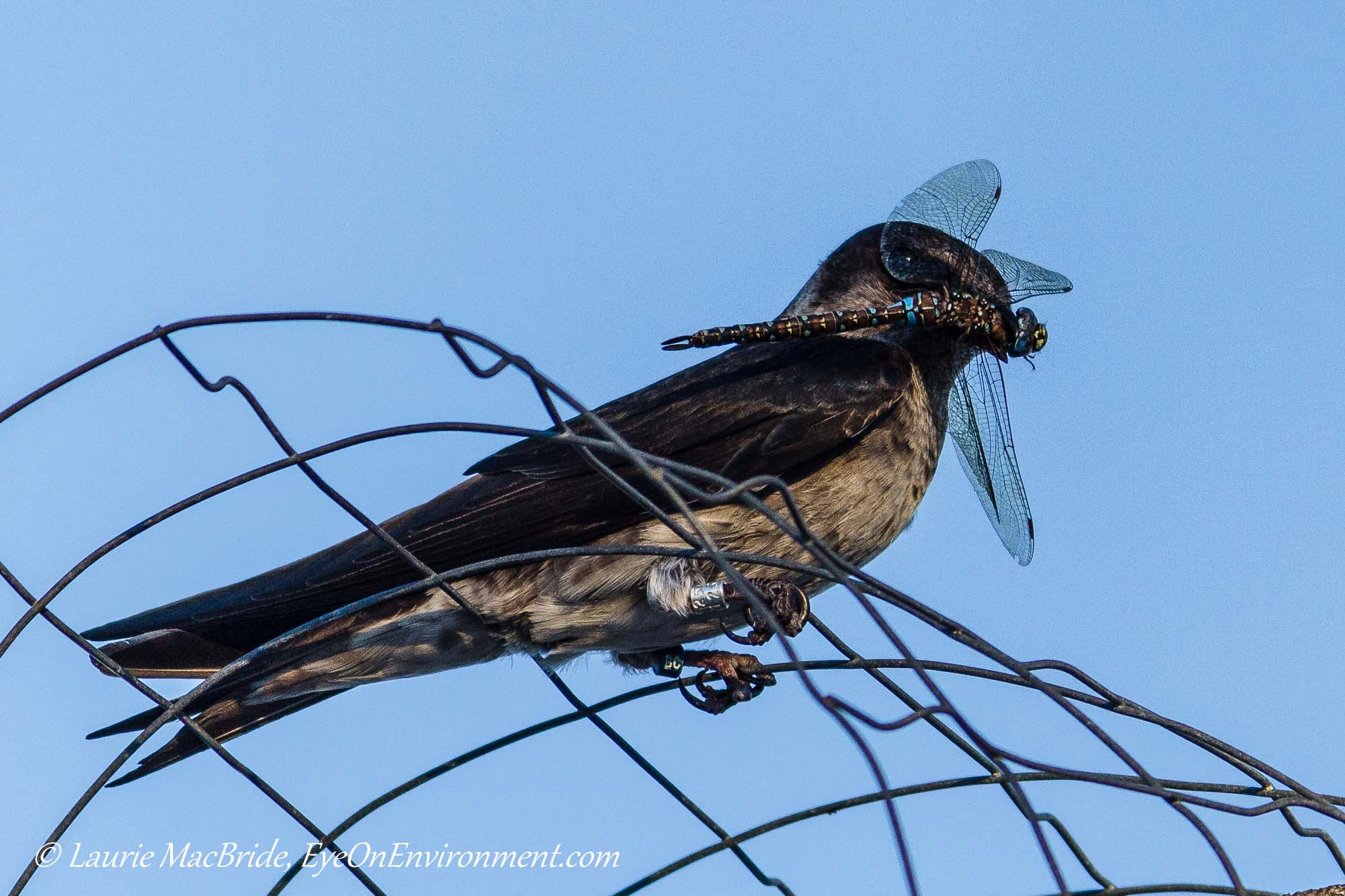
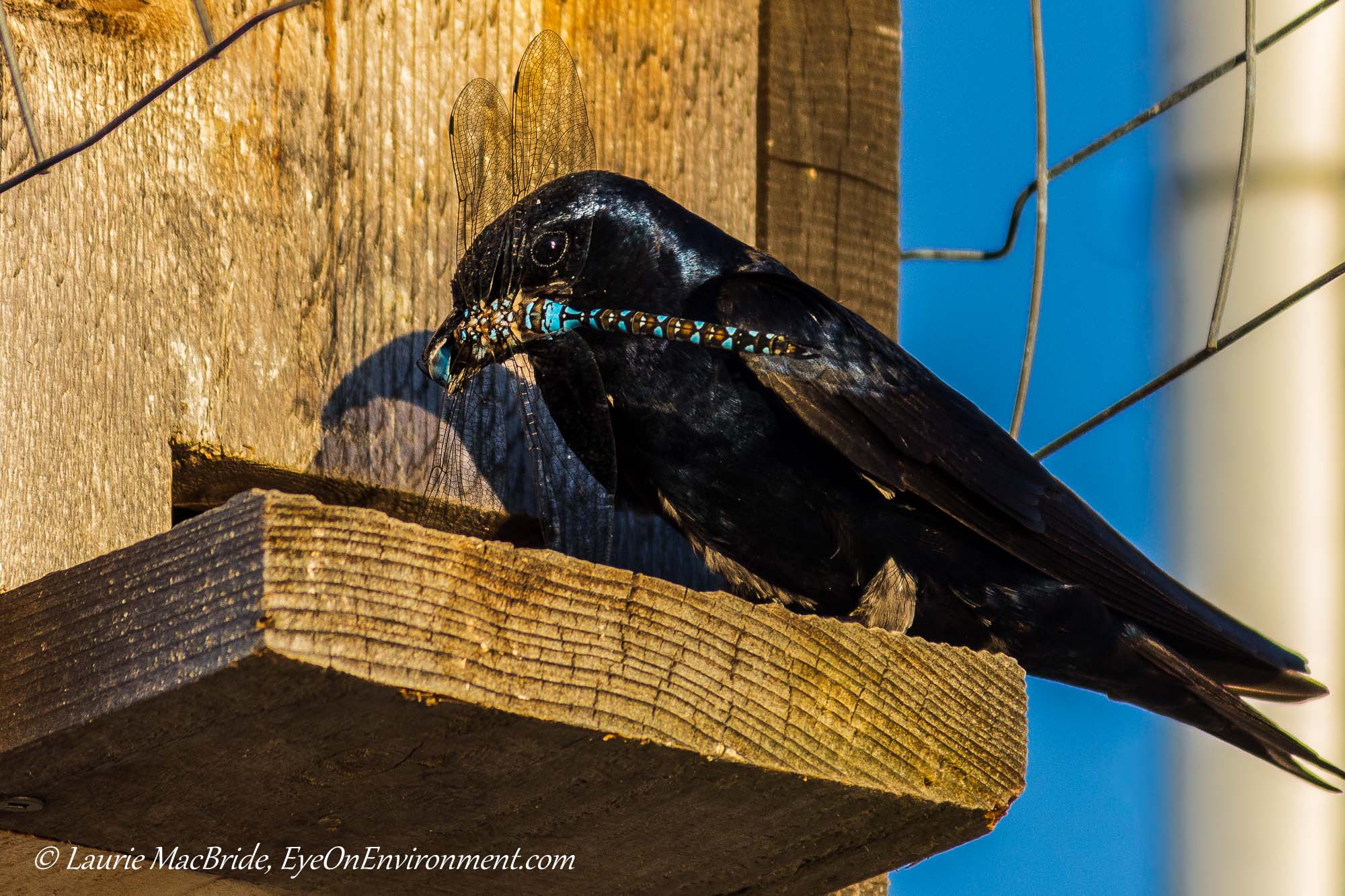
Young Purple Martin with dragonfly

Dinner Time (click on image to enlarge) – more photos below

I love dragonflies – and so, apparently, do Purple Martins. But not in quite the same way as me.

At each marina we visited this summer we saw and heard Purple Martins, busy raising their next generation. From the early hours until almost dark, we’d hear the melodious voices of these oversized swallows – their lovely, almost metallic song that reminds me of the twang of halyards against aluminum masts (appropriate for birds that spend their summers hanging around boats).

We watched the adults swooping about – mostly overhead, but on one thrilling occasion, a fast-flying Martin came right through our open wheelhouse. The birds did their best to keep the insect population at bay, and served up a steady stream of meals to their youngsters back at the nest boxes. Dragonflies were sometimes on the menu – but fortunately so were mosquitoes and other insects I feel less charitable towards.

You’ll notice that the young Martin in the photo above (possibly a second-year male) has bands on both legs. That’s because, like the rest of his colony, he’s part of an intense stewardship and recovery program aimed at bringing back Purple Martins, which are a Species of Special Concern on the west coast of North America.

In 1985 the population of Purple Martins in BC plummeted to an appalling low of just five breeding pairs. Loss of their natural nesting habitat (including Garry oak forests) and competition from introduced species such as starlings and House sparrows were likely the main causes.

Since then, volunteers have installed about 1500 Purple Martin nest boxes around the Strait of Georgia. Many are mounted on pilings at marinas, giving boaters a first-rate opportunity to watch the birds’ antics as they come and go. Overhanging wire mesh covers protect them from predators and (as you can see in these photos) serve as “patios” for the birds to enjoy the summer air.

Thanks to the efforts of the volunteer program, BC’s Purple Martin population now stands at over 1000 breeding pairs. They’re not out of the woods yet, but at least these birds have a fighting chance.

Which is more than I can say for the dragonflies when these “swallows on steroids” are around!

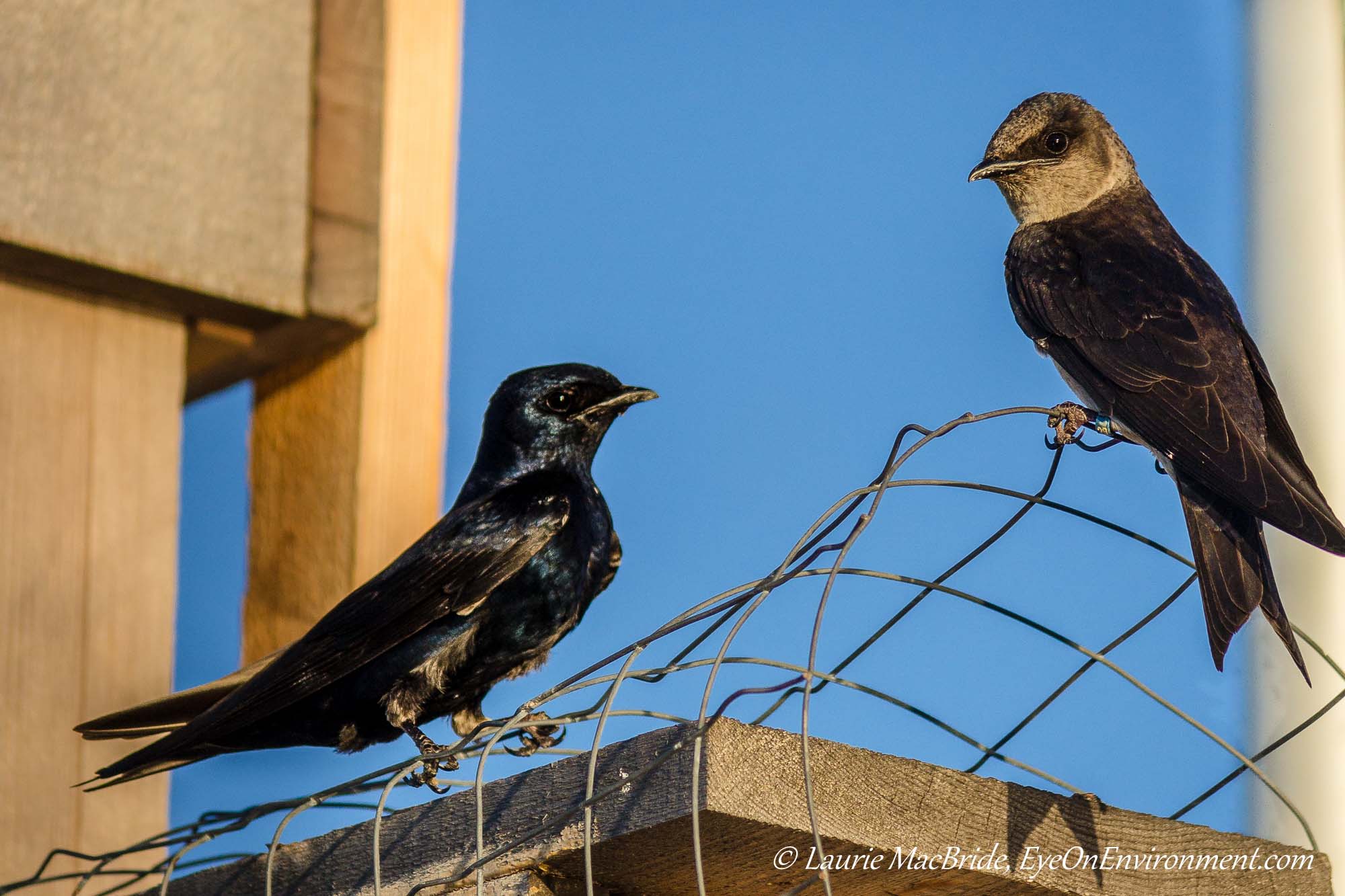
Mom (right) and Dad – perhaps discussing whose turn it is to fetch the next round of dinner for those ravenous youngsters:

Purple Martin male and female at next box

Looks like it’s Dad’s turn. Dragonflies beware!

Adult male Purple Martin with dragonfly, at nest box

Must be the Season of the Frog

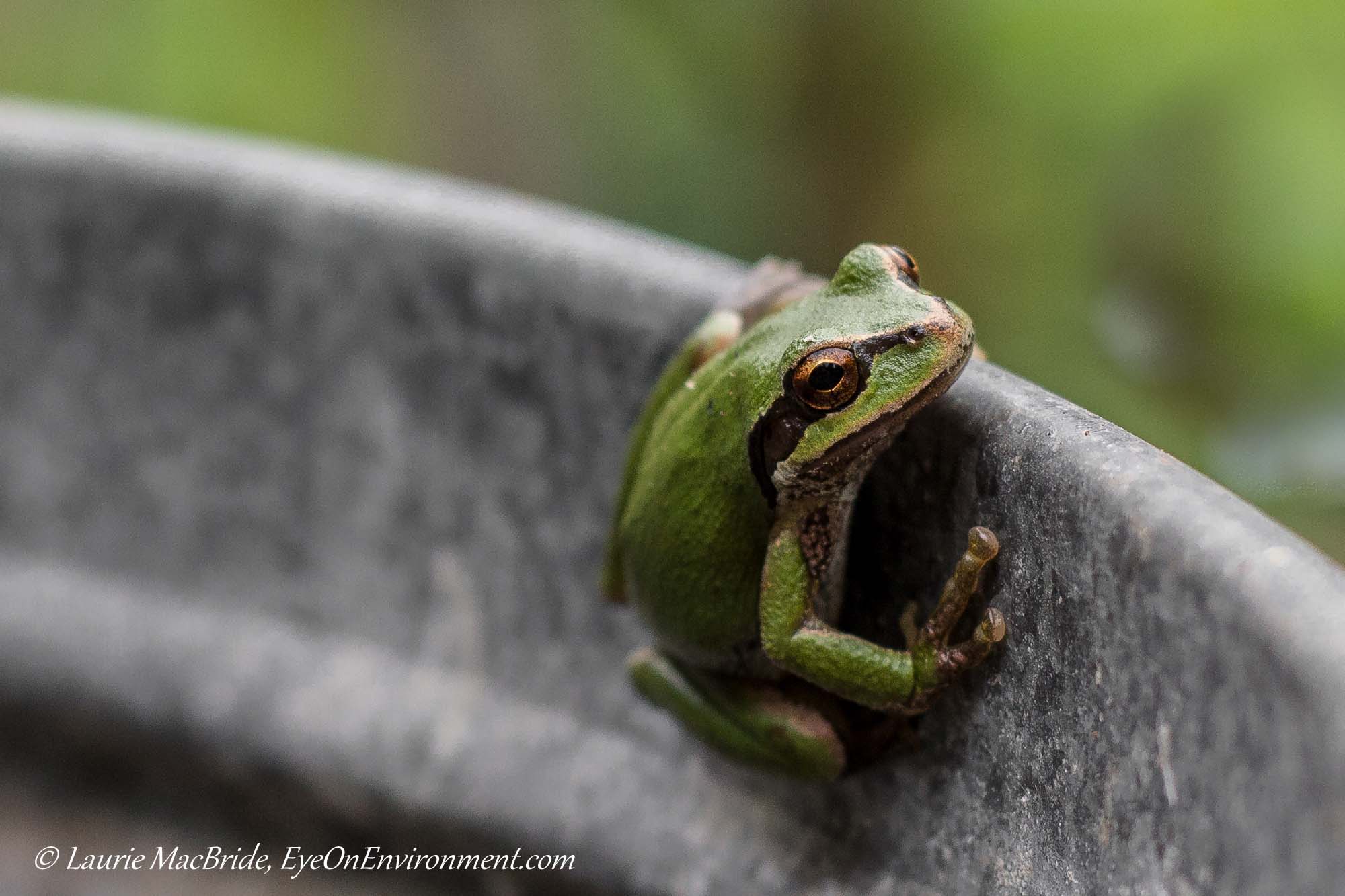
Pacific tree frog clinging to barrelAugust is Tree Frog Month around our place. The steady chorus that came from our ponds every night in March and April has, thankfully again this year, resulted in a new generation of Pacific Chorus frogs.

Our two ponds go dry by late June or early July, so the little frogs need to fan out to moister habitats when summer arrives. By August they show up all over the garden. We find them sunning themselves atop the viburnum and rhubarb leaves, or enjoying the shade among the lilac branches or kale. Sometimes when we’re walking under the fruit trees a frog will drop onto our head or shoulder, and catch a ride around the garden with us. What fun for frog and human alike!

Although we see them in various places, they seem to have two reliably favorite abodes. One (shown in the photos above and below) is inside the old metal garbage can that sits at the edge of the garden and serves as our compost tea barrel – a little roofed “pond” of sorts.

Strangely, it doesn’t seem to bother the frogs that their roof regularly vanishes for ten minutes at a time or that the water level in their pond goes radically up and down each day when we water the tomatoes and refill the barrel. They just climb up onto the edge of their metal pond and watch the proceedings.

Two frogs on edge of barrel

When it’s time to close up, I often have to give them a gentle nudge so that I don’t accidentally crush their tiny fingers (toes?) with the garbage can’s lid.

Frog with prominent toes on edge of barrel

Their other favorite summer place is inside our plastic deck box – on, under and between the cushions that we store there. Most August days I find three or four frogs in residence at any given time. I guess it’s warm, protected from predators and of course comfy, with all those cushions, but still it seems like a very odd (and rather dry) place for frogs to hang out.

Needless to say, we go slowly and with great care whenever we need to move a cushion or lower the box’s lid – including giving a gentle encouragement to any of the little guys who need to get into a safer position before the sharp plastic edges of the lid come down.

After all, frogs and other amphibians are having a tough time surviving all over the world these days. We aren’t able to do a lot on the global front, but here at home we try to help them out in any way we can.

Slowing Down for the Details

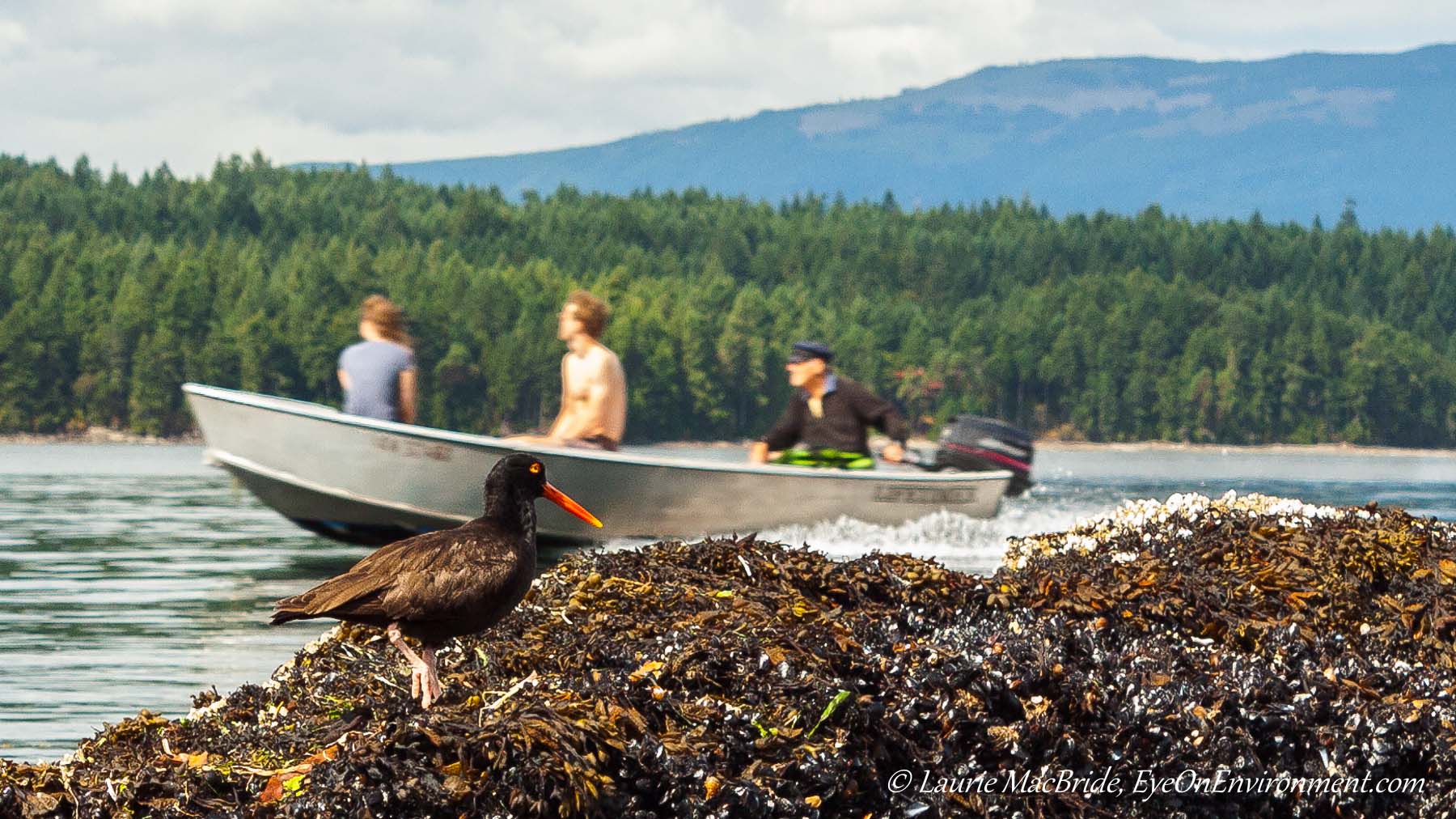
Oystercatcher on shore with a speedboat full of people rushing by

Oystercatcher Overlooked (click on the photo to see the details)

It seems like we’re often so busy rushing about, trying to get the “most” out of life, that we miss out on the delightful little details around us.

The folks in the boat above, for instance, didn’t seem to notice the Black oystercatcher as they sped by. I’m not judging them – I’ve been in the same metaphorical boat myself, way too many times. But this was one occasion when I was grateful to be in the slow lane.

I was in my stubby little kayak – a craft which, even when I  paddle hard, seldom exceeds 3 knots (about walking speed on land). Moving along the shore at such a tortoise pace allowed me to spot the oystercatcher – one of many little details that made that day on the water a very special one for me.

Click here for my earlier post about Black oystercatchers and why these lovely little birds always make me chuckle.

Summer School for Seals

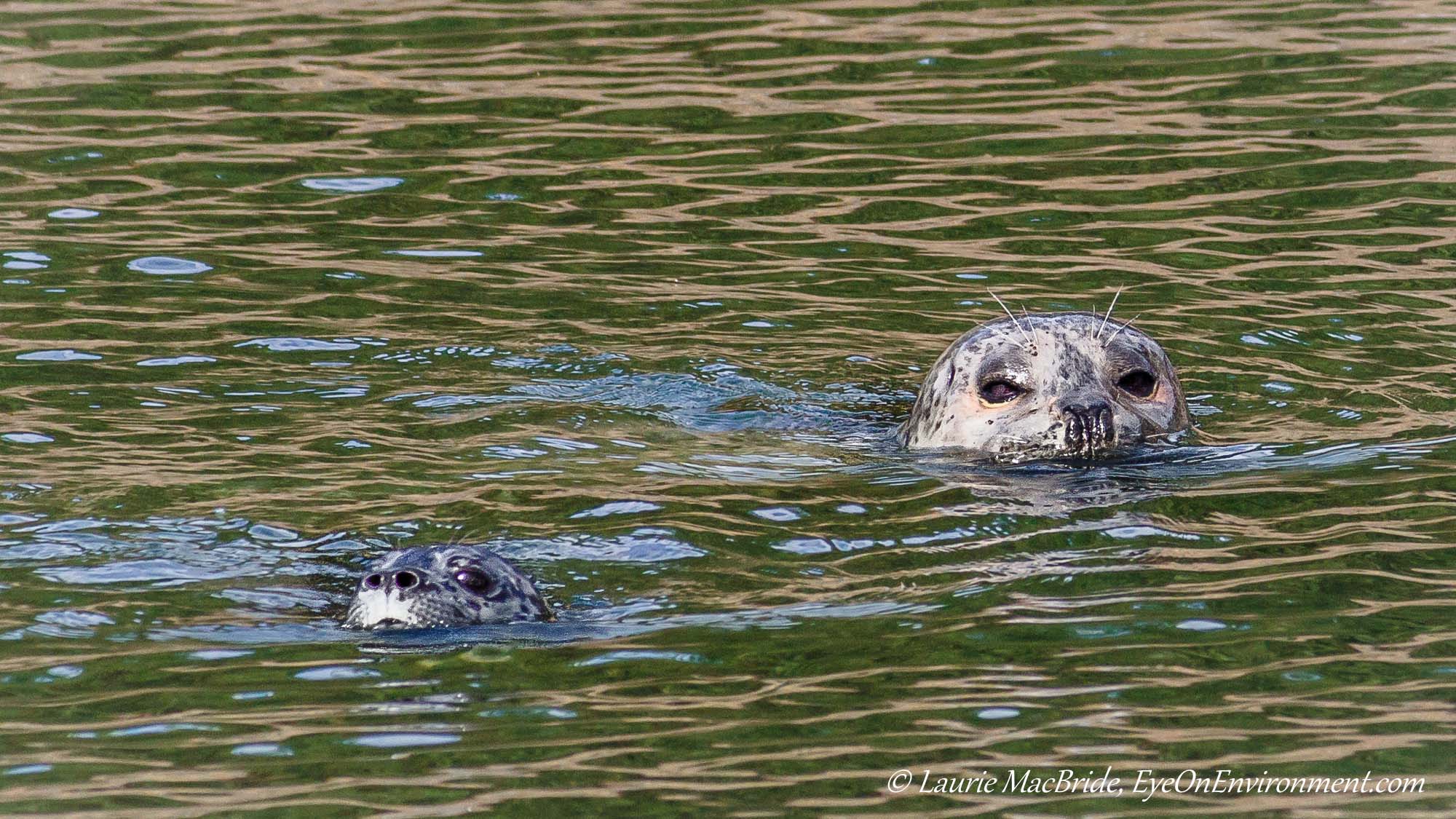
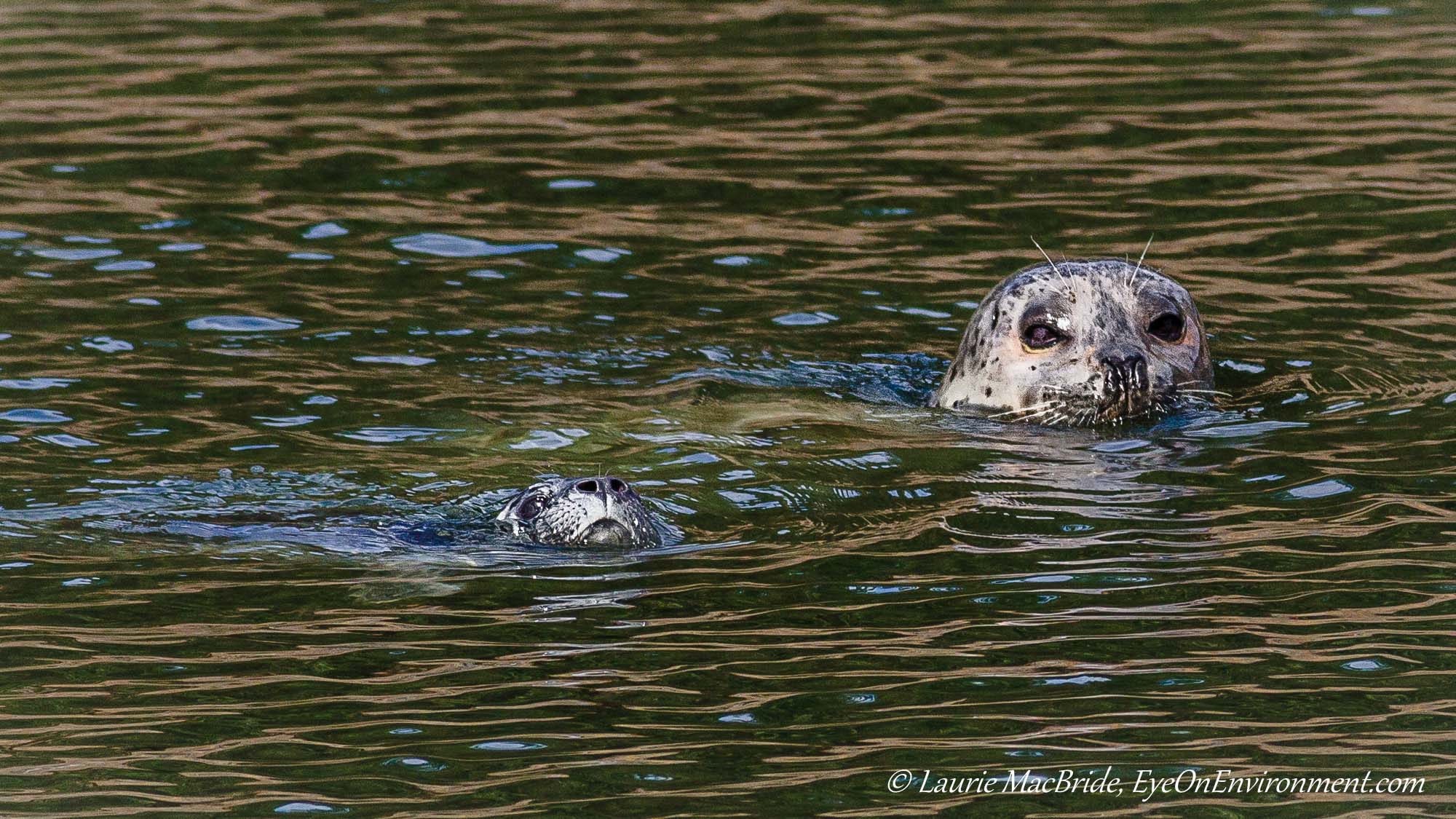
Young seal pup learning to swim with its motherPerhaps we resembled kindly grandparents. Or perhaps the distance around our boat was just right to safely challenge a young harbour seal. Whatever the reason, we were delighted that out of half a dozen boats anchored in the bay that day, Momma Seal chose ours for her pup’s swimming lesson. (Click on the photos to enlarge them.)

Like so many mothers, she showed immense patience – slowly leading the pup on a wide circle around us, giving it a push when it strayed off course or too close to our boat. The little one was probably only a few weeks old, and still an ungainly swimmer, particularly when it surfaced for air – struggling to get its nose out of the water and floundering behind Mom until it regained its balance.

Seal pup learning to swim with its mother

Pacific harbour seal pups are born on beaches or tidal reefs right through the summer, beginning in late June, and for their first month they depend on their mother’s milk. The moms have only a single pup each year, which is a good thing considering how much these little tykes need to eat – often doubling their weight by the time they’re weaned.

Although pups can swim within hours of their birth, their grace in the water is somewhat lacking – thus the need for swimming lessons. I expect that once they’re mastered that critical skill, the second course in their summer school curriculum is focused on fishing.

Seal pup swimming behind its mother

Success! And now for the fishing lessons…

A reminder if you’re on Gabriola Island this summer: about a dozen of my marine-focused prints are on display at Gabriola’s popular dockside eatery, Silva Bay Restaurant & Pub. I hope you’ll stop by for a meal and have a look.