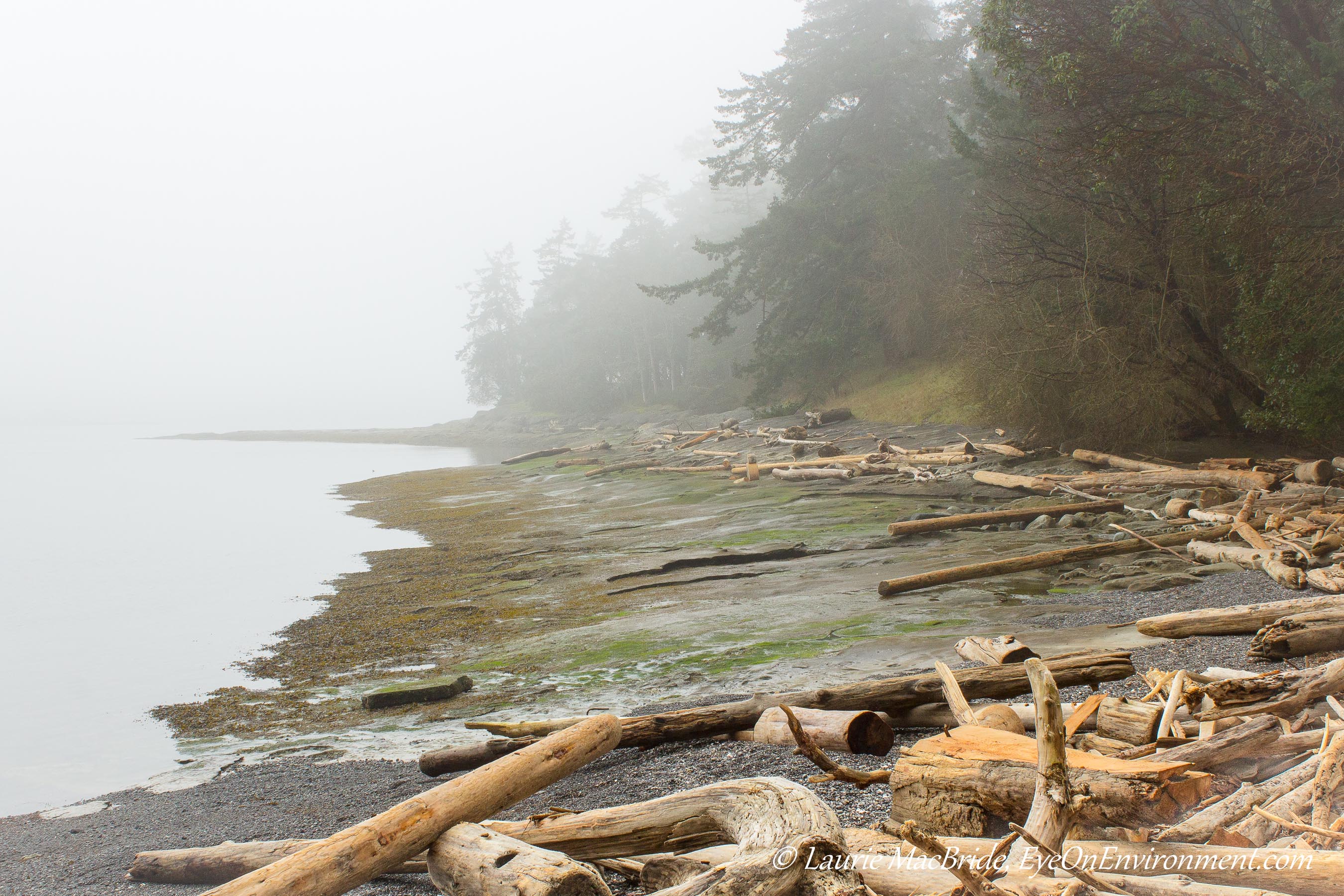
“Adrift” in the Fog

Beach with fog and drift logs.

Fog over Drumbeg (click to enlarge)

Here on Gabriola Island, we’ve been deep in fog for much of the past week – weather which can dramatically shift my sense of solid ground. When all landmarks beyond those immediately in front of me disappear, along with the horizon, it can feel like being aboard a ship on the open sea.

Fortunately, I welcome the fog – so long as I’m on dry land rather than in an actual boat, where fog can make for major stress (see here and here for examples). This week’s weather has been perfect for photography: bright, diffused light that allows for fast enough shutter speeds to leave the tripod at home, with none of the glare that sunny days bring.

Here’s a collection of images from my walk at Drumbeg Park the other day. Click on the first image to begin the series and bring up the full captions. (Note: if you’re reading this blog from your email, the slideshow format won’t work – I suggest you click on the link to my post to open the webpage in your browser instead, then click on the first image. Voila – it will work properly!)  

A reminder: no matter what the weather, if you’re on Gabriola Island I hope you’ll drop by to see my new photography show, “Afloat in the Salish Sea: Images of Gabriola”. It’s downstairs at the Community Health Centre (691 Church St.), open Mondays through Fridays, 8:30 am to noon. Final day to see it will be April 2.

Emerging from the Decay

Yellow crocuses

Heralding Spring (click to enlarge)

I love crocuses. They pop up all over the garden every February, bright and cheerful no matter what the weather might be doing.

Our yellow crocuses come first, followed a week or two later by their paler, but no less beautiful purple cousins. Both serve as a reminder that spring is just around the corner, helping to bring a smile and a lighter step after the wet, dreary months of winter.

Purple and orange crocuses

Springing Up (click to enlarge)

Crocuses are reliable and utterly undemanding. I’ve been way too busy lately to do any cleanup or weeding, but nevertheless, these beautiful little flowers have emerged from the decay of last year’s garden, right on schedule. I won’t have to weed, deadhead, stake or prune them, and even if I never get around to sprinkling any compost or bone meal over them (which I’m sure I won’t), these hardy little delights will return again next year.

Now if only all the other plants in our garden would be so cooperative, I’d have it made.

A reminder: if you’re on Gabriola Island over the next month, I hope you’ll drop in to see my new photography show, “Afloat in the Salish Sea”. It’s at the Gabriola Community Health Centre (691 Church St.), open Mondays through Fridays, 8:30 am to noon, until March 30. 

Afloat in the Salish Sea

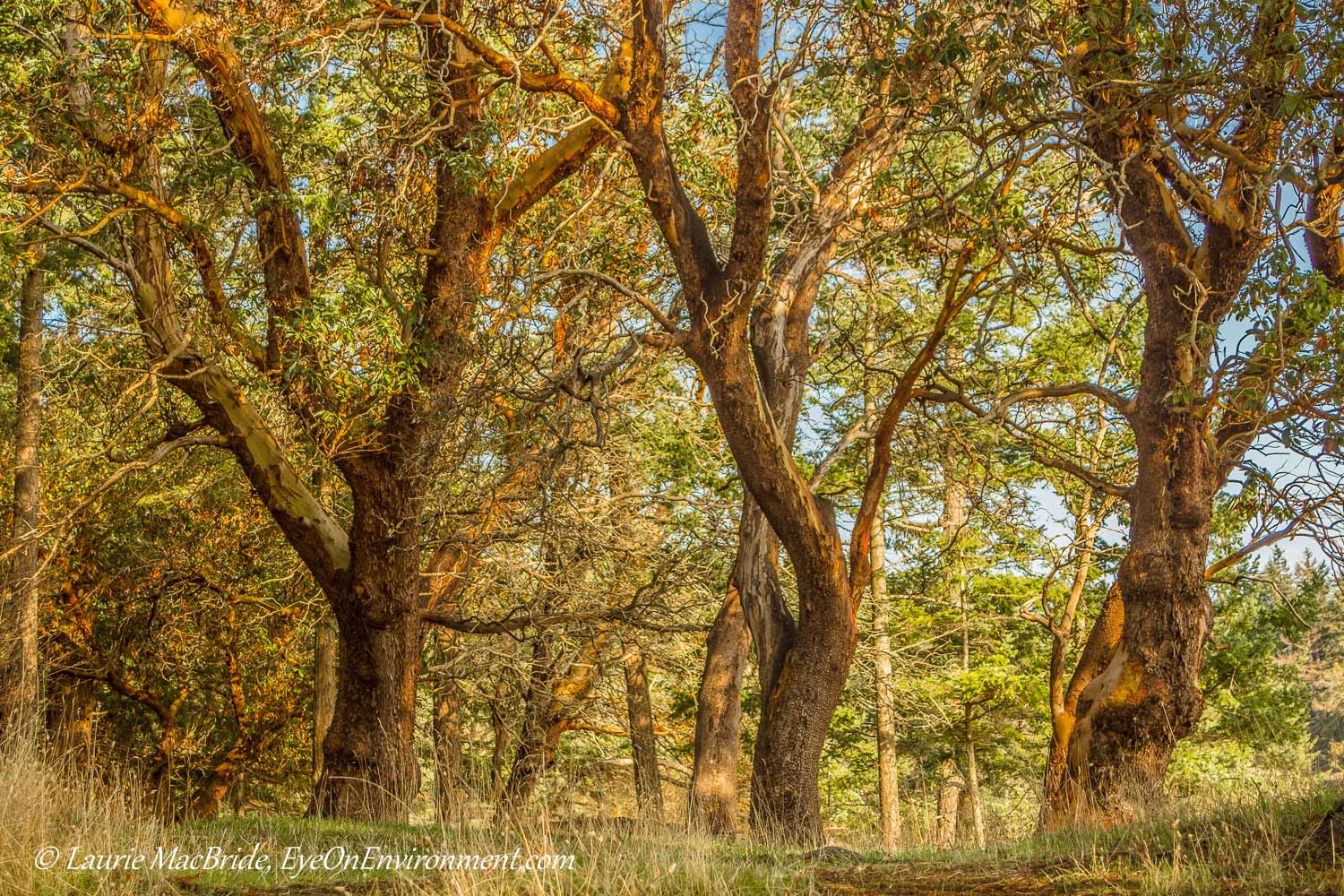
Arbutus grove

The Dancers (Drumbeg Park) – click to enlarge

Just over 30 years ago I moved from Vancouver Island, to put down new roots on the much smaller island of Gabriola.

A west-coaster from birth and an islander all my life, I continue to love this little jewel of a place, afloat in the Salish Sea. And on an almost daily basis, I continue to find photographic inspiration here – which is why I’m focusing my new show (opening Feb. 16) on images of Gabriola. “The Dancers”, shown above, is one of five photos of Gabriola’s Drumbeg Park in the show (which has over two dozen mounted prints in all).

Known affectionately to old-timers as “The Rock”, Gabriola is only 57 km² (22 miles²). But though it’s small, it offers plenty of opportunities for appreciating the natural wonders that are all around us: our fellow creatures and the plants, forests, wetlands, meadows and shorelines of this island home.

We’re the northernmost of BC’s Gulf Islands, just a short ferry ride from the city of Nanaimo, over on “The Big Island”. This means we’re lucky enough to have the best of both worlds: the faster pace of city life when we want it (though I seldom do), and the rest of the time, the relatively unspoiled environment and serenity of island life – a place to breathe deeply, remember our place in nature, and enjoy the photographic opportunities on offer.

My new show is entitled “Afloat in the Salish Sea: Images of Gabriola”. It opens Feb. 16 and runs until March 30, at the Gabriola Health Centre, 691 Church St. (downstairs).  If you’re on the island I hope you’ll stop by to see it – open Mon. to Fri., 8:30 am to noon.

Beauty on a Dark Day

large orange jellyfish

Lion’s Mane medusa  (AKA Sea blubber or Sea nettle) – click to enlarge

Cruising on the remote, outer Central Coast of BC, we had anchored in a cove on Stryker Island. It was an utterly gray day with an almost steady rain, so I declined the invitation to go paddling. Taking some “alone time” in the relatively dry confines of our boat seemed the better option.

When the rain finally stopped for a few minutes, I ventured out to the foredeck with my camera, in case anything interesting could be found among the copious bits of seaweed, wood and other debris that were floating by in the current. To my delight, a large orange jellyfish (above) was undulating towards the boat.

Despite the technical deficiencies of this photo, I like it, for two reasons. First, it was taken in the wild, with only the available light of a dreary afternoon. By contrast, most jellyfish photos that you can find online seem to have been taken in aquariums, with good light and shooting conditions.

The second reason is that I’ve tried unsuccessfully over the years to photograph jellyfish from kayaks and dinghies. It never works for me. Either the jellyfish floats away right at the crucial moment, or the current pushes my vessel off course when I let go of the paddle to pick up my camera, or I paddle hard to get properly situated, creating too much turbulence for a clear shot. But on that dreary day at Stryker Island, I was finally able to manage a reasonably clear jellyfish shot. No wonder I like the photo!

The Lion’s Mane medusa, AKA Sea blubber or Sea nettle (Cyanea capillata), is the world’s largest jellyfish. It’s commonly found along the northwest Pacific coast in the warmer months of spring, summer and fall. In our area they’re usually about 50 cm (20 inches) in diameter, with trailing, 2 metre long tentacles – but in high latitudes they can grow to a staggering 6.6 ft (2 m) across, with 9 metre long tentacles!

Juvenile haddock and other small fish swim among the tentacles to take shelter from predators, but for the rest of us, a safe distance is advised. These jellyfish pack a painful sting, so you won’t want to go swimming when they’re around, or touch one that has washed up on the beach. Look and admire these oddly beautiful, pulsating orange creatures – but best not to touch.

Rolling Out the Hot New Wheels

Man riding enclosed tricycle

First ride in the new ELF  (click to enlarge)

Here on Gabriola Island these days, my father-in-law, Ted, is turning heads, attracting crowds and prompting smiles every time he goes out.

It’s not just because he’s well-liked on the island – though he definitely is. The buzz is because of his hot new wheels: an electric-assist ELF tricycle, which arrived on a foggy morning in early January.

This is not your ordinary pedal trike. Aside from its smooth, continuously variable transmission and its comfortable ride, it has the added bonus of an electric motor to help get up slopes, powered by a battery that’s recharged by the the ELF’s solar panel or by plugging in to household power. It also has brake lights, turn signals and other safety features, a locking trunk that can carry 150 or more pounds of cargo, plus a pod-like body to keep off the rain while you pedal or cruise along. Tiny, practical AND deluxe all in one!

Ted, who is 94, has been an active cyclist for a long time, pedaling a recumbent trike to get around ever since he retired his car and driver’s license some years ago. He’s still very fit and capable, but nowadays a bit of occasional electric assist is welcome – thus the upgrade to the ELF.

He’s pleased to see how well people are responding, and hopes the ELF will encourage others to consider climate-friendly transportation alternatives. He knows how urgently the planet needs a green revolution, so he’s happy to roll out his new electric wheels for the cause. Aside from that, he has to admit that the ELF is a whole lot of fun.

A couple more photos (click to enlarge):

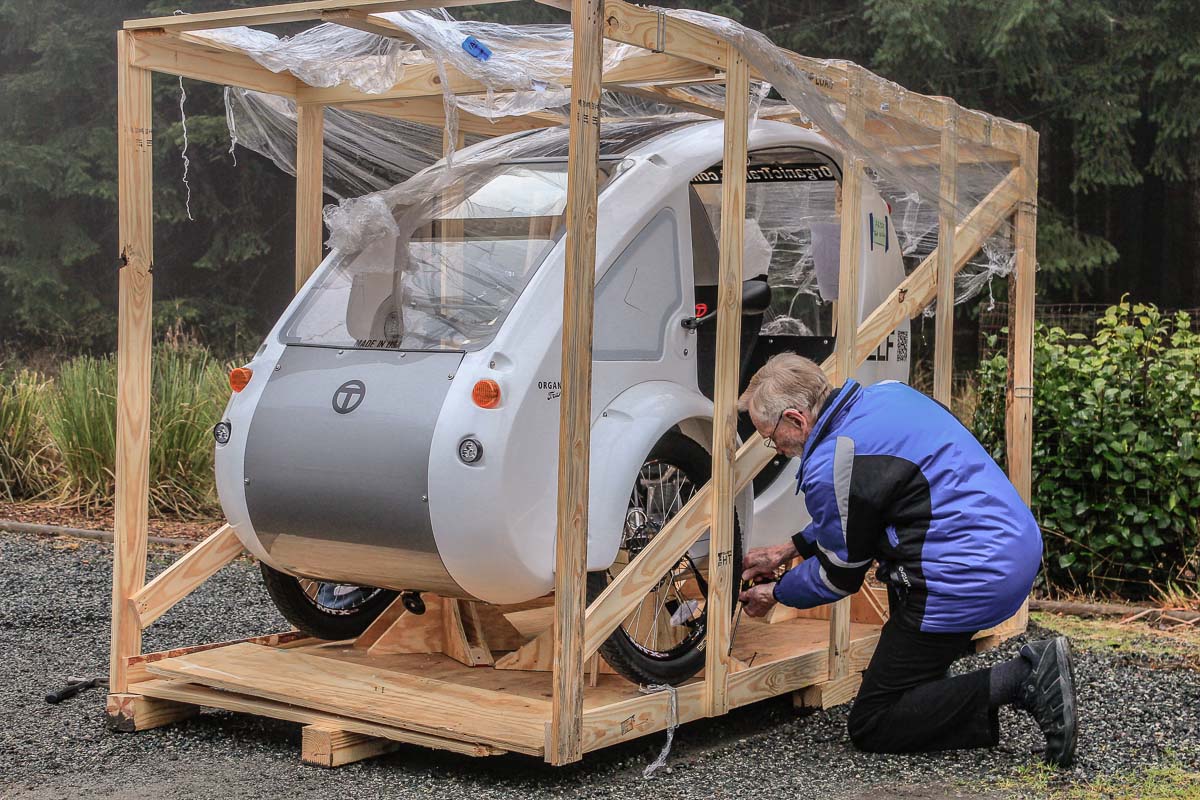
Unpacking ELF from its shipping crate

Removing the ELF from its crate after its arrival from North Carolina

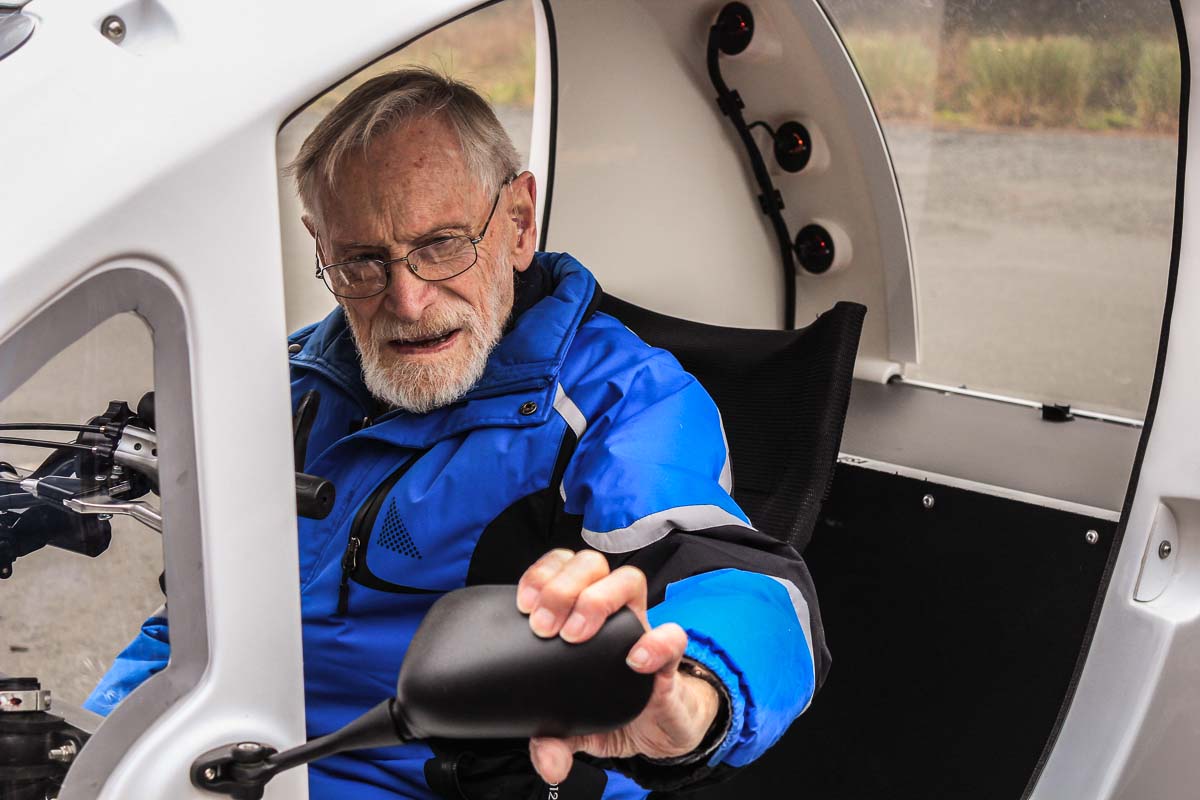
Man adjusting side mirror

Adjusting one of the side mirrors

Welcoming Back the Light

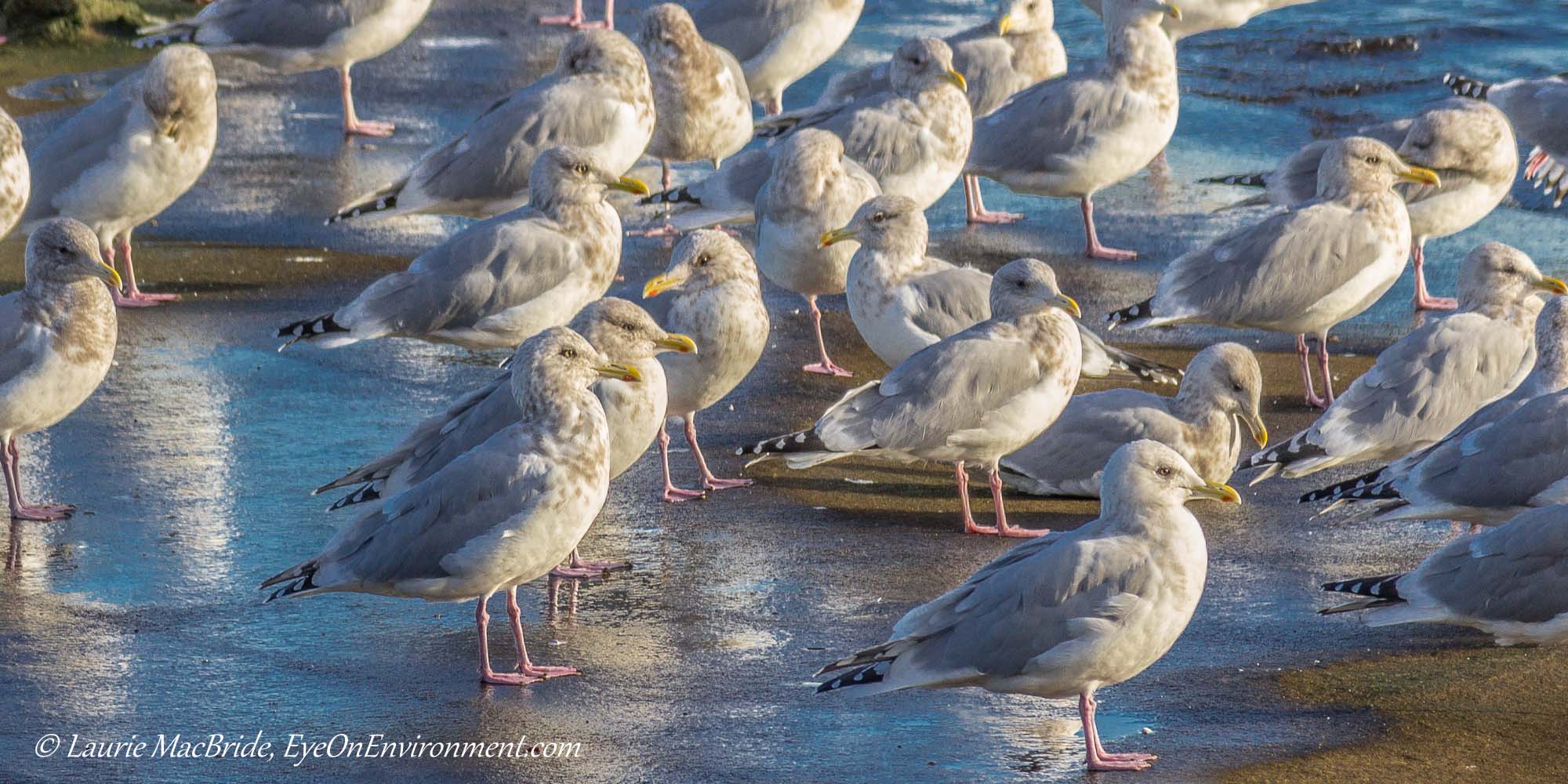
Seagulls on a sandstone beach

Loving that Light  (click to enlarge)

We all crave a bit of extra light at this time of year, especially those of us who live under the often-grey skies of BC’s wet coast. I spotted the seagulls in the photo above, enjoying some winter afternoon sunshine on the sandstone shore of Drumbeg Park on Gabriola Island – and by their relaxed looks I think they were appreciating it every bit as much as I was. (Click on the photo to enlarge it, and you’ll see that they really do seem to be smiling!)

It will likely be another month before we notice the difference, but the days have finally started to grow longer rather than shorter here in the northern hemisphere. I expect the little bit of additional light each day is as much a relief for gulls and other wild critters as it is for humans.

To all of my blog readers, a big thank you for your visits to my blog and your comments, which I always welcome and appreciate. Here’s wishing you a peaceful, healthy and happy holiday season, wherever you are and however you might – or might not – celebrate such occasions. And if you live in the northern hemisphere, may you thoroughly enjoy the return of the light.

Finding Fascination in Confusion

Partly frozen pond with grass blades

Pond Transformations (click to enlarge, then click again to see more details)

This photo of our partly frozen pond is never going to win any awards. It’s visually chaotic, with lines running every which way, a jumble of geometric shapes, and no clear focal point. Not to mention, my shivering hands were probably shaking when I pressed the shutter.

Nevertheless, I can’t resist looking at it. I zoom in on the details, drawn one moment by the network of slow, meandering ridges of slush, and the next by the straight, decisive tracks made by the floating sticks and twigs.

Maybe it’s the dense colour of the pond grasses that I like, and the boldness with which they rise from the water. Or perhaps it’s the quieter details, like the little concentric circles of water around the stems and tips of each blade, and the way the grasses collectively create a miniature lake of calm – empty of ice but full of reflections.

Like most photographers, I usually prefer a simple composition and a clear sense of order in my images. By contrast, this one is a jumble of light, shadows, grass, water, ice, algae and miscellaneous floating bits of debris: the complex reality of a winter afternoon in our little pond.

It seems that nature is often untidy, and every now and then I feel like simply embracing the chaos. It may not make for a “winning” photograph, but still, I can find fascination, and sometimes even beauty, in the confusion.

Transformed by the Tide

Two islets in the Southgate Group

Southgate Sentinels (click to enlarge)

The Southgate Group lies close to the BC mainland, at about the spot where the wide open and treacherous waters of Queen Charlotte Sound meet the only-slightly less exposed waters of Queen Charlotte Strait. With huge waves often pounding in from the Pacific Ocean, these islands provide a bit of welcome protection for boaters along this stretch of coast.

On a cloudy, calm summer morning, we kayaked from our nearby anchorage to the Southgate’s furthest edges, to explore its outer reefs. As you can likely tell from the photo, it was low tide, and there was just enough room to squeeze our little boats between the steep walls of the islands.

Now, imagine the tide rising by 16 or 18 feet, as it does in that part of the coast. Visualize the water rising all the way up to the lowest branches of the trees, and you’ll realize how different these islands are at high tide. Each one is reduced to an isolated little chunk of rock, with a towering topknot of vegetation that looks bigger than the islet itself – while the outer reefs vanish entirely. It can be hard to believe you’re in the same place, from one stage of the tide to another.


About the name:

I had thought that maybe the Southgate Group was named for its location. After all, the islands seem like natural gatekeepers, lying just south of the narrow channel that leads to Nakwakto Rapids, the entrance to the massive inner waterways of Seymour Inlet, Belize Inlet and eventually, Alison Sound. But it turns out that like so many places on the BC coast, the islands were named for a British mariner – in this case, James Johnson Southgate. 

Southgate arrived in Victoria in 1858 and became a prominent merchant and elected representative in what was then the government of Vancouver Island (a separate colony until 1866, when it joined British Columbia). The Southgate Group was named in his honour by Royal Navy Lt. Daniel Pender, who carried out hydrographic surveys along the BC coast in the famous paddle steamship, the Beaver.

Pender and his ship were also immortalized in geographic names. At least 10 places along our coast were named for Pender, and many others have “Beaver” in their name – not surprising, since during the 53 years that the Beaver operated (first as a trading ship, then as a survey vessel, and finally as a towboat and freighter), the plucky little ship seems to have travelled virtually the entire coast, as far north as Alaska.