Clash of Cultures
Were they a form of news reporting? A historical record? Public art for creativity’s sake? What stories are behind the fading images found along the sheer granite walls of Alison Sound and Belize Inlet?
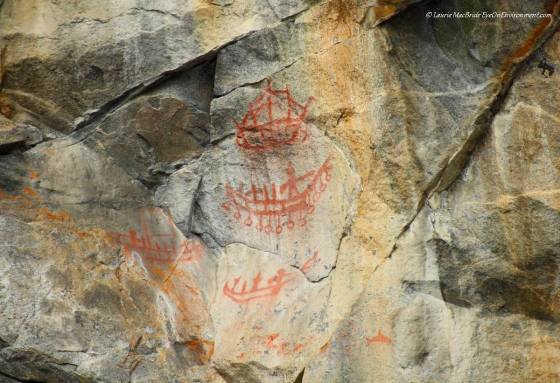
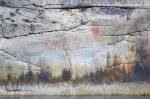
Numerous pictographs, painted with red ochre on mostly south-facing white rock, can be found along these spectacular inland waterways. The photo above shows the best known and most well preserved pictograph, in Belize Inlet, just outside the entrance to Alison.
It appears to depict a killer whale or dolphin in the foreground (perhaps several, but time has degraded the image somewhat), a square-rigged schooner in the distance, and between them, three other vessels. One of these looks like a longboat with a dozen oarsmen; the second seems to have a square sail; the means of propulsion of the third isn’t clear. All three seem to have one thing in common: a crew member shooting a musket. (You can click on the photo above to enlarge it.)
It’s hard to find information on this pictograph, but I’ve read that Provincial archaeologists believe it immortalizes the British Navy’s shelling of the Nak’waxda’xw (Nakwaktok) settlement at Village Cove in 1869, in which many villagers were killed. That sorry chapter of our history apparently began in 1868 with the rape of a Nak’waxda’xw woman by a Hudsons Bay trading company employee, provoking a retaliatory attack by the Nak’waxda’xw on the trading vessel Thornton. In response, our government of the day (Britain) sent a warship.
This tragic chain of events must have held considerable importance in Nak’waxda’xw history. Some writers have speculated that it may have been why they moved from the Village Cove area to the remote reaches of Alison Sound, where they lived until relocating to Blunden Harbour in the late 19th century.
Another well preserved pictograph, further up Alison Sound, appears to illustrate seven native canoes, and is believed to commemorate the Nak’waxda’xw attack on the Thornton. But no one’s really sure, and it’s very difficult to find definitive information about any of these pictographs.
One thing is for certain: with their long, narrow stretches of vertical granite walls, these waterways make an awesome gallery for the images, whatever they might signify.
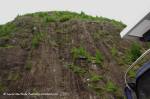
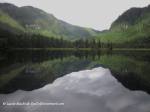
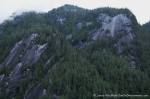
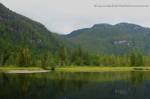
More from Alison Sound & Belize Inlet – click on any thumbnail to enlarge & launch gallery view:
-
-
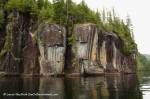
Cliff with pictograph (Alison Sound)
-
-
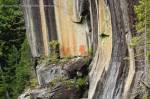
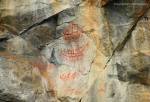
Fading pictograph in Alison Sound: what might the image have been?
-
-
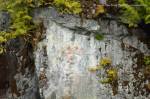
Pictograph near Village Cove
-
-
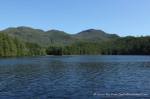
Village Cove today: no sign of the old settlement
-
-
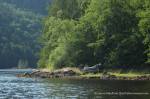
Village Cove: at peace today
-
-
-
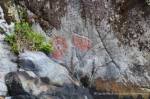
Figure on right looks like a canoe, but what could the Happyface-like image be?
-
-
Old pictograph or more recent painting? Either way, I love the textures and colours of the rock wall.
If you enjoyed this post you might also like:








 Eye on Environment