Fogust: Love It or Loathe It

foggy shoreline

Skull Cove, morning

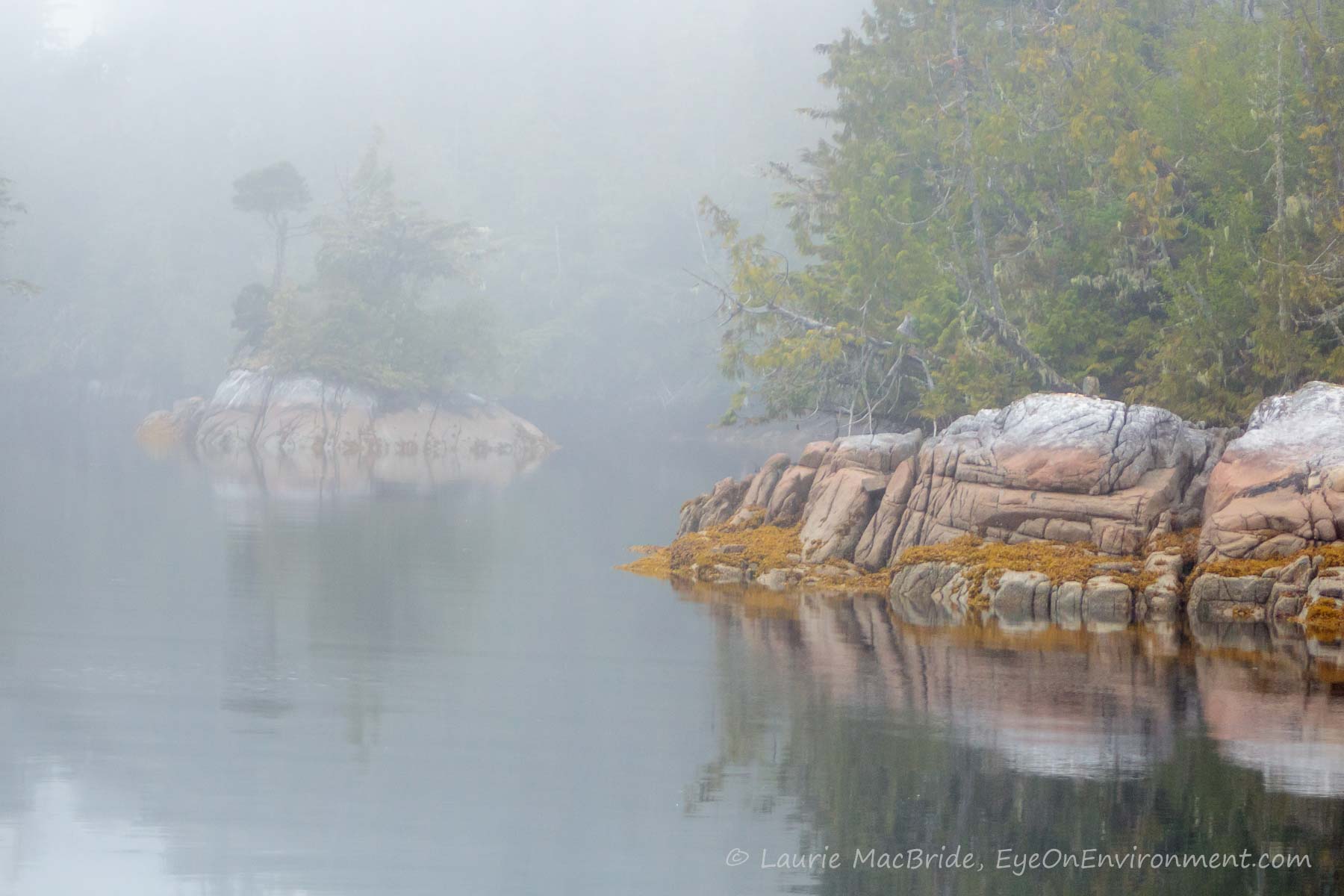
Along parts of the British Columbia coast, boaters refer to August as “Fogust”, for good reason. As warm, moist air moves over the colder sea surface, fog forms overnight, and often doesn’t dissipate until the next afternoon. It can make for some tricky traveling.

I was thankful for our radar, GPS and chart plotter this summer, as they enabled us to travel in relative safety on foggy mornings in Queen Charlotte Strait (unlike the old days when we’d be stuck in our anchorage until the fog lifted).

But even with the aid of such electronic gadgets, fog requires you to stay on high alert, especially when you’re traveling in unfamiliar waters or areas frequented by cruise ships, tugboats with barges or log tows and other large vessels. It’s an understatement to say that it’s challenging to steer a straight course – not to mention disorienting – when you have absolutely no visible landmarks or even a horizon for reference. It’s definitely not a relaxing way to cruise!

Nevertheless, there’s something profoundly beautiful about the fog, with its ethereal light and mysterious hints of hidden shorelines. As a cruising boater, I loathe fog – but as a photographer, I love it. Such are life’s dualities.

We’re off the grid for most of the summer, with only occasional access to the internet. I welcome your comments, but it might be September before I can reply.

If you enjoyed this post you might also like:

Sunflowers of the Sea

Sunflower Star (Pycnopodia helianthoides)

Sunflower Star

Looking down from our kayaks as we drift along in the shallows, we almost always see plenty of interesting sea life. Even the “common” critters can be pretty amazing – like the Sunflower Star, for instance.

These colourful animals are BIG, at least in starfish terms: in the nutrient-rich waters here in the Pacific Northwest, they can grow up to 40 inches in diameter.

For a starfish, they’re also fast, travelling along the sea floor at up to four feet a minute. Maybe this gives them a useful edge as a predator (they eat clams, crabs, sea cucumbers, sand dollars and other species, as well as dead fish). Or maybe they need the speed to escape from the King Crabs that prey on them!

When I was young I used to call them “19-legged starfish”, convinced that they always had that precise number of appendages. But in reality, Sunflower Stars begin with five or six arms, and grow anywhere from 15 to 24 arms as they mature. (The one in the photo above appears to have 17.)

Their scientific name is Pycnopodia helianthoides (“dense-footed sunflower”). The “feet”, located on their underside, are actually thousands of tubular suckers, and if you’ve ever pulled a Sunflower Star up with your crab trap, you’ll know how just effective those “feet” can be. It’s hard work hauling all that weight up to the surface, but it can be even more difficult to convince this critter to let go!

We’re off the grid for most of the summer, with only occasional access to the internet. I’ve scheduled some new posts to appear during that time and welcome, as always, your comments – but it might be awhile before I can reply.

A Meeting of Paddlers

Three Canada Geese

Taking a Gander

Sometimes I think we humans can be every bit as interesting to wildlife as they are to us. Propelled by the powerful strokes of their broad feet, these Canada Geese paddled over to have a close look when we were passing by their rocky promontory.

They didn’t seem the least bit agitated or concerned, only curious. Perhaps they were looking for a handout, or maybe they were drawn by our brightly coloured kayaks. Whatever the attraction, I can’t help but wonder if they might have seen us as their fellow paddlers.

We’re off the grid for most of the summer, with only occasional access to the internet. I welcome your comments – but it might be awhile before I can reply.

If you liked this post you might also enjoy:

Cameleon Skies

Paddling in Cameleon Harbour

Between the Showers (Cameleon Harbour)

Sometimes, after weighing your options and finding that none of them are perfect, you just have to seize the moment and “go for it” – that is, if you’re to have any hope of reaching your day’s goal.

Cameleon Harbour on Sonora Island is a lovely anchorage and a good place to paddle, even if the next rain shower might arrive at any moment – which, of course, it did. No matter: that’s what raingear is for, right?

We’re off the grid for most of the summer, with only occasional access to the internet. I welcome your comments, but it might be awhile before I can reply.

If you enjoyed this post you might also like:

Mudflat Riches

Sandpiper feeding on the beach

Mudflat Banquet

I love watching sandpipers on the beach, though they move so fast it’s hard to keep up with them: they rush along on their tiny legs, come to an abrupt stop, dip their beaks down for a moment, then rush on to the next spot, usually just a few feet away.

The sandpiper in the photo above was part of a flock we encountered in Potts Lagoon on West Cracroft Island. Unlike the sandpipers that I wrote about last year, who were relaxing in the sun at Blunden Harbour, the ones at Potts were hard at work, taking advantage of the low tide to gather their dinner.

While it might just look like sand to us, low tide provides a veritable banquet for hungry sandpipers, who feed on micro-organisms that live in the surface film of the mud. If the activity level of these birds is any indication, those tiny morsels must pack a powerful punch of nutrition – or maybe they’re just incredibly tasty!

We’re off the grid for most of the summer, with only occasional access to the internet. I welcome, as always, your comments – but it might be awhile before I can reply.

If you enjoyed this post you might also like:

Blue on Blue

Blue layers of landscape

Coastal Blues

For most of the year, we live surrounded by the greens and browns that dominate the forest around our Gulf Islands home.

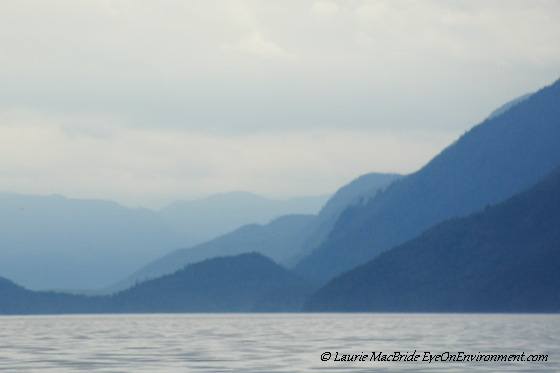
But in the summer, when we’re travelling up the BC coast on our boat, blue takes over. Water, waves, surface currents, tidelines, distant shorelines, mountain ranges and sky: together they form a multi-hued blue landscape, stretching out ahead and rolling out behind like a long, delicate tapestry.

Blue on blue on blue: it’s a look I love. The variations are subtle, but having spent a lifetime boating on this coast, I find these layered landscapes beautiful and deeply comforting.

Perhaps it’s why I’ve always thought of blue as my favorite colour.

We’re off the grid for most of the summer, with only occasional access to the internet. I’ve scheduled some new posts to appear during that time and welcome, as always, your comments – but it might be awhile before I can reply.

Regaining our Sea Legs

Red morning sky, Quadra Island

Morning Caution (Small Inlet)

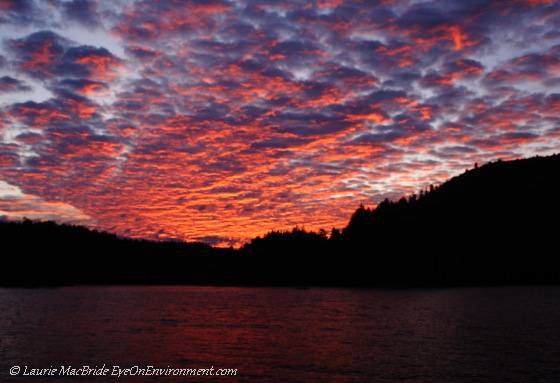
“Red sky at night, sailor’s delight – red in the morning, sailor take warning!”

After months of preparation, we’ve cast off the lines, heading north to cruise the BC coast. Our sealegs and boating brains are rusty from months on land, but we’ve begun our annual process of shifting from terrestrial beings to mariners.

There’s a lot to think about when you’re going off boating, especially if you’re heading to remote places. Paying close attention to the weather signs is just one of the many ways you need to stay vigilant.

Perhaps you find yourself in a beautiful cove, looking forward to a quiet night at anchor. But first you must assess what wind is expected and calculate the depth at both the highest and lowest tides, so that you can decide how much line to put out. You need to double-check the chart to ensure there are no hazards lurking under the surface anywhere within your swinging radius, and you need ensure sure that your boat isn’t going to be within the swinging radius of any other anchored boat.

Before setting off the next day you must assess the weather again. You must calculate the distance and time to your next destination, taking into consideration how current might affect you. While studying the charts, it’s wise to identify some spots en route that could offer refuge in case you have to duck in unexpectedly – if, for example, the wind or seas should rise suddenly.  You have to stow anything loose, make sure your charts, binoculars and safety gear are close at hand, and do the engine checks (fuel, oil, coolant etc.). Only then can you start the engine and raise the anchor.

Our constant companions include the tide and current tables, the VHF radio (we listen to Environment Canada’s continuous marine weather broadcast several times each day), charts (both electronic and paper) for every part of our route, and the depth sounder. We consider all of these, along with many other pieces of equipment and gear, so important that we carry two of each – three in some cases. We figure redundancy is a good thing when we’re travelling alone in remote areas.

Within a day or two of leaving home, we’ve regained our sealegs and left our terrestrial concerns behind. The house and garden are in the capable hands of our housesitters; we have no appointments or meetings until September.

Now our focus is on what will matter most over the coming weeks: determining our route and studying the charts for reefs, rocks and other hazards along the way; making sure we reach each tidal pass at the right moment to safely transit; assessing the wind, waves and likelihood of fog; keeping a lookout for cruise ships, tugs and other vessels; planning where to get our next fill-up of fuel and fresh water; and re-aquainting ourselves with the seals, whales, herons, auklets, urchins and all those other wonderful creatures we’ve not seen for awhile. It’s time to enter their world again.

We’re off the grid for most of the summer, with only occasional access to the internet. I’ve scheduled some new posts to appear during that time and welcome, as always, your comments – but it might be awhile before I can reply.

If you enjoyed this post you might also like:
An Enduring Gift

Foxglove (Digitalis purpurea)

Fairy Thimbles (Foxglove)

Perhaps as a result of the cool, cloudy spring we experienced, our foxgloves have reached for the sky this year – some are well over seven feet tall! Every time I look out the bathroom window, which overlooks their woodland corner, I feel transported to Tolkien’s Middle-earth: it’s as if Elrond and Legolas might emerge from the forest at any moment.

The foxgloves are the enduring result of a gift my father-in-law brought me many years ago: an envelope of seeds he had gathered from wild foxgloves near his home. I’ve been growing them ever since, gathering the germ of a new generation every second fall when seeds form on these bienniel plants (Digitalis purpurea), then starting a new round of seedlings when winter’s end is near.

Foxglove has had some interesting monikers over the centuries. Some reflect their poisonous nature: Witches’ Gloves, Dead Men’s Bells, Dead Men’s Thimbles, Bloody Fingers. Others are gentler: Lady’s Gloves, Fairy Caps, Fairy Thimbles and Folk’s Glove (which gave rise to its modern name).

Whatever you call them, I can’t help but love these magnificent plants and the Tolkienesque tableau they create in our forest garden.

Foxgloves (Digitalis Purpurea)

Foxglove Tableau

If you enjoyed this post you might also like: