Leaps and Lullabies

Pacific tree frog on a rhubarb leaf

Pacific Chorus frog on a rhubarb leaf

I’ve been rushing about, leaping from one task to another. April has kept me hopping, between preparing prints and hanging them for my show which opens this week, planting seeds and transplanting my veggies starts to the garden, doing our income tax returns, and a long list of other “must-do’s”.

Fortunately, after each busy day, sleep has come quite easily, thanks to the steady nighttime music provided by the Pacific Chorus frogs (AKA Pacific Tree frogs) who have been hanging out at our pond. For the past six weeks the males’ lusty courting songs have filled our night air – a stimulating sound for the lady frogs, but more like a lullaby for me. (Here’s a link to their calls if you’re curious.)

With April almost over, we’re now in a time of transition. The short pauses between songs are getting longer and the nighttime voices fewer. Soon our yard will be quiet at night – but that won’t mean the frogs have deserted us. They may be leaving the pond, but they’re not going far.

By August we’ll delight in finding tree frogs of all sizes everywhere in our garden, enjoying the warmth of the sunshine or the cool of the “rain” that the sprinkler has delivered. They sometimes land on us when we walk under the apple trees, and we find them inside our compost tea barrel when we lift the lid to water the tomatoes.

Other times, they’ll just be hanging out on a gently swaying leaf, like the fellow in the photo above – enjoying the moment, or perhaps contemplating what the next great leap will bring.
O-So-Berry Busy!

Flowering Indian Plum tree

The Picnic Tree in Bloom – click to enlarge

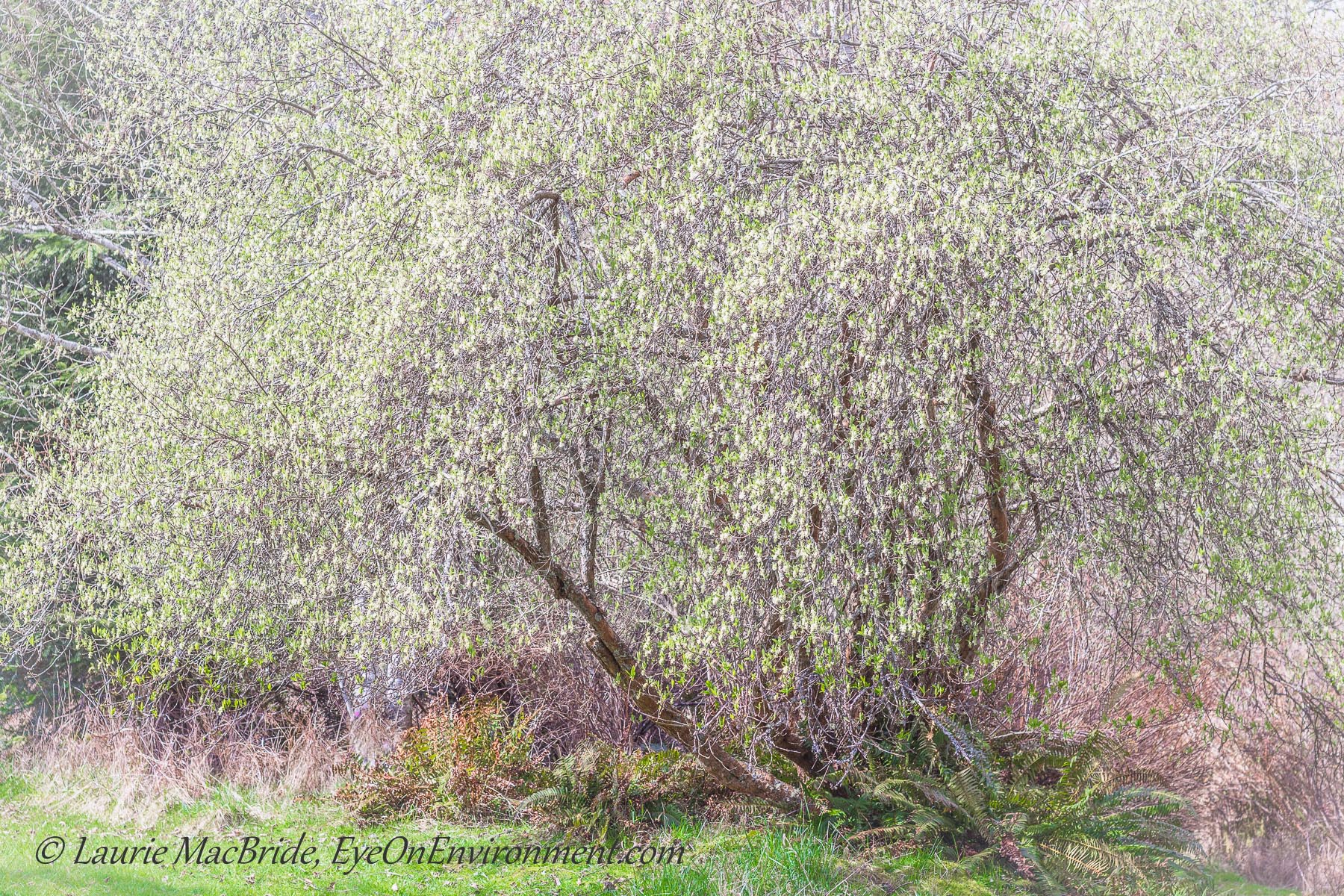
It’s been a long time since my last post, and since then, spring has definitely sprung around our place. The best spot to witness this vibrant season in all its beauty, aroma and fast-paced action has been our “Picnic Tree” – a large, multi-trunked Indian Plum (AKA Osoberry, Oregon Plum or Oemleria cerasiformis).

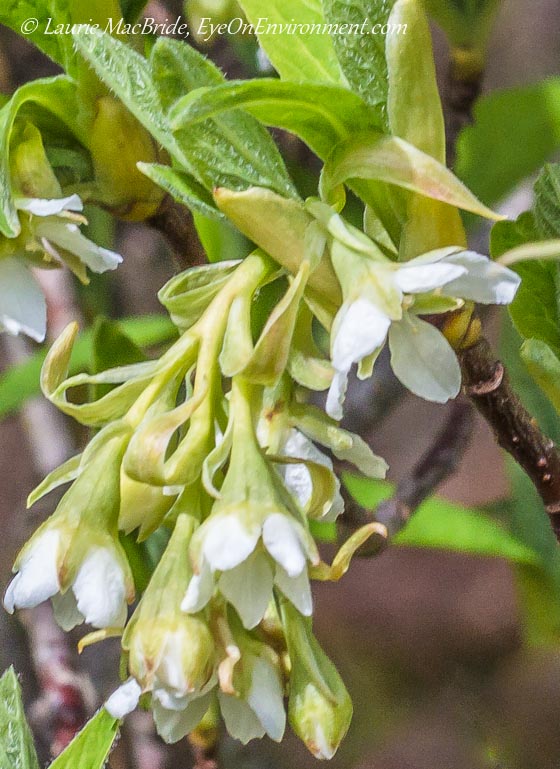
Indian Plum is the first plant to flower here each year, and for the past few weeks it has been in its glory – and busy beyond belief. In the daytime you can stand beneath its white canopy, watching a multitude of bees moving rapidly from one delicate flower to the next, taking advantage of the early pollen. (They’re too quick for me – I’ve given up trying to photograph them.)

Detail of Indian plum flowers

Indian Plum flowers

If you close your eyes and listen, the constant buzzy thrum all around your head makes it easy to imagine you’ve been transported to the centre of a busy beehive.

But the insects aren’t the only active ones around here – I’ve been a busy bee too.

I’m currently preparing 30+ prints for a new solo show, “The Coast Inspires Me”. All are coastal and marine-focused and almost half haven’t been shown before.

They’ll be on display through the summer in a suitably nautical (and delicious) venue: the Silva Bay Restaurant & Pub on Gabriola Island, a long-time favorite of boaters, locals and island visitors alike. It’s set to re-open at the end of this month under the capable new management of Robert Stutzman (proprietor of the popular “Robert’s Place”), and I’m looking forward to some great meals there. I hope you’ll stop by as well over the summer to enjoy the food – and my photos!

Under Hellebore Skirts

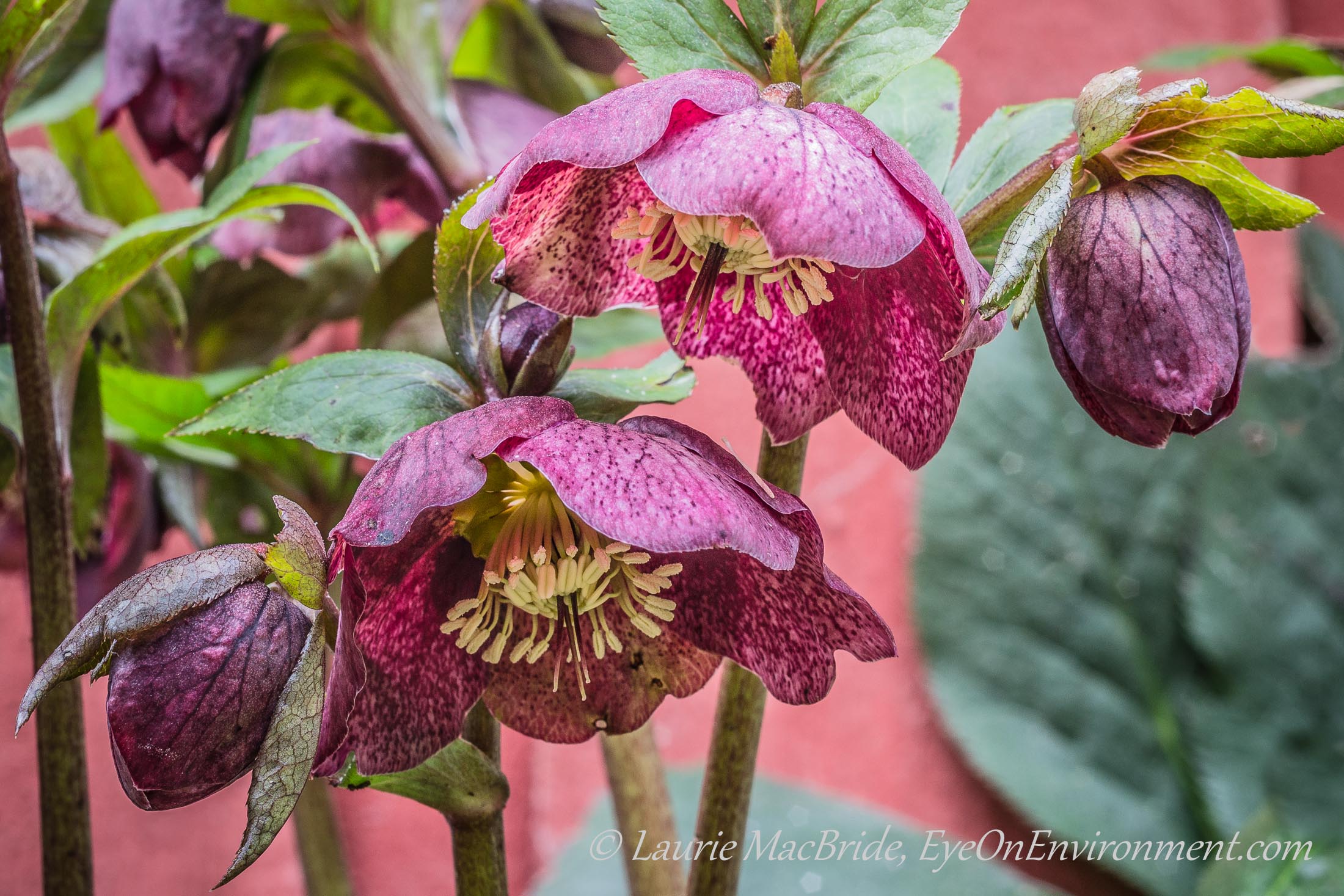
Brightly coloured hellebore (Lenten Rose) flowers
Click to enlarge – or double-click and see all the details.

I have two types of hellebore plants in the border garden beside our house, and I’ve blogged about them once before. But that was in late spring, when their colours were more subdued and their carpels (ovaries) were huge with seed.

This year I caught them much earlier, before the seeds had started to form. When I knelt down on the patio stones and maneuvered my face and camera underneath the flowers of the purple hellebore (not an easy task, believe me), I was in for a surprise. I hadn’t expected the riot of polka dots and leopard-like spots, nor the intense pink and purple hues – colours reminiscent of the Carnaby Street fashions we loved back in the mid-1960s.

Hellebore flowers face down and the plants grow fairly low to the ground, so it’s hard to see what’s going on under those full-skirted petals. Viewed from above, the flowers seem much more subdued than the gaudy floozies that danced above my lens the other day. My knees suffered for the experience, but all the same, I’m glad I took the time for a close inspection. 

While hellebore flowers seen from below
The white hellebore was beautiful too – but much more subdued (click to enlarge).

With Weather Like This…

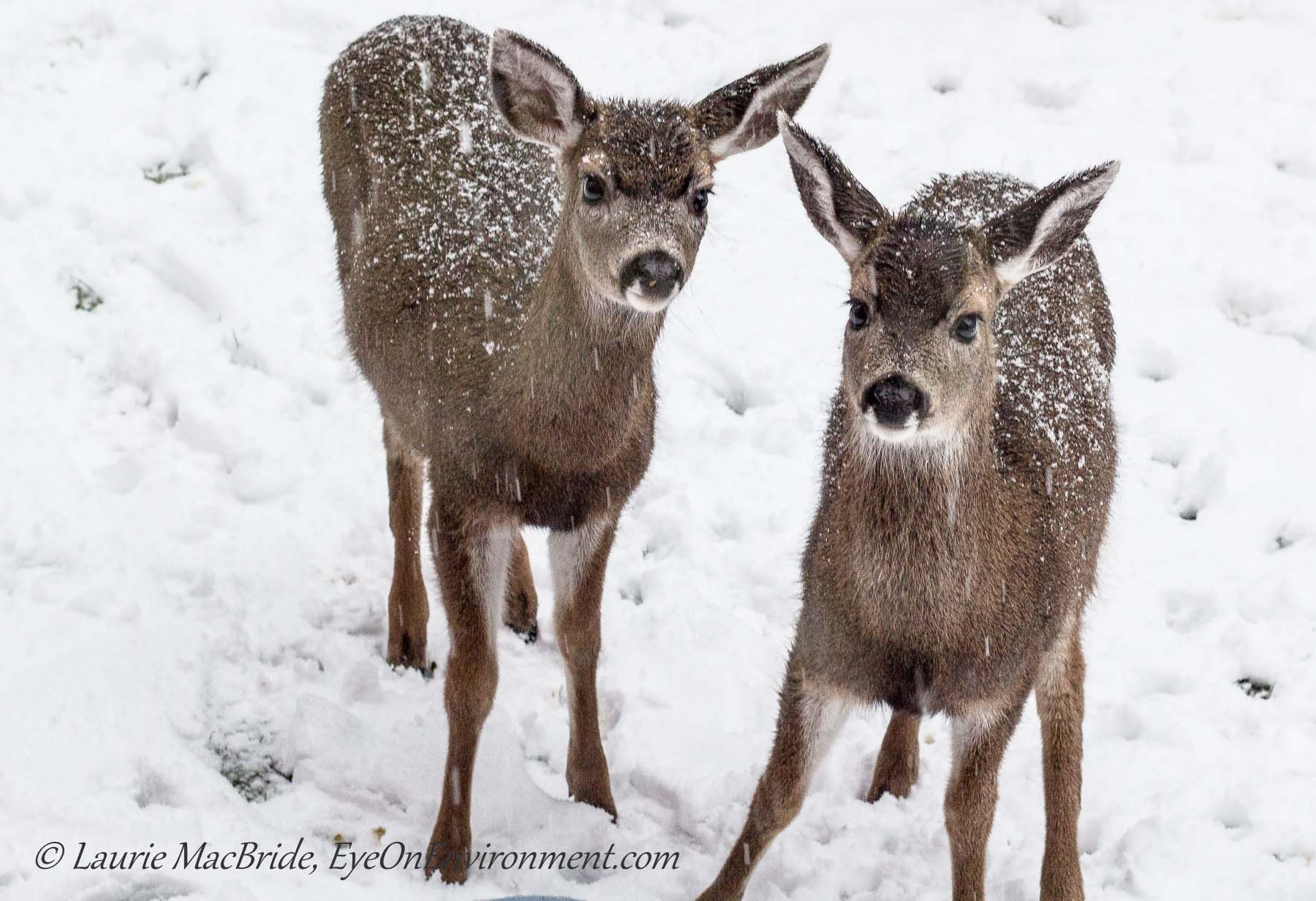
Twin black-tailed deer fawns

The Twinnies: “Brrr…it’s cold out here!” – click to enlarge

Ironically, right after I published my post about the little yellow messengers of spring, we had a huge (by west coast standards) dump of snow, more than a foot in all. That was followed by – no surprise – a multi-day power outage.

Snow is still covering most of our garden and patches of our lawn, though it’s been melting a bit more each day. While the crocuses haven’t yet re-emerged from under their white blanket, I’ve been happy to see our weather heading back to “normal”. But today, to my dismay, it’s been snowing again.

I think “the Twinnies” are also rather dismayed by it all. It’s the first winter for this pair of Columbian black-tailed deer, the youngest of the family of six who make their living on and around our property and visit us daily. (Their diminutive moniker is meant to distinguish them from their older siblings, “the Twins”, who were born a year earlier.)

Fortunately, the Twinnies’ coats look rather cozy; in fact I expect they’re better than my parka has proved for warmth and waterproofing. Nevertheless, I’m sure the pair – like me – will be happy when spring finally arrives.

Little Yellow Messengers

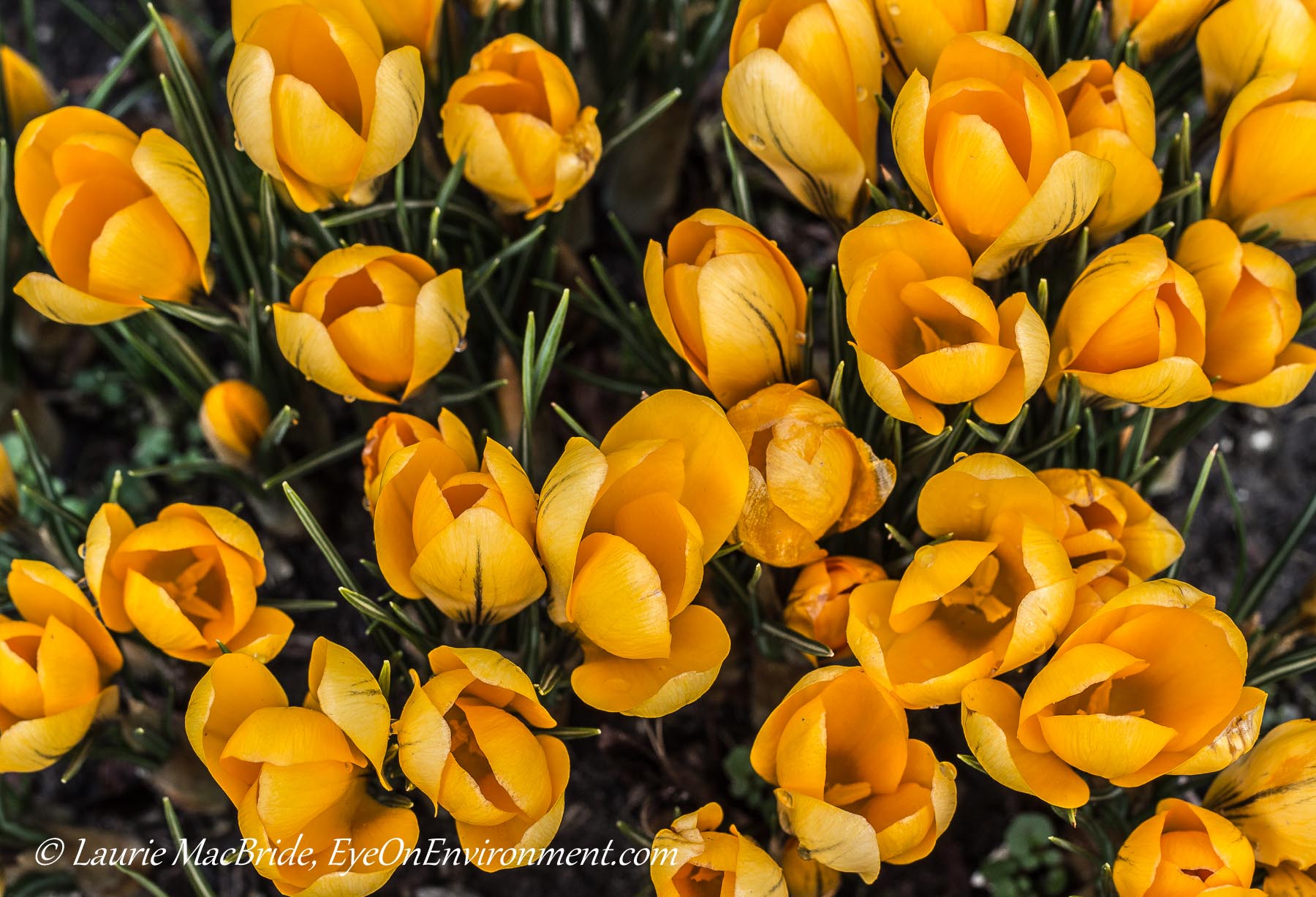
Yellow crocuses

Promise of Spring: crocuses in the winter garden (click to enlarge)

Patches of bright yellow, bearing a promise of spring: exactly what I like to see in my February garden.

Some snow has fallen since I took this photo a couple of days ago, so I know we’re not completely out of the winter woods yet. Nonetheless, as I look at these little crocuses on my computer screen I feel reassured by their cheery, upturned faces. They seem to express an utter joy in being alive, and they tell me that spring is almost here.

They also remind me of the energy that comes to plants and people alike as temperatures warm and the days grow longer. With the start of a new growing season, there’s always a lot to be done, so I’ll soon need to shake off my winter cocoon and get moving again. 

Humming through the Winter

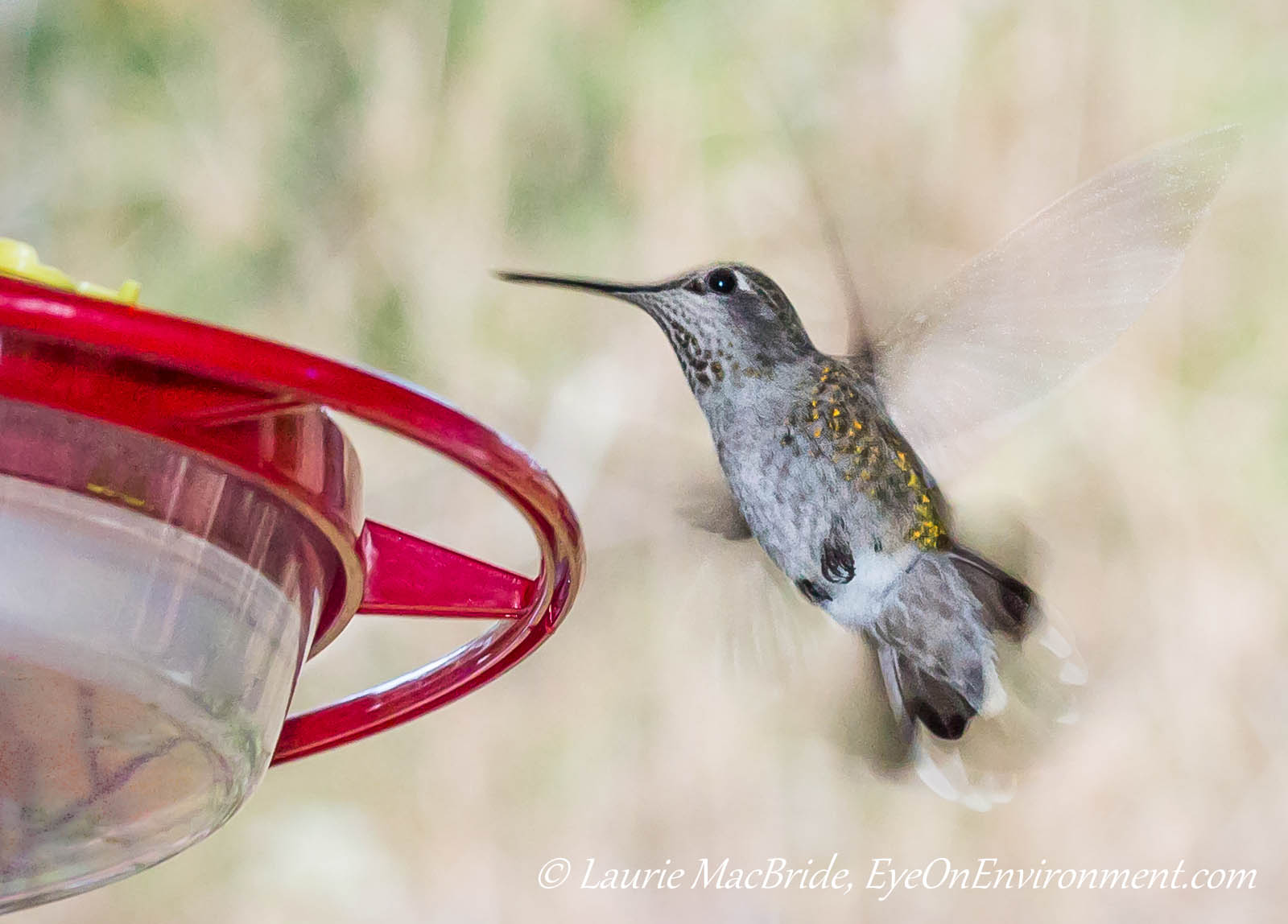
Anna's Hummingbird beside feeder

Flying in for a Meal: Anna’s Hummingbird (click on image to enlarge)

Meet “Hummy”, one of the “charm” of Anna’s Hummingbirds that is lighting up our winter days.

Charm is the recognized collective noun for hummingbirds, but the Cornell Lab of Ornithology suggests a few other terms: a bouquet, a glittering, a shimmer or a hover of hummers. All seem appropriate, as does the Lab’s description of  Anna’s Hummingbirds as “flying jewelry”.

The one in this photo, at the feeder on the north side of our house, is a female. A male often visits the south feeder – likely a youngster, since the red on his head is still a bit patchy. We’ve sometimes seen two hummers at a time at each of the feeders. But they move about very quickly, so trying to get an accurate census is like playing musical chairs at high speed – which is why we’re a bit vague about the exact number within this lovely little charm. We know there are enough to be keeping our two feeding stations busy this winter.

This is only the second year that we’ve been graced with Anna’s Hummingbirds. Their range has been gradually extending northward over the past few decades and now they’re year-round residents in parts of our region.

They seem remarkably calm compared to the Rufous Hummingbirds that are here each summer. Or perhaps it’s just that we’re not used to seeing hummingbirds in winter, before the raucous rites of courtship have begun.

For the past couple of months a female has regularly perched in a bush of ocean spray (Holodiscus discolor), close to the north feeder. When we step outside we hear her short, sharp “chick-chick-chick” calls, and a second bird is often responding. We can join in and engage in what feels like an extended conversation, which is always fun. The females tolerate our presence well, and don’t hesitate to use the feeder even when we’re just a couple of feet away from them. They seem especially mellow when one of us is wearing a bright red raincoat.

About the photo: while this is by no means my best-ever hummingbird image, I’m pleased with it all the same, especially as the odds were stacked against it working at all. I took it handheld with my 50-mm prime lens (not exactly a wildlife lens, but it’s what I had on the camera at the time), at a high ISO because it was late afternoon and the light was low. To make matters even worse, Hummy was backlit, so I needed to use flash – something I would never normally do with an animal, but this calm little bird didn’t seem to mind. 

Perigee Moons and Cluttered Shores

Driftwood piled high on the beach on a windy day

High Tide’s Leavings, Drumbeg Park (click to enlarge)

Thursday will bring a “supermoon”, with the New Moon occurring at the same time as the moon is in Perigee (the closest its orbit comes to the earth). Larger than average tides accompany every New and Full Moon, year-round. But the added Perigee component means that over the next few days, our high tides will be much higher than normal, and the difference between high and low tides will be more extreme.

Along much of the BC coast, these extreme tides will bring many more drift logs onto our shores. Remnants and escapees from BC’s forest industry, the logs are a hazard to boaters when they’re loose in the sea, especially when they’re in the form of “deadheads” – partially sunk, vertical poles that are virtually impossible to spot until you’re almost on top of them. And believe me, you really don’t want to land on one.

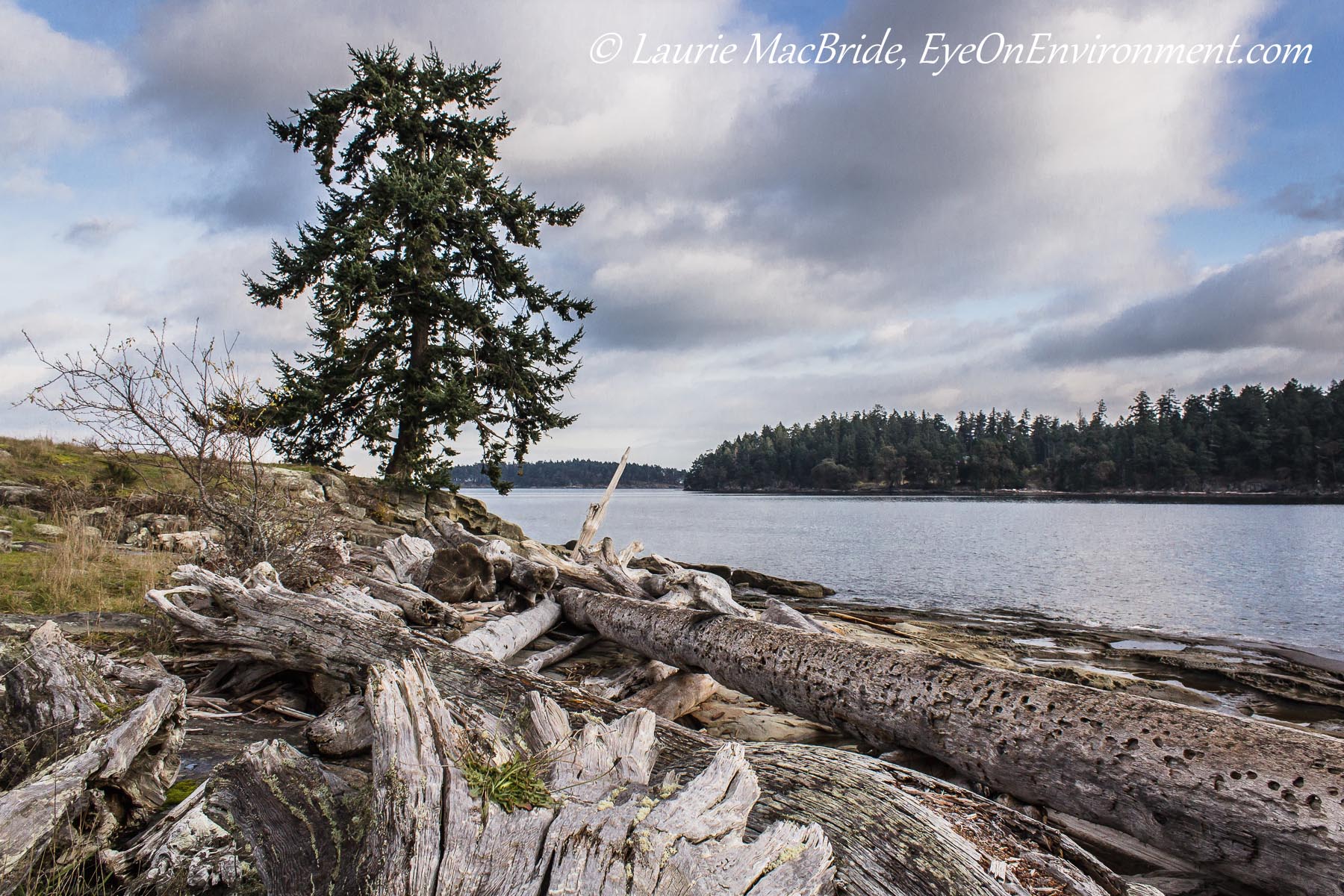
Fortunately for boaters, high tides and winds can drive many logs up onto the beach, where some get stranded, at least for awhile – until the next extreme tide or storm pulls them out again, to drift about until they’re driven onto some other shore. The choicest logs might be collected by salvagers, but most are economically worthless by the time they settle on our shores – weather-beaten or riddled with teredo (shipworm) tunnels, like the log on the right in the photo above.

I took this photo a couple of months ago at Gabriola’s Drumbeg Park, which is exposed to the Strait of Georgia and therefore gets more than its share of drift logs. The tides had been fairly high that week and a sizeable collection was already evident. But I’m guessing the pile will be much deeper by the end of this weekend, especially if we get strong winds along with those supermoon tides.

Subtle Hues, Fragile Shores

Sandstone beach in winter

Sandstone Shoreline, Gabriola (click to enlarge)

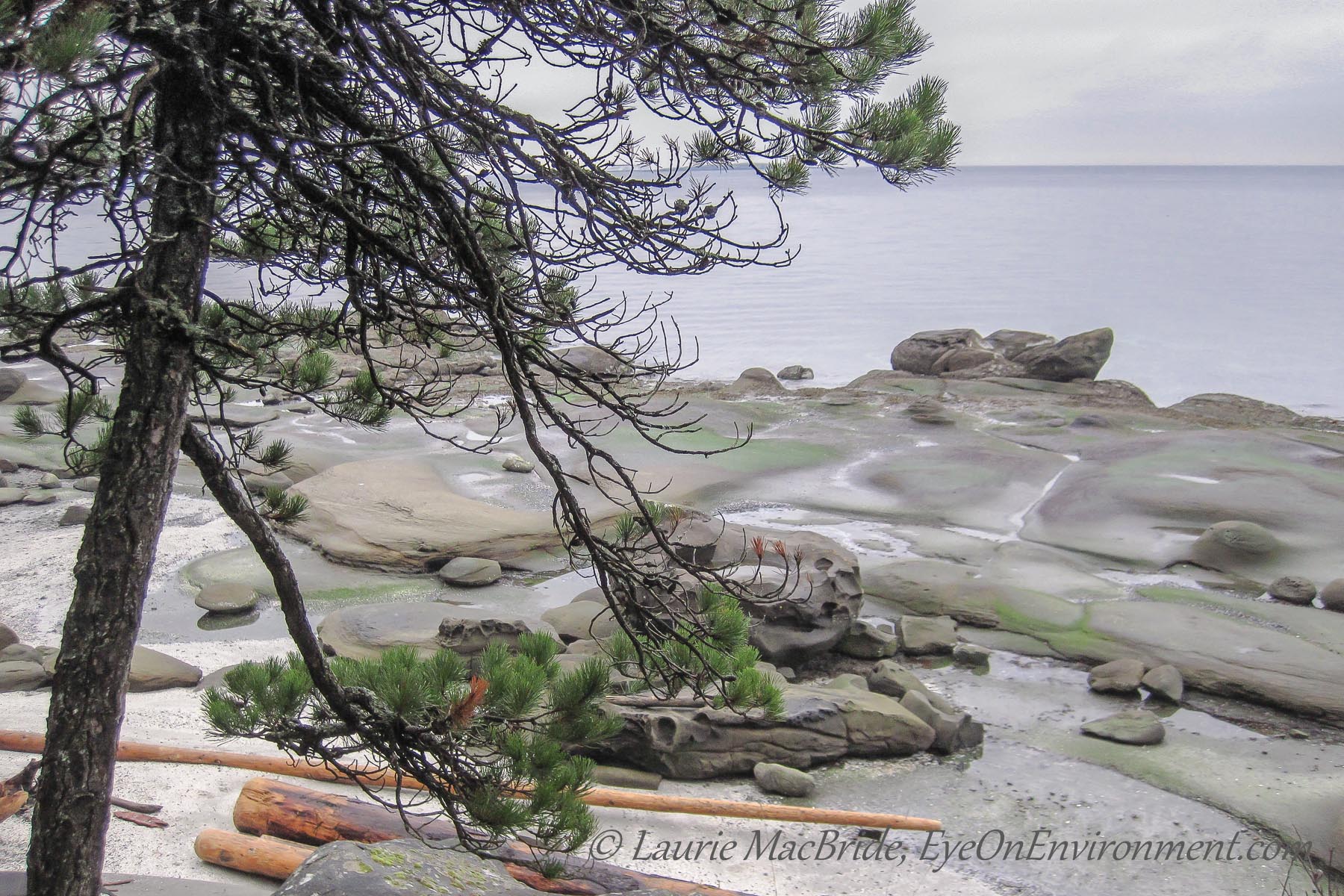
Our mostly grey west-coast winters tend to have little in the way of colour – so instead, we learn to appreciate the subtle textures and monochromatic hues that dominate this season.

The  sandstone shoreline in the photo above is typical of Gabriola Island. The soft rock has been eroded over the ages by salt water, wind and waves rolling in from the wide and often windy Strait of Georgia. As a result, long, shelving pans appear as the tide goes out – gently undulating sandstone that calls out to be walked upon. But beware: in winter these shores are slippery with algae, so they can be treacherous.

Much more treacherous, though, would be the huge increase in the number of massive crude oil tankers moving through the Strait if Kinder Morgan gets its pipeline expansion plan approved. It would make a major oil spill here an eventual certainty – with our shores, beaches and the intertidal life they support directly on the receiving end.

Most of us on the west coast take for granted the ability to enjoy beautiful, life-affirming shorelines, year-round. But clearly, we shouldn’t. The good news is that public awareness is growing, and many people are starting to add their voices to the growing campaign to say “no” to more tankers passing through our waters.

In the meantime, I’ll remind myself to notice and appreciate, more than ever, the beauty contained in the soft rock, subtle textures and gentle hues of our island’s shores – even on the greyest day that winter can bring.

If you’d like to learn more about the tanker issue here in our region or how you can help, here’s a link