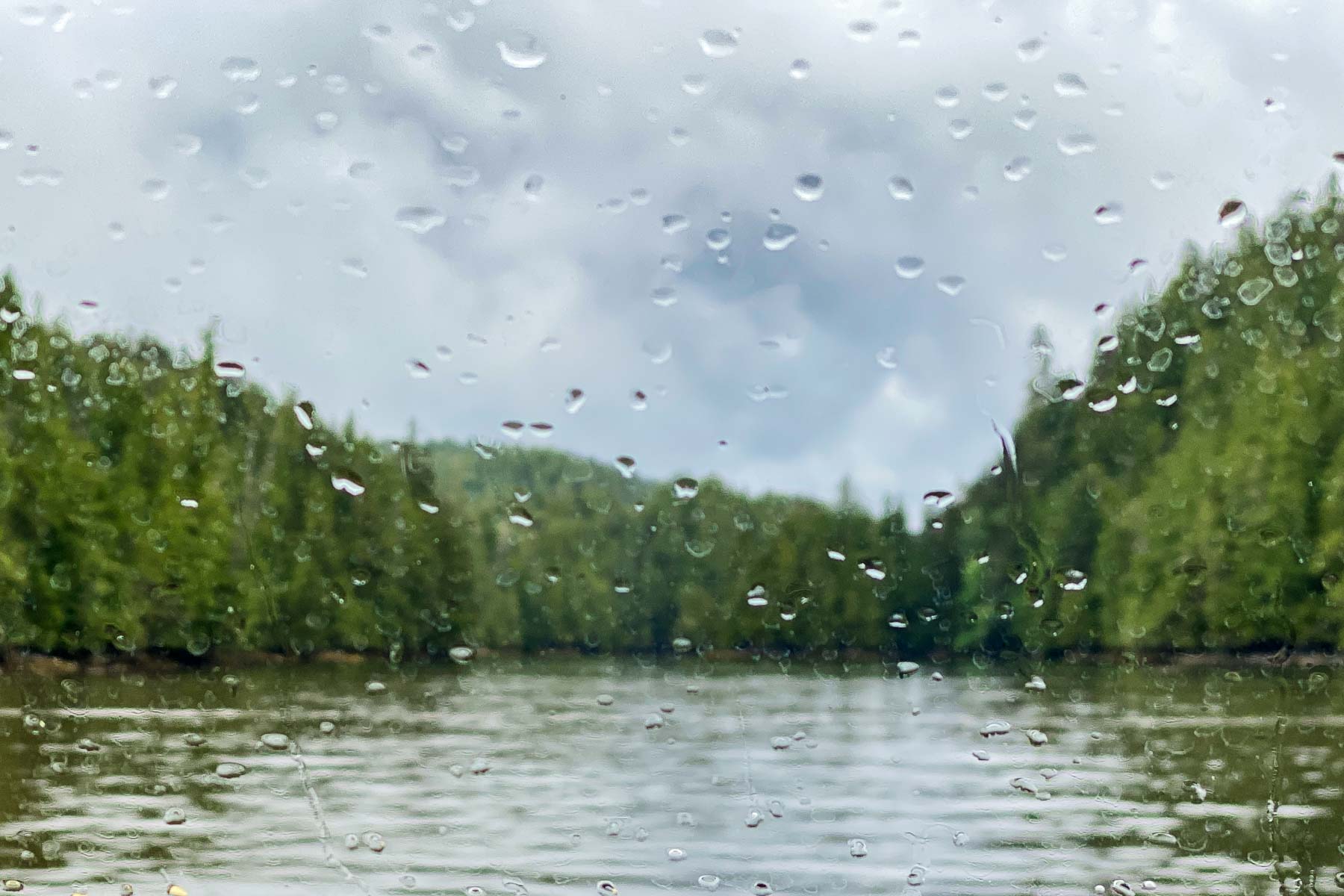
Water, Water, Everywhere

Forested shoreline through a blurry, rain-spattered window

Rain made it tricky to see the narrow entrance to Philip Inlet

Northward on our ten-week Great Bear Sea trip last summer, the first “new-to-us” stopover was Philip Inlet, a small notch on the east shore of Fitz Hugh Sound just south of Addenbroke Island. As you can see from the photo above, it was raining steadily when we arrived, making it challenging to spot the narrow entry and any drift logs that might be blocking it.

Our plan that morning had been to head up Rivers Inlet and fill our water tanks at Dawson’s Landing, a floating supply point we’d visited years before. But with calm sea conditions it made more sense to push on past Rivers and make tracks up Fitz Hugh. I worried a bit about our water supply, but as it turned out there was no cause for concern.

Philip Inlet is a beautiful, remote and quiet anchorage – although entering is a bit of a nail-biter thanks to a couple of narrow spots and a mid-channel submerged rock (thankfully all well charted).

Once we had anchored at the head of the inlet and shut down the engine, we heard the rush of multiple streams. The first two weeks of our trip had been rainy, so plenty of freshwater was on offer all around us. We loaded empty plastic jugs into a kayak and soon we had enough for a week’s worth of daily showering and dish washing – lessening the demand on our potable water supply in our main tanks.

Totem-like symmetric reflection  of the forest and rocks along a shoreline.

By late afternoon the rain had stopped and the sky had brightened a bit. With utter calm inside the inlet, totemic shoreline reflections were all around us. (Click to enlarge and see details on this or other photos.)

Golden hour light on forested shoreline

And by golden hour that evening, the forest seemed to come alive.

Entry channel of inlet with bright, sunny sky

By the time we left the next morning the weather had changed. Funny how that narrow entry looked less intimidating under a sunny sky!

Cozy in the Cold: Sea Otters

Sea otter floating on its back with its back feet sticking up.

Warm and cozy, I bet. (Click on images to enlarge.)

With another Arctic front heading our way, I find myself thinking about sea otters – specifically, how well suited (literally) they are for winter.

Their incredibly thick, waterproof coats must be cozy even on unseasonably chilly days. Sea otters have the densest fur of any animal on earth, which is why they were hunted almost to extinction by the early 20th century.

Their smaller cousins, river otters, are common throughout our region and I see them often, both on land and in the sea. But it’s only been in the last few years, and further north, that I’ve had the privilege of seeing sea otters – thankfully returning from the brink to repopulate some of the inside waters along the BC coast.

These impossibly cute members of the weasel family live their whole lives in the sea, almost never venturing onto land. We’ve encountered small families and groups far from shore when we’ve been cruising up Queen Charlotte Strait, in water over 1000 feet deep.

Sea otter popping up to look at the viewer, with kelp bed behindOnce a sea otter (left) delighted us by popping up repeatedly to have a close look when we were kayaking close to shore. Luckily it was one of those rare days that I had my dSLR with its zoom lens along with me in the kayak.

Last summer another one popped up unexpectedly when we were in just 16 feet of water – hardly a usual haunt for these deep divemasters! He/she stuck around for a few minutes, chowing down on lunch. Having only my phone that day, I wasn’t able to get a photo worth sharing. No matter: the memory of the experience still brings me a warm smile, even on a cold winter’s day.

A Question for Our Times

QT’s question: it’s the right one to be asking ourselves (click to enlarge image)

This week has brought a major dump of snow and bitter, unusually frigid temperatures to our region – a place normally balmy enough to be the winter envy of the rest of Canada.

Our senior resident buck, QT, was not favourably impressed. As I aimed my lens at him through our window this morning, I could hear his complaint, and his related question: “I’m OK with a bit of snow, but this is WAY too much, Mr. and Mrs. Man! Why on earth did you allow this to happen?”

It’s a very good question, indeed, for all of us humans to be asking ourselves about now.


I haven’t been blogging much recently, but I have been posting photos and short comments several times each week to Mastodon (which I’m using instead of Twitter these days). If you’d like to join me there, you’ll find me at: @lmacb@mstdn.ca

September with Squirrelly

Red squirrel looking at the viewer

An afternoon visit with Squirrelly (click on photos to enlarge)

Squirrelly and I had a nice visit the other afternoon – a welcome break during a very busy season.

We’re really quite alike, the two of us. Sure, he/she’s a North American Red squirrel (Tamiasciurus hudsonicus), and I’m a human (Homo sapiens), so at first you might not spot the resemblance – until September. That’s when you’ll find us both scurrying about, hard at work to bring in the harvest and store it away for the winter.

Squirrelly’s haul is mostly Douglas fir cones, efficiently stripped off the trees, dropped to the ground and hidden in caches in the forest. Mine includes a seemingly endless stream of zucchini, grapes, and soon (once I get the grapes out of the way), hardy kiwis, stashed in the freezer and pantry instead of the forest.

Whether squirrel or human, all this rushing about is tiring for any animal. So it’s good to take little break with a friend now and then (even if that friend is sometimes a bit preoccupied by an itch).

Red squirrel scrathing its back

I enjoyed our time together, and Squirrelly seemed to as well. But eventually, he/she let me know that it was time to go – that we both needed to get back to work. After all, September is almost over!

Red squirrel on branch, looking back over shoulder

Foraging Time

Harvesting seaweed from a kayak

Gathering fresh greens (click to enlarge)

Grocery stores are noticeably absent when we’re cruising in remote areas of the BC coast. So when we run short of fresh veggies, it’s time to go shopping by kayak or dinghy.

Handful of greens

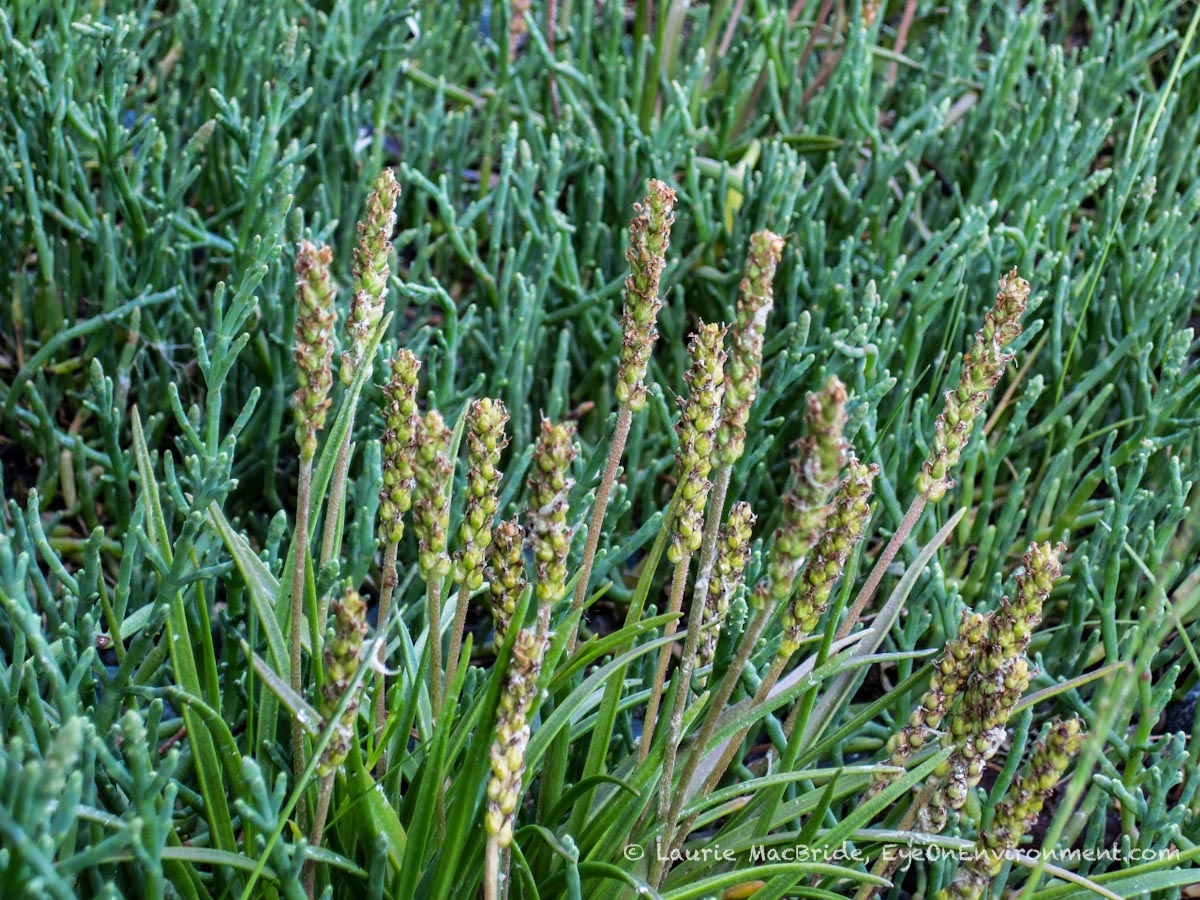
Goose-tongue greens (Plantago maritima), which grow in little crevices in the upper intertidal area of rocky shores, are one of my favourite edibles.

They’re simple to prepare – just wash and briefly steam or stir fry – and they readily take the place of green beans in any dinner menu.

Another tasty and nutritious intertidal veggie is Sea asparagus, AKA Pacific samphire or American glasswort (Salicornia pacifica), found along more protected shorelines with tidal mudflats. It’s often submerged when we spot it, but at lower tides it’s usually exposed or at least reachable.

Goose tongue greens and Sea asparagus

Occasionally we get lucky enough to find Goose-tongue greens and Sea asparagus growing together on an accessible beach!

Last summer both were in short supply in the areas we cruised, so we focused on what was plentiful instead – seaweed.

Green string lettuce on a rocky shoreline at low tide

The steep, rocky shores at the mouth of Kingcome Inlet were richly hung with Green string lettuce (Enteromorpha). I loved how its bright green hues contrasted with the rich golden brown tones of the Rock weed (Fucus) that grew just above it.

At the right tide, the string lettuce was easy to pick without having to step out of our kayaks, as you can see from the photo at the top of this post.

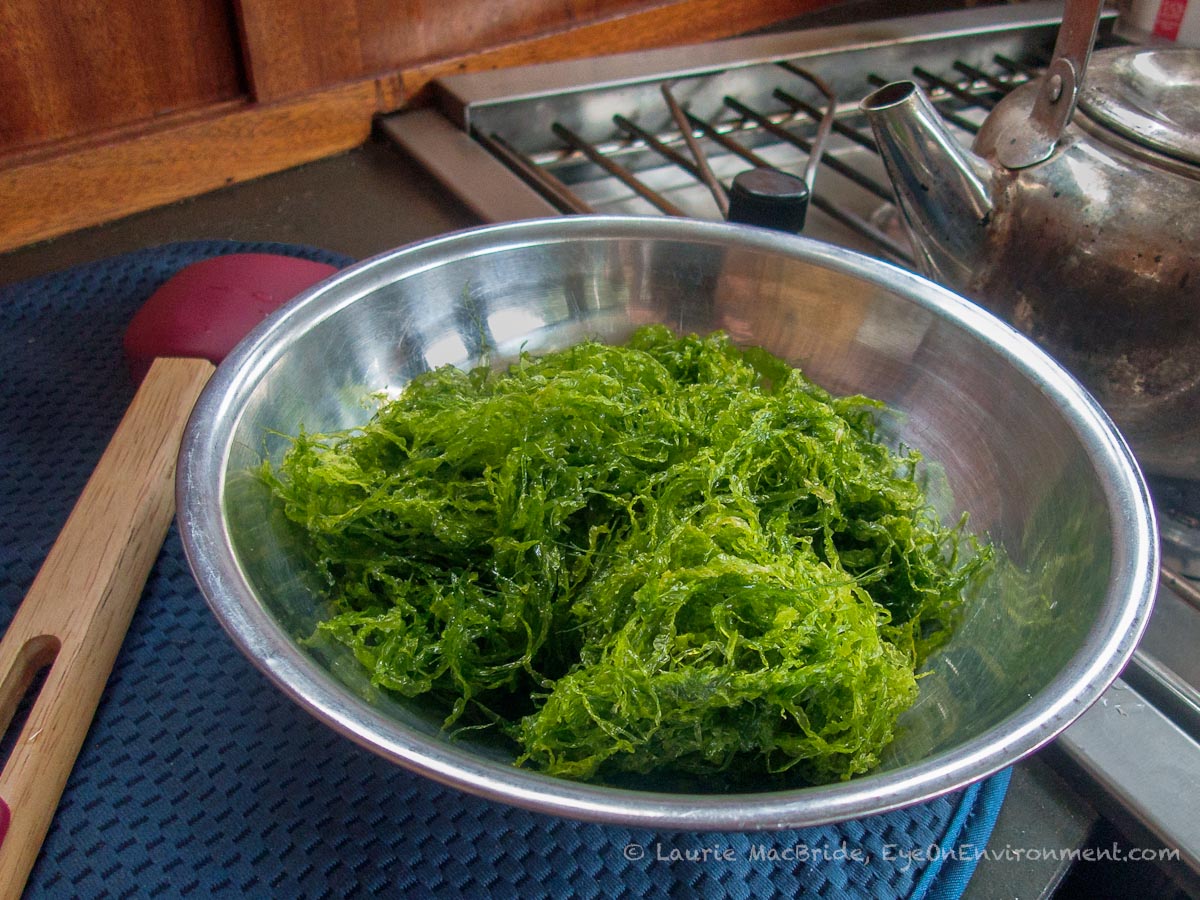
Bowl of washed seaweed

We’d never eaten it before, but inspired by the seaweed salads we’d been buying from our local deli back at home – and reassured by a reference book I keep on board – we gave it a try. I washed it well and turned it into a salad, adding a bit of onion and a few other items we had on board. It was delicious!

Surprises at Kumealon

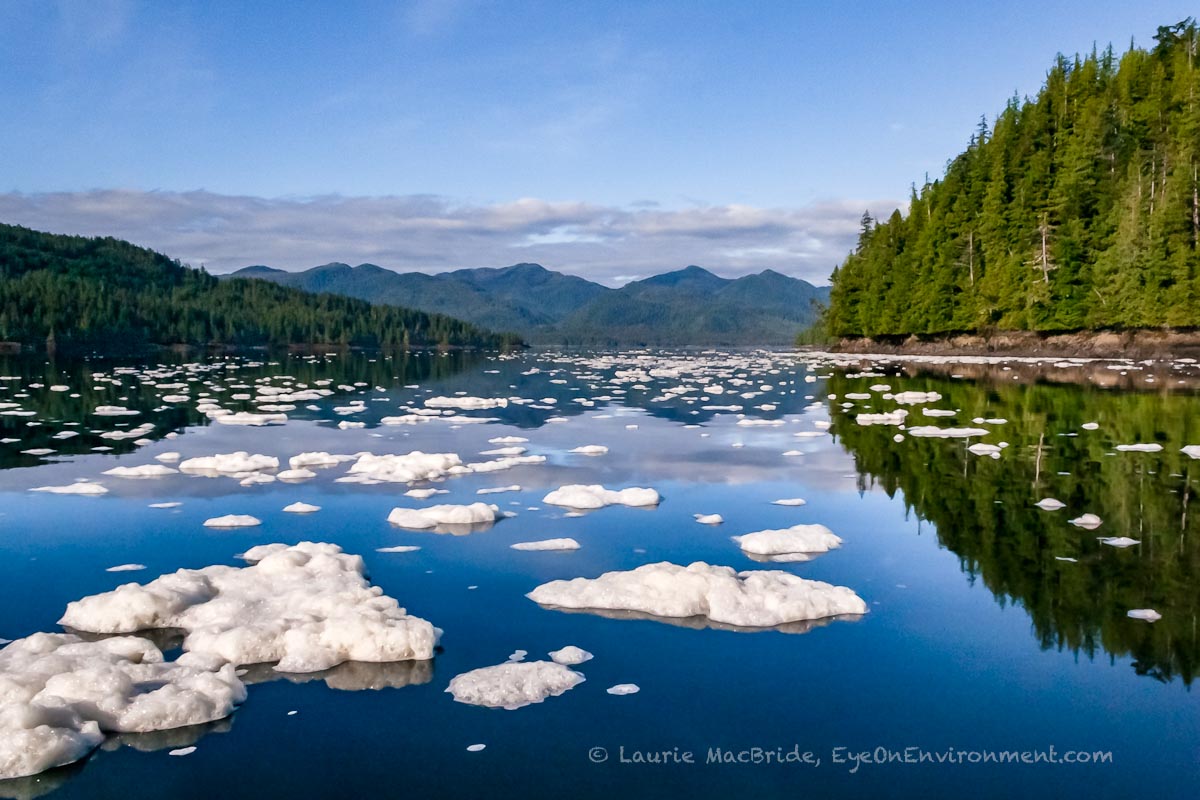
“Foam bergs” on water

An Arctic illusion (click on images to enlarge)

Some years back, during a long run up Grenville Channel on BC’s North Coast, we pulled into Kumealon Inlet to anchor overnight. It was the first time we’d been there and we weren’t sure what to expect – certainly neither of the big surprises that came the next morning.

The more welcome of the two occurred when we were leaving, and is shown in the photo above.

At first we wondered if we could be hallucinating. In the still water ahead, dozens of icebergs seemed to be blocking the channel out of the Inlet.

But as we drew closer we realized they weren’t made of ice, of course, just whipped up air and water – beautiful and delightfully harmless.

Their source was the huge lagoon at the head of Kumealon Inlet, which connects to the inlet by a narrow, rock-strewn passage and tidal falls. At low tide, water from the lagoon cascades over the falls and is forced out though the narrows. The resulting turbulence creates large, bright white natural “foam bergs” that can, at least on large tide cycles, extend almost to the Inlet’s mouth, a mile away.

The other, less pleasant surprise had come earlier when we had awakened and looked out the wheelhouse window.

Directly ahead of us, awash in all its jagged, boat-eating glory, was the reef that we’d seen on our chart the previous evening on entering Kumealon at high tide – but whose exact location we’d been unable to pinpoint. As you can see in the photo below, we’d dodged a bullet, but only just.

Jagged reef at morning low tide

Kumealon Inlet was indeed full of surprises.

Low Tide Charms

View across long sandstone beach

Low tide at Drumbeg Park (click on images to enlarge and see detail)

With summer finally approaching many of us have our eyes on distant shores. But if truth be told, no matter how lovely those shores might be, some of the ones close to home are just as beautiful.

Over the past few months we didn’t go far in terms of recreational outings – only about 2 km, actually – all the way to Drumbeg Park, one of our favorite walking spots here on Gabriola Island.

One of those trips coincided with a significantly low tide, allowing a view of the tidepools formed by erosion along the broad stretch of sandstone shore.

View across tide pools in sandstone shore

Graceful curving lines of bladderwrack, exposed by the tide, added panache to the tableau that day.

Seaweed and sandstone at low tide

It’s a lovely place to walk, to be sure, and especially at low tide. But if you happen to be there at high tide instead, no worries – a walk through the forest at Drumbeg can be every bit as charming.

Trail alongside mixed forest and Garry oak meadow

Spring Rhythms and Routines

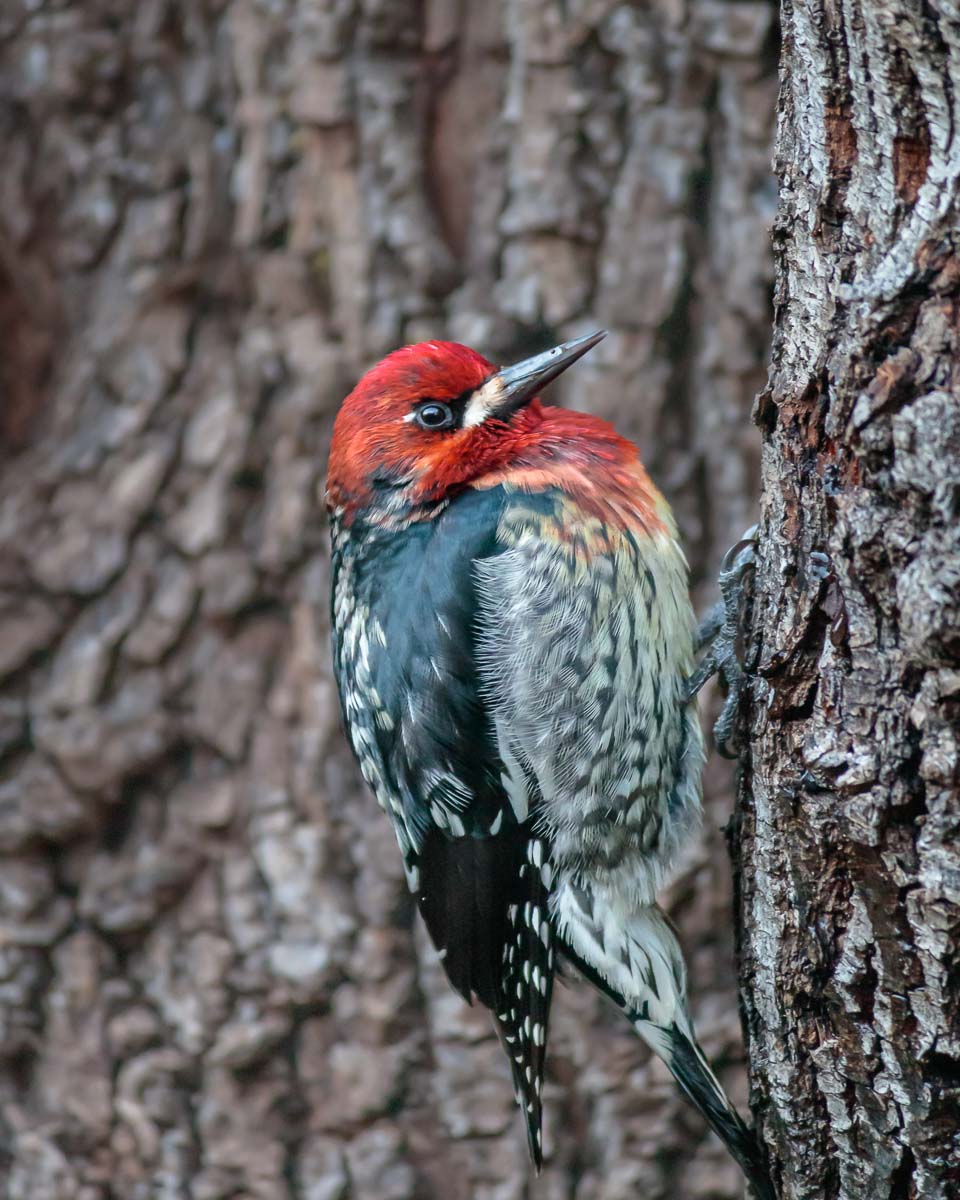
Red-breasted sapsucker on a tree trunk

“Sappy” on the job site (click to enlarge).

In these unpredictable and troubling times, it’s good to have a few things you can rely on. This spring, one dapper bird and a whole lot of small amphibians provided me with just that.

For a month or longer,”Sappy”, the bird in the photo above, would show up at his worksite (or perhaps her worksite – the sexes look alike). There, at the old, multi-trunked Bigleaf maple just outside our front door, he/she would put in a lengthy shift, working up and down the main trunk, tapping and poking the rough bark for sap and insects. The routine never varied, which I found comforting.

Red-breasted sapsuckers (Sphyrapicus ruber) live in our region year-round, so we often see these beautiful birds, or hear their calls, which remind me of a supercharged squeaky toy. But it was a treat to be able to watch this one at such close range, often at eye level, for so many days. Sappy has moved on since then, likely to some other nearby tree, where he/she is probably busy sharing parental duties with a mate.

Another creature that has brought me comfort this spring is the Pacific Chorus frog (AKA Pacfic Tree frog, Pseudacris regilla). I haven’t seen any – we won’t for a few months yet – but each night for the past eight weeks, a loud choir has been steadily broadcasting from our pond, as lusty males call out in search of mates.

The pulsing rhythm of their song has lulled me to sleep. And it has brought me comfort in the knowledge that these imperiled amphibians are still here, striving to bring forth the next generation.

Long may Sappy tap, and the Chorus frogs sing.