Life Among the Ghosts

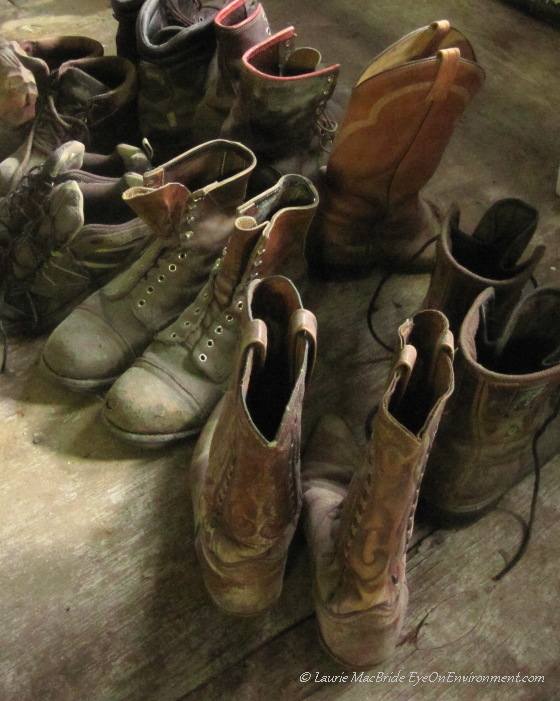
Old boots in Ocean Falls museum

Footsteps in Time

Today I’m revisiting a place I wrote about in a previous post, the ghost town of Ocean Falls (more photos below). Nestled against the mountains of Cousins Inlet on BC’s Central Coast, it’s a town that lives up to its name: with 172 inches/year of rain, it’s no wonder the 50 hardy year-round residents of Ocean Falls and adjacent Martin Valley call themselves The Rain People.

History is everywhere in Ocean Falls, covering the place like the fine dust on the boots in the photo above – one of hundreds of exhibits in the eclectic museum that one man has created above the old shipyard.

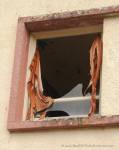
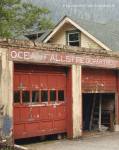
After the pulp and paper mill closed for the final time in 1980 and the town was written off by the government, a few determined residents managed to save part of the townsite from the wrecking crews. Among the “survivors” were the Martin Inn – once the largest hotel north of San Francisco – along with the firehall, ambulance station, high school, a large apartment building and a number of homes.

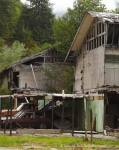
But they’re all pretty much in ruins. The paved roads of the townsite are travelled mainly by deer these days, who browse amid the deserted buildings and remnants of a once-thriving city of 5000 people. Each year brings the forest’s edge a bit closer.

But along the waterfront, however, there’s still life in Ocean Falls. The harbour authority provides sturdy and well-maintained docks for visiting boaters, and the lodge and the gift shop welcome tourists. The church and its garden are carefully tended by local volunteers. The post office is open for business, and the courthouse (complete with its old jail cells) has a new lease on life as home to the local improvement authority and public library.

And of course there’s the museum, occupying the top floor of the old shipyard. Curator “Nearly Normal” Norman Brown spent years sifting through the town’s ruins, unearthing a veritable treasure trove from the detritus of decades of everyday life: objects of work, play, commerce and household life. Collectively – and more eloquently than words could ever do – they illustrate the history of Ocean Falls and honour the thousands of people who lived here over the years.

More photos from Norman’s museum, Ocean Falls townsite & Martin Valley. (Click on any image to launch the gallery viewer with larger versions of the images.)
If you enjoyed this post you might also like:

Lowly Bulb, Simple Beauty

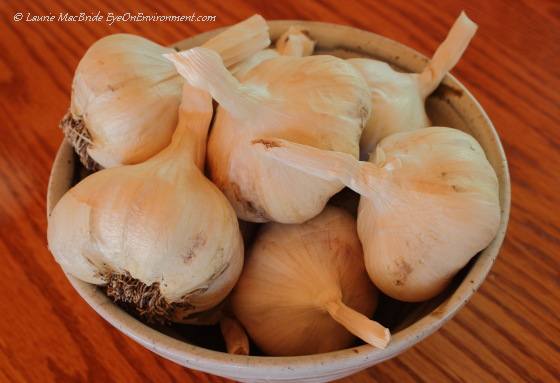
Garlic bulbs

For millennia, people have appreciated the culinary and medicinal powers of garlic. The ancient Egyptians swore their oaths on garlic bulbs. Garlic was among the items found in King Tut’s tomb, and this lowly vegetable was so highly regarded in ancient times that it was used as currency.

To me, garlic is both a kitchen essential and a thing of beauty.

Many people plant their garlic in September and overwinter it. But I wait until the worst of winter is over before planting mine – and besides, in September, all my garden beds are still occupied with the summer and fall crops.

I use a variation on an old family theme to time my garlic crop. My grandfather’s system was to “plant on the shortest day of the year, harvest on the longest”. He worked as a gardener for the City of Victoria, beautifying parks and streets, and in his spare time kept a highly productive vegetable garden that occupied just about every square inch of the family’s Fernwood Street backyard.

Gabriola Island’s climate isn’t as mild as Victoria’s, so my planting and harvest dates are a bit later than Grandpa’s. I usually plant garlic in late February – March if the weather is iffy – and I put row cover over the patch for the first few weeks, to keep the robins from digging up the cloves.

I pull the garlic plants (by then about three feet tall) in September and let them dry in our solarium for several weeks, then I clean and trim the bulbs. Before moving these to the pantry for storage, I take one last, but very important step: I select out the largest, most perfect bulbs, isolate them in a separate basket, and add a label: “For planting – do not eat”. As a result, the size of the garlic bulbs we harvest has increased steadily each year.

For each of the past few years I’ve planted about 100 cloves, which produce 20 to 25 pounds of organic garlic – more than enough for our year-round needs. About 75% of the crop is a hardneck variety (photo above), originating from a single clove given to us by a neighbour a decade ago.

The rest are softneck (photo below),the type that can be braided, though I never bother with that. Softneck garlic is more finicky in the kitchen, as the cloves are smaller and harder to peel, but it keeps longer in storage so proves very useful in late spring and summer – especially when the basil is ready for making pesto.

I managed to get the garlic into the ground by my target date of February 27 this year. But before I did, I couldn’t resist making a few photos. Who could resist the simple beauty of these lowly bulbs?

If you enjoyed this post you might also like:

To purchase or license photos

When Negative is Positive: The Power of Trees

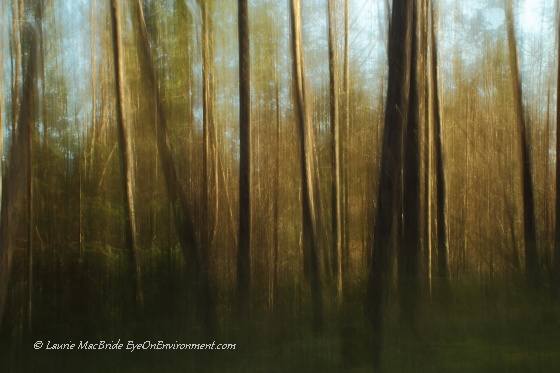
Douglas fir grove abstract

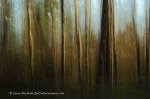
This photo is an abstract impression of one of my favorite spots on our property, a small stand of Douglas firs that we call “the hammock grove”.  I wanted to convey the dream-like feeling I get amid these tall trunks, so I deliberately used camera motion and a slow shutter speed. (More photos below.)

The grove is bounded by trembling (quaking) aspens, black hawthorns and wild roses. With our hammocks strung between sturdy fir trunks and dappled light poking through the canopy, it’s a cool place to hang out on a hot summer afternoon.

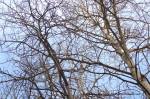
Right now the aspens are bare, as you’ll see in one of the photos below. But soon they’ll leaf out, and in the summer they’ll move with the breeze in a near-constant dance of gold and green, high above our heads: a gentle clickety-clack percussion that soothes the soul. 

I recently learned that when the leaves of a tree move, they release negative ions, which is said to benefit our health and elevate our mood.  The effect is strongest with conifers; I’m guessing this is because a tree with a multitude of tiny needles, like a Douglas fir, has a considerably greater surface area than its deciduous cousin.

Conifer or not, a tree’s surface area is huge. To calculate it you must consider not only the visible parts – its trunk, its ridges and folds of bark, its branches, boughs, both sides of all of its leaves – but also the parts we don’t normally see: its long, complex network of tap roots, lateral roots and root hairs.

In this way, the total surface area of a 15-metre tree, when it’s in leaf, would cover 200 hectares. That’s a million times greater than the two square-meter surface area of an average human!

The value of trees, though, is so great that it’s likely beyond calculation. They provide habitat for 50% of the world’s biodiversity, and although people don’t live in them, we cannot live without them. They cool and humidify our atmosphere, remove heavy metals and other pollutants, and absorb and store vast quantities of carbon dioxide – helping to make it possible for us to live on this planet. They give us oxygen to breathe, wood to build our homes and furniture, fuel to keep us warm, medicines to heal our ailments, and all manner of edible fruits, nuts, seeds, berries and oils.

Not to mention those very positive negative ions!

Here’s a gallery of photos from our hammock grove. Click on any photo to enlarge and view as a slide show. If you wish to comment on a photo, click the “Permalink” button appears under it during the slide show.

If you enjoyed this post you might also like:

To purchase or license photos

Mosaic of Green: the Wet Coast

West coast rainforest shoreline with kayaker

Two things had me thinking of BC’s Central and North Coast as I sat down yesterday afternoon to start this post. One was the noon hour CBC radio coverage of the hearings in Prince Rupert on the Northern Gateway pipeline and tanker proposal. Everyone who called in was, like us, opposed to the project, concerned about the likelihood of a spill and the impacts of tar sands on the marine life and communities of the coast.

The other thing turning my mind north was the hard rain that was teeming down here on our little island in the Strait of Georgia: filling our ponds, drenching our garden beds, and feeding the groundwater reservoir that we’ll need to carry our island and all of the plant and animal life it supports through a dry summer and fall.

The rain reminded me of last summer on the Central Coast.

The photo above was taken in mid-July 2011, off Stryker Island, about 15 miles north of the Goose Group on the outer coast of BC.

Twenty-eight days into our summer boat trip, we’d had 19 days of rain so far with no real let-up in sight – forcing us to don a full set of raingear each time we left the boat to go kayaking. Still, any exercise is better than none, and it was an antidote to the claustrophobia that comes from hanging out together for too many hours in a relatively small boat. But vitamin D had to come from a bottle.

Off-and-on rain, at times heavy, continued for most of the remainder of the trip, ending only when we finally made our way back to the South coast – just in time to catch the last few weeks of  blue skies and summer warmth.

So why do I want to return to the Central Coast?

I love the quiet and remoteness – finding anchorages where you’re the only boat – and it’s inspiring to watch humpback whales, seldom seen in my home waters of Georgia Strait.  Some of the paddling spots are sublime, such as the outer coast kelp beds, where we’ve seen sea otters, another endangered species. And I have long felt a passion for BC’s remote coastal communities – places that cling tenaciously to life despite the odds, like Ocean Falls.

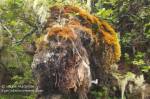
I also love the subtle colours and textures. All that rain nourishes a remarkable profusion of growth: hemlock, red cedar and fir, salal, thimbleberry and countless other bushes, even on steep, wind-battered shorelines where vegetation seems utterly improbable. Thick mounds of moss grow atop the rocks and along the tree trunks, and everywhere you look, branches are festooned with long garlands of lichens that dance in the wind like Buddhist prayer flags.

So despite the rain – even, perhaps, because of it – we may head up the coast again this summer for more of that wild, wet and wonderful world of green.

A few more photos of Stryker Island (click for larger view):

Moss and lichens on rock, Stryker Island Colours of mosses, lichens, trees and bushes Trees and bushes along shoreline, Stryker Island

If you enjoyed this post you might also like:

To purchase or license photos

Tidal Edge: Where Land, Sea & Ancient Cultures Meet

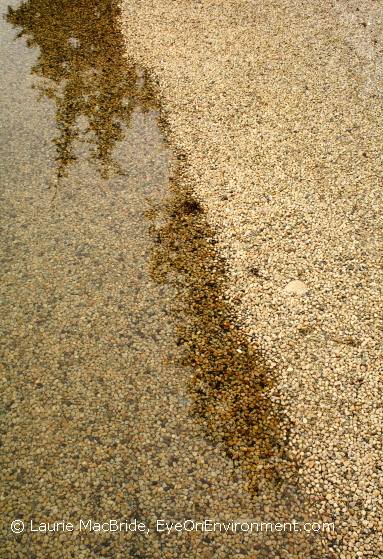
Pebble shoreline with reflection of trees in waterCoastal Fusion, © Laurie MacBride
Perhaps it’s because I’ve lived on the coast all my life, or maybe I’m simply attracted by “edges”: my eye is inevitably drawn to the places where sea and land meet – the constantly moving interface of brine and terra firma.

The specifics change along with the weather and tides, so that on any given beach, the location of the edge varies from moment to moment – it’s never exactly the same. And if you watch closely enough, over time, you’ll see an immense variety of curves, angles, reflections, shadows and shapes along and beside that moving edge.

The photo above was made at Pruth Bay on Calvert Island, on a calm summer’s day at a fairly high tide. Standing on the pier over the beach, I was struck by the textures and subtle colours of the pebble shoreline, and with the water’s reflection of the forest’s edge. The moment seemed like a perfect blending of the water and the land: our planet Earth in miniature.

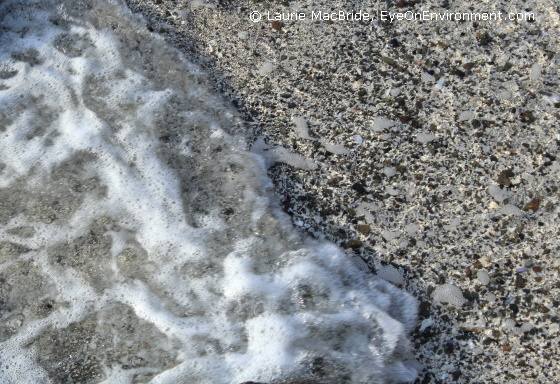
The photo below was made further south, at Drumbeg Park on Gabriola Island, on a winter day when a light breeze was blowing.

Wave hitting shell midden beach, Gabriola Island

The sea was active that day and the tide was definitely high – in fact, we had just experienced a “king tide”, an exceptionally high tide that occurs only infrequently (although with increasing sea level rise, such heights will become more and more common).

Drumbeg beach, like many on the BC coast, is a shell midden, composed of broken clam, barnacle, geoduck, mussel and other mollusc shells – the waste products from human dinners over millennia. Shell middens along our coast can be many metres deep, indicating continuous occupation by aboriginal people for up to 10,000 years – perhaps as many as 12,000 in some places. In the sites that supported large villages, shell middens extend up from the water’s edge a considerable distance into the forest.

Because the shells are predominantly white, middens are highly visible; from a distance they often resemble a sandy tropical beach. But many of the smaller middens are harder to spot, because they’re underwater even at the lowest of tides – an indicator of the amount of sea level rise we’ve already experienced, since the end of the last ice age. When we’re kayaking close to shore, we see these middens below, as bright white patches on the sea floor: a vivid reminder that on this coast, what constitutes the “edge” is always changing.

If you enjoyed this post you might also like:

To purchase or license photos

Life on the Edge: the Cliff Dwellers

Trees on edge of cliff, Valdes Island

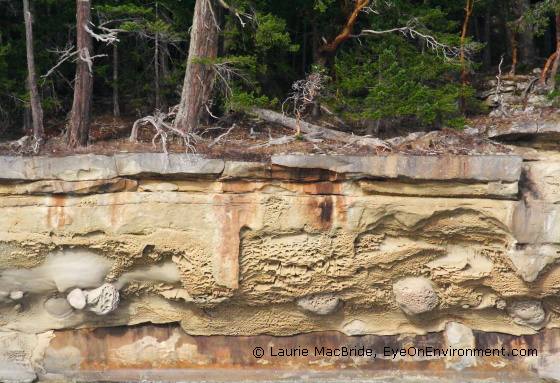
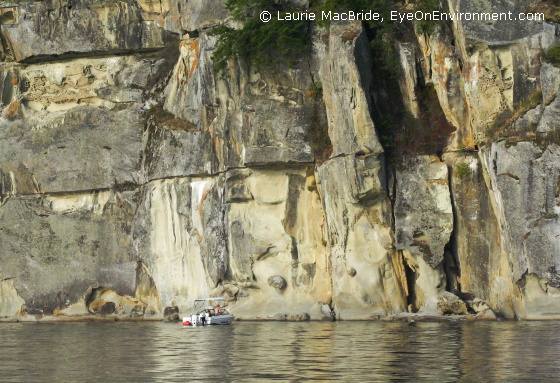
On Valdes Island, Gabriola’s neighbour in BC’s Gulf Islands chain, fault lines have exposed the underlying sandstone to the elements. With the passing of time, the combined forces of salt, sun, rain and wind have carved an intricate design of hollows, crests and ledges in these west-facing cliffs.

Atop the cliffs, the soil is thin and dry, and I’m left wondering how large trees like these Douglas fir and Arbutus in the photo above can manage to take root and survive on what seems such a perilous edge. How do their roots find purchase in such a thin layer of soil, and how do they make it through the driest summers? How in the world do they hang on when the winter winds blow?

The cliffs they sit upon are not insignificant, as you can see below. In places they rise more than 200 feet, and they seem to go straight up – in fact you can approach very close with no worry of grounding, even if you’re in a larger, deep-keeled boat than the one in this photo. The view is worth it: the sandstone galleries beneath these cliffs are stunning, especially late in the afternoon, when the western sun reveals the depth of their contours and rich mix of light and shadows.

Boat in front of Valdes Island cliffs

Nearby, among the smaller Flat Top Islands, weather and time have also created challenging conditions for trees. The elevations here are much lower than Valdes – there are no real cliffs on these aptly-named islands – but the textures of their shorelines are no less complex. Weather, salt water and waves have created myriad ridges and hollows in the sandstone, and over time, have worn rough surfaces smooth. Here’s an example:

Arbutus tree growing out of a crevice

Life on the Edge #2 (Flat Top Islands), © Laurie MacBride

Many of the rock crevices in the Flat Tops are tiny, but even so, trees like this Arbutus are able to grow there. By sending their roots down into tiny fractures in the sandstone, they open up larger spaces in the rock, enabling more growth. But despite understanding “how” these trees manage to do it, I continue to be amazed each time I see them: living on the land’s edge, perched so precariously over the sea.

If you enjoyed this post you might also like:

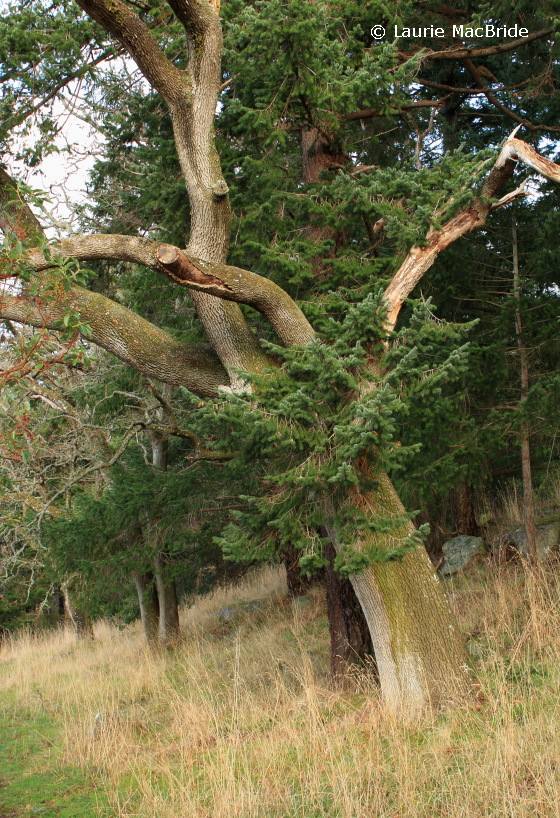
A Forest of a Different Kind: Garry Oak

Garry oak trees

My relationship with the Garry oak (Quercus garryana), British Columbia’s only oak species, goes way back. I grew up near a large Garry oak meadow, an undeveloped park with a maze of trails just wide enough for our bikes. The twisting oak trunks called out for climbing, and the tall, dry grasses and wildflowers provided a wonderful playground into which we could disappear all day. (This was, of course, back in the days of free range children.)

Well before my time, Garry oak (also known as Oregon white oak) used to grow profusely throughout southern Vancouver Island and the Gulf Islands, in meadows that were important habitat for songbirds, butterflies, snakes, insects and larger animals. Grazing by black-tailed deer thinned out enough of the newly sprouting trees to keep the canopy open, allowing the remaining trees to flourish, and aboriginal people harvested the camas and other edible bulbs that grew among the grasses.

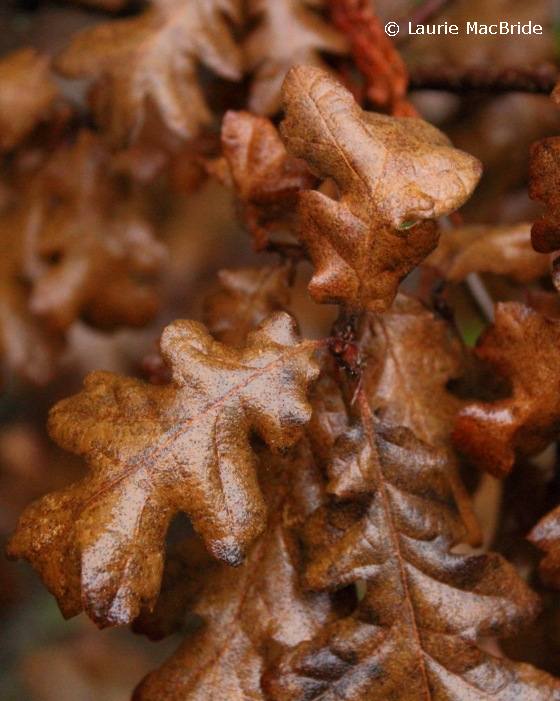
By the time I came along, urban development had reduced Garry oak stands to isolated patches like the park in my neighbourhood. Today, these Garry oak meadows are among BC’s most endangered habitats, and many of the plant, birds and insect species that these ecosystems support are themselves at risk.

The photo above was shot at Uplands Park in Victoria, a large (at least by today’s standards) Garry oak meadow. We have small patches of these trees on Gabriola Island as well, most notably at Drumbeg Park.

A small Garry oak tree grows in our yard on Gabriola, protected from the deer by a wire enclosure. A friend started it from an acorn and, 10 years ago, brought it to us in a one-gallon pot as a housewarming gift. It’s now about six feet tall and doing well. To my surprise, it turns out Garry oak is fairly easy to grow. So if you have a well-drained, sunny, relatively open spot – south or west-facing preferred – and a little bit of space in your yard, you may like to give it a try. You’ll be helping to preserve an important piece of our region’s natural heritage.

A few more Garry oak photos (click for larger view & info):

Garry oak tree limbs Garry oak leaves in fall Garry oak with other trees

Much More than Meets the Eye

Pond surrounded by forest, with reflectionsOne of our ponds is surrounded by a tangle of Pacific crabapple, black hawthorn, Indian plum and Douglas fir. But the most dominant tree is a large, multi-trunked Pacific willow which has changed repeatedly in the decade we’ve been watching – its old, brittle limbs breaking off, replaced by new and vital branches.

The pond is a natural one, fed by surface runoff which fills it to the brim each winter. By July it’s dry, the flattened grass evidence of the soft summer bed it provides for the deer.

Songbirds can be heard year-round in the surrounding thickets, and on warm afternoons a red squirrel often suns itself on one of the willow’s trunks.

In the spring mallards visit and paddle about the tiny bays, feeding on the vegetation – and perhaps on the tadpoles and newts that have hatched in the shallow, warm water. The ducks seem to enjoy this private place, where they are hidden by brush from the view of hawks and other predators.

The day to day changes at the pond are subtle, and to the casual observer it may seem like nothing much ever happens here. But if you watch and listen, you realize there’s really a lot going on – much more than meets the eye.

If you enjoyed this post you might also like: