The Little Things

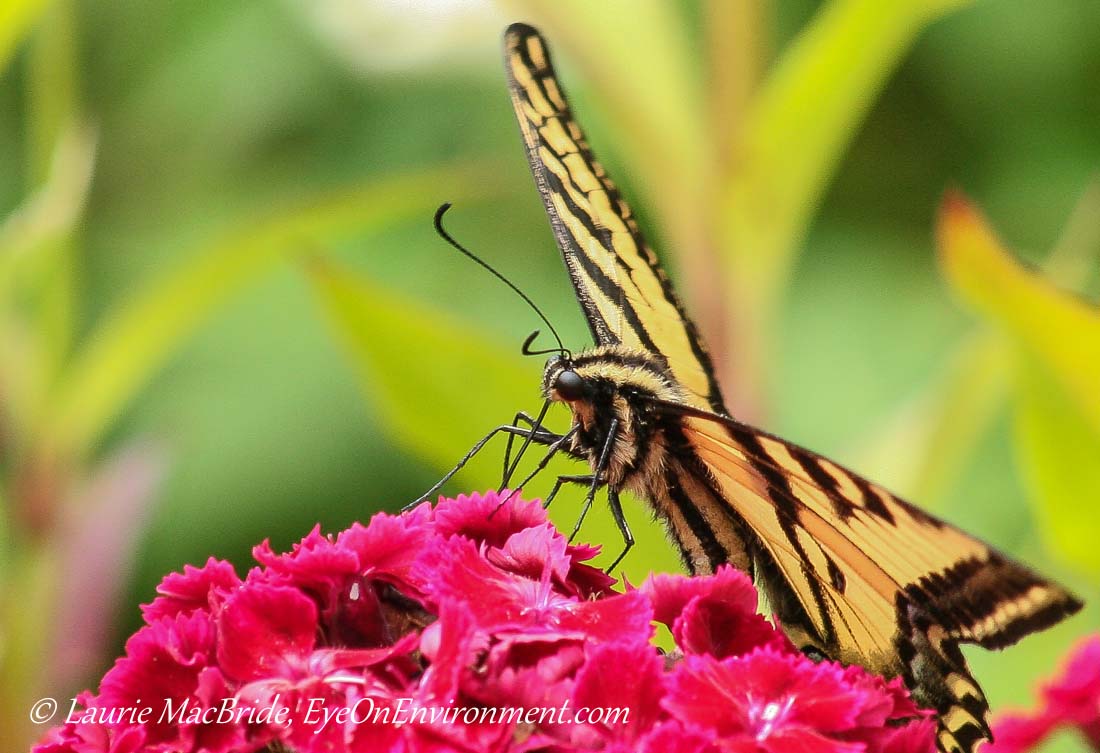
Closeup of Swallowtail butterfly on Jerusalem Cross flowers

Swallowtail at Work (on Jerusalem Cross)

My days have been busy lately, now that the harvest is fully upon us. Summer is racing by, and already we’re starting to see the signs of approaching fall.

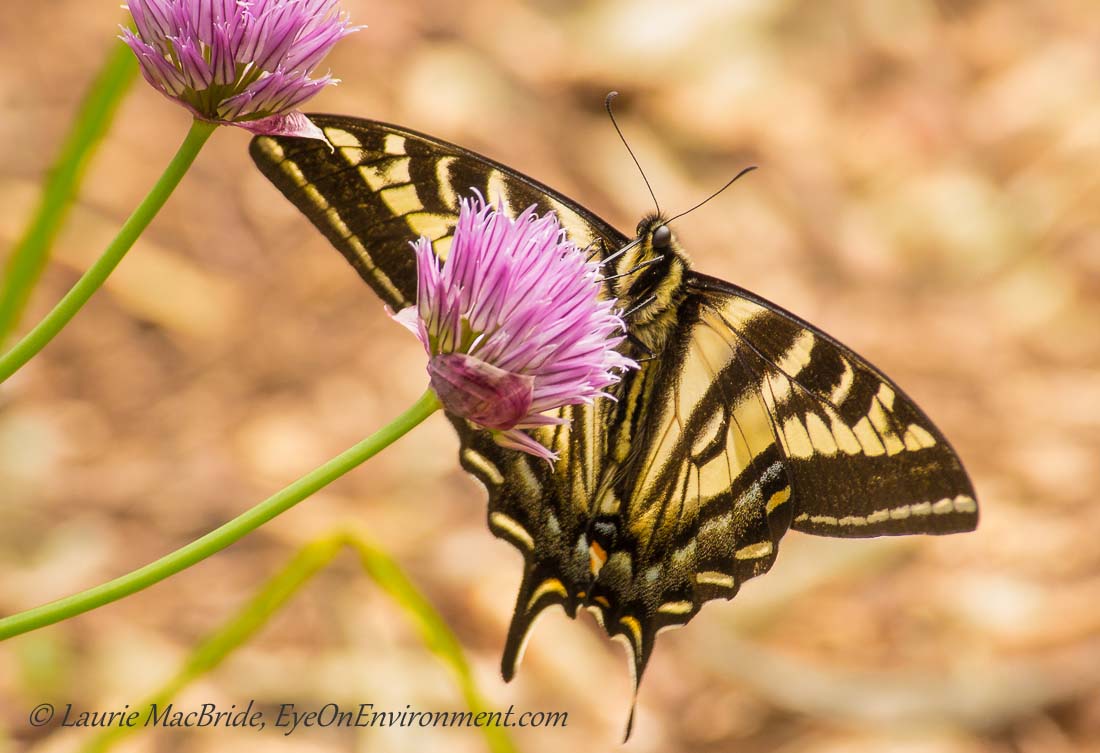
But before this glorious season ends, I want to make sure I take time to appreciate some of the little things of summer, such as these butterflies. I believe they are Western Tiger Swallowtails (Papilio rutulus rutulus), but I could be mistaken. Whatever the species, these lovely butterflies show up every summer in our garden, diligently pollinating our plants – and delighting the humans who eagerly await their arrival.

Swallowtail butterfly on a chive flower

Swallowtail at Work #2 (on chive)

If you enjoyed this post you might also like:

Coast of Dreams

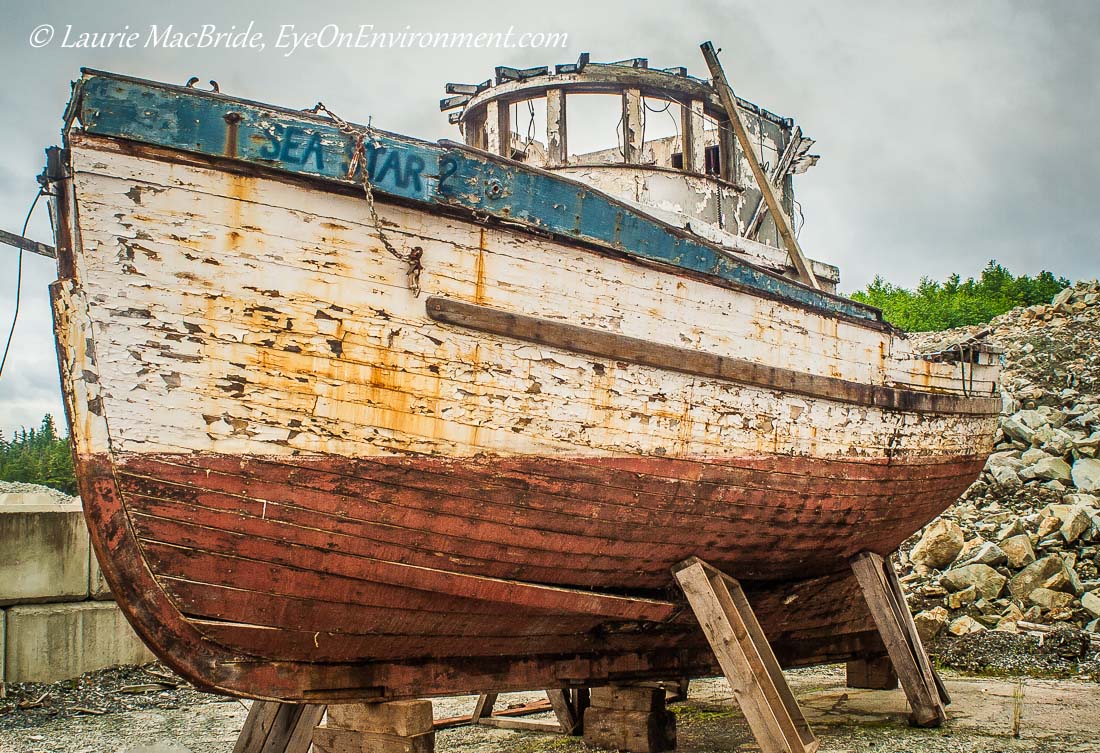
Old wooden fishboat on dry land

The Project (click to enlarge)

What is it about the BC coast that inspires so many dreamers?

In one community after another, you can see the evidence: an old boat that someone once planned to restore to its former glory.

We came upon this long-retired fishboat (above) in the dusty back reaches of the shipyard at Shearwater, on BC’s Central Coast – but you don’t have to go that far to find other, similar old boats. They’re in back yards and boat yards everywhere, and they represent a lot of abandoned or forgotten dreams.

Those dreams have been built, perhaps, on a passion for this coast’s history and an overabundance of optimism – and more than a touch of impracticality.

Keeping an old wooden boat healthy is a labour of love that requires ongoing vigilance and a huge input of time.  (I know this well: for a number of years, we owned a converted 1927 West Coast fishing troller.)  Bringing an old wooden boat back from the brink of death is even more challenging.

Our coast is hard on wooden boats, especially once they’re pulled up onto shore. They need the salt water:  without it, hulls dry out, caulking falls from the expanding seams, fasteners rust and planks spring. With our copious rains, wooden cabin walls, window frames and decks become riddled with fungus, resulting in dry rot – a straight course to the end for any wooden vessel.

Still, even in their dying days, many of these old boats have beautiful lines. And what a history they hold!

If you enjoyed this post, you might also like:

The Little Spirit Lifters

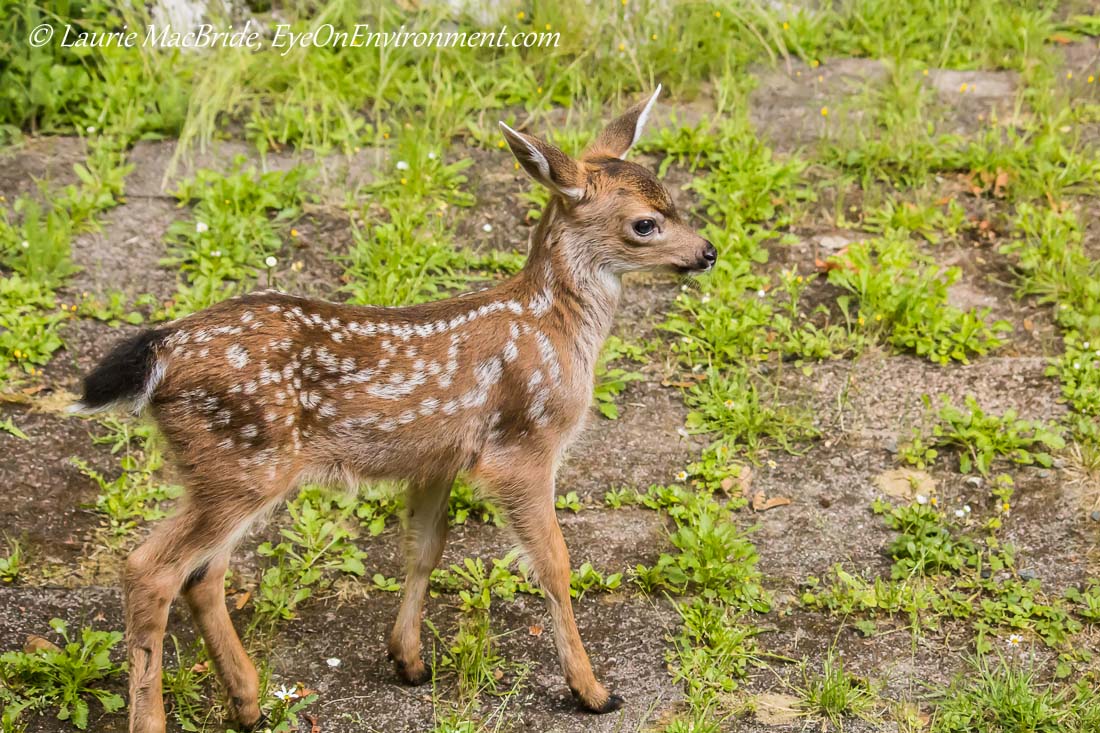
Tiny fawn walking on patio stones

Can there be anything that lifts one’s spirits more than watching a wide-eyed little fawn starting to explore its big new world?

I captured these three photos of our newest residents a couple of weeks ago, when they were just two weeks old (click on any of the photos to enlarge). It was the first time their mom, Teardrop, had brought them along on one of her daily visits to our place.

We watched from inside the house as the little guy (gal?) above ventured tentatively across the patio stones to keep up with mom. Meanwhile, his/her twin (below) seemed a bit more shy, staying at the forest’s edge until mom returned.

Fawn watching at the forest's edge

Teardrop seems to be patient and attentive to the new fawns, and perhaps a proud mom, too.

Black-tailed doe with new fawn

Now that they’re a month old, they’re visiting a bit more frequently and exploring more of our yard. At this point in their lives, Teardrop doesn’t let them stay for long  – a quick frolic, then it’s back to the forest for the tiny twins. But no matter how brief, every visit from these little spirit lifters is a celebrated event at our house.

If you enjoyed this post you might also like:

Seeing the Art in Artichokes

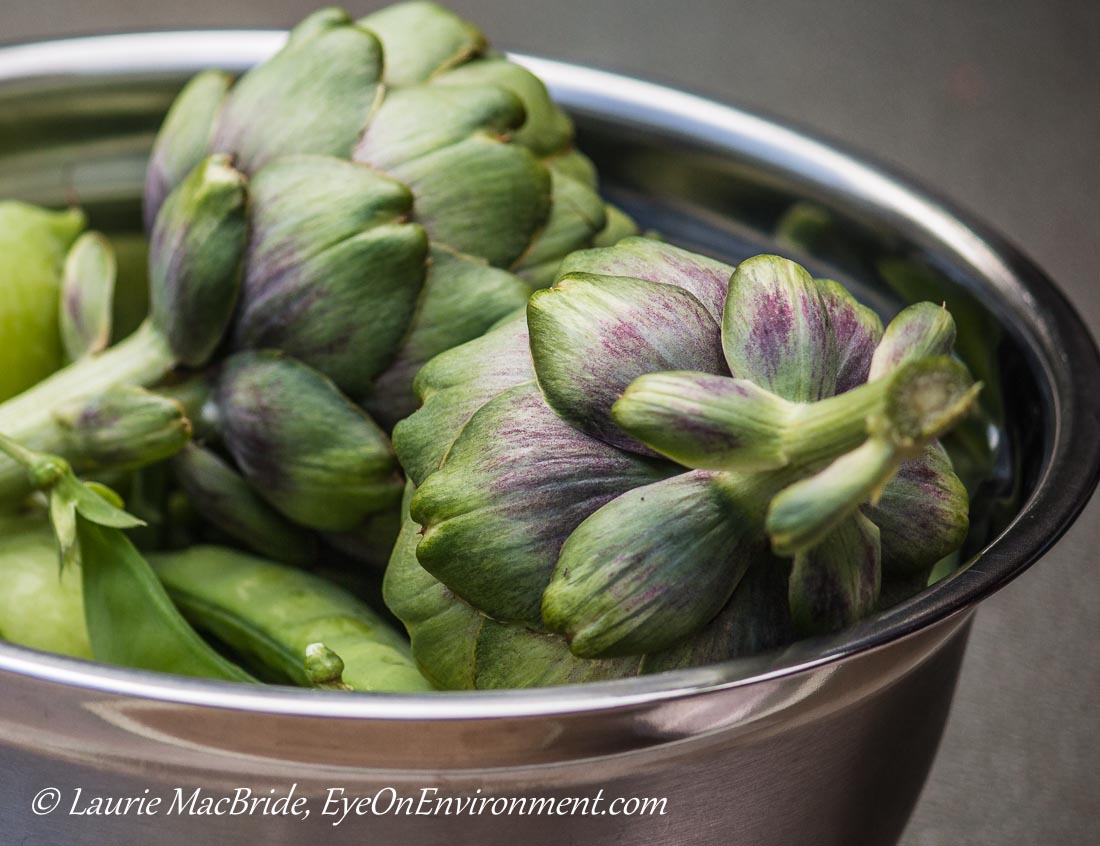
Artichokes in a bowl

Artichoke Season

Vegetable or flower? I guess it depends on your point of view.

In the ornamental garden outside our neighbourhood restaurant, artichokes are grown for their lovely purple flowers, and never eaten. But in our own garden, we cut them long before their flowers can form, to enjoy as tender young vegetables.

Botanically, artichokes are a type of thistle, but unlike most of their cousins, they’re very welcome in the garden. These undemanding perennials keep on producing delicious morsels all summer long. And to my eye, the fascinating shapes and subtle hues make an artichoke’s vegetable form every bit as beautiful as its flower. Almost – though not quite – too pretty to eat.

If you enjoyed this post you might also like:

Eating is a Dirty Business

American Robin with his beak stuffed with worms

Bringing Home the Worms: how many more can he manage? (click to enlarge)

My grandfather was a dedicated gardener who grew most of the family’s vegetables in his tiny backyard in Victoria. One of his pearls of wisdom, passed on to me by my mother, was that “you have to eat a peck of dirt before you die.”

I expect the Robins spending the summer in our garden agree. To gather meals that will satisfy a nest full of hungry youngsters requires a good measure of  careful observation, stealth, speed and skill. Sometimes it means getting virtually underfoot of the gardeners who are busy turning up the soil or trenching a furrow for seeds.

But most of all, it means getting your beak and face very, very dirty. (Click on the images below to see just how dirty they get.)

No wonder we so often see the Robins taking a vigorous afternoon bath in the corner of our pond!

If you enjoyed this post you might also like:


Perches Aplenty

Red-breasted nuthatch on top of a pea trellis

Checking out the new perch: Red-breasted nuthatch. (Click to enlarge)

We’ve added a number of trellises, tripods and other supports to our garden this year. They’re functional rather than glamorous, and some are on the rustic side, made from scrap wood. But they seem to have made the birds pretty happy.

The nuthatch in the photo above tried out the new pea trellis one recent afternoon, along with the frames for the netting that will soon surround the blueberry and raspberry beds. All seemed to pass muster.

Similarly, the squash tripods, bean trellises and extra-tall tomato stakes won chirps of approval a day or two later when the Robin family checked them out.

Despite my linguistic limitations, I think I was able to follow the gist of the conversation. “Plenty of perches, hooray! What great viewing platforms for spotting bugs and worms! And hey, look, there’s a big stand of salmonberries just coming ripe, over there in the corner, with no pesky netting! This place should do nicely for the summer.”

American Robin looking over his domain

“Fresh worms and lots of perches – I like this place!” says Robin. (Click to enlarge.)

If you enjoyed this post you might also like:

Fisgard: A Guiding Light

Fisgard Lighthouse with fogbank and the Olympic Mountains behind

Fisgard Light, with a fog bank and the Olympic Mountains beyond – click to enlarge.

For mariners trying to safely navigate their way along the rugged and often foggy southwest coast of Vancouver Island, Fisgard Light is vital.

The oldest lighthouse on Canada’s west coast, it was built in 1860 on little Fisgard Island, just off the entrance to Esquimalt Harbour in the Strait of Juan de Fuca (the passage separating British Columbia and Washington State). Just beyond Fisgard, to the west, lies Race Rocks Light, and both feel plenty of the wind, waves and fog that roll down the Strait from the Pacific Ocean. Those influences, along with the off-lying reefs along the Vancouver Island shore, mean these are not waters with which you want to trifle.

Up until its destaffing in 1929, Fisgard was maintained by a series of 12 keepers – 13 if you include the widow who took over her husband’s duties for six months after he drowned on his way back to the island. The longest-serving keeper stayed 19 years; the shortest, only 12 days – leaving, he said, out of “boredom and monotony”.

Nowadays Fisgard is a national heritage site, run by Parks Canada, which hosts an interesting historical exhibit inside the old lighthouse. Since 1951 it’s been joined to Vancouver Island by a causeway from Fort Rodd Hill National Historic Site, making the island accessible by land. The day we visited, however, we arrived by kayak, having left our boat moored in Esquimalt Harbour. Some renovations were underway, which is why you can see scaffolding on the lighthouse.

It was a clear day with a light breeze, so we had a brisk but easy enough paddle and a great view beyond the lighthouse to the Olympic Mountains in Washington State. But the dense fog bank across the whole length of the southern portion of Juan de Fuca Strait served as a powerful reminder of how dangerous these waters can be – and how essential light stations like Fisgard and Race Rocks remain.

If you enjoyed this post you might also like:

Antlers at Last – and Fast!

Young male black-tailed deer lying under a Deodar cedar

Solo relaxing under the Deodar (click for larger view). More photos in slideshow, below.

Some readers will remember meeting Solo a few months ago, and perhaps appreciate an update. He’s two years old now, still immensely curious and still visiting us daily. But one thing is different: our little boy is looking quite grown up.

Over the years we’ve watched a number of male black-tailed deer at close range. At two years old, each has been different in the headgear department. Some early antlers, like those worn by Pretty Boy, have been symmetrical beauties; others have been short and stubby; a few have been only long, thin points. One of my favorite young bucks, Holey Coat, had just a single antler (I called him our “unicorn”).

I’d noticed the variety, but I’d never really paid attention to how fast those antlers can develop once they start growing. I’ve tried to document this growth in the short slideshow below (6 images with dates).

As you’ll see in the earliest photo (December 2012), up until last winter Solo showed only the slightest hint he would ever have antlers: tiny round marks on his forehead. By April, those nubs had swollen into respectable little bumps.

Then the pace suddenly picked up. His first set of antlers started to emerge: wide, thick and ever so promising. All being well, they’ll keep growing through the summer and into the fall, then late next winter he’ll lose them – to start all over again next spring.

I’ve read that deer antlers grow by half an inch a day at this time of year. Check out Solo’s progress in these six images (start from December – for manual controls, mouse over the lower part of the image). Don’t you agree, he’s growing up quickly?

This slideshow requires JavaScript.